Feeds:
Posts
Comments

Posts Tagged ‘beer’

Last night I made the dinner that my brother-in-law probably would have preferred over Meatless Monday, I grilled up some skirt steak!

I got a steak that weighed about 1.3 lbs. For it to fit in my largest dish to marinate, I had to cut it into thirds. I marinated it in a mix of 6 tbls of soy sauce, 4 tbls of sake, 2 tbls of mirin, 1 tbls of sesame oil, 5 minced garlic cloves, a bunch of chopped cilantro, black pepper, and nanami togarashi. I wrapped it and let it sit in the fridge for about an hour. I took it out about 30 minutes before grilling to bring it up to room temperature.

For vegetables I found these great little sweet onions at Stanleys. I halved them and set them on the upper rack of the grill so that they’d get real sweet but not burned. They also had some great little purple potatoes. I quartered them, drizzled them with olive oil, threw some salt and pepper on, then grilled them as well. They get a nice crisp skin and get real soft inside. I love grilled potatoes! I also cut a couple of red bell peppers into disks. I waited until everything was about 10 minutes from being finished on the grill. Since they were pretty thin, I didn’t want them to burn.

I served everything with some sliced avocado and halved cherry tomatoes. Some cilantro garnish, a beer, and we were set! Yuki had to have some white rice too, she has white rice with everything.

Read Full Post »

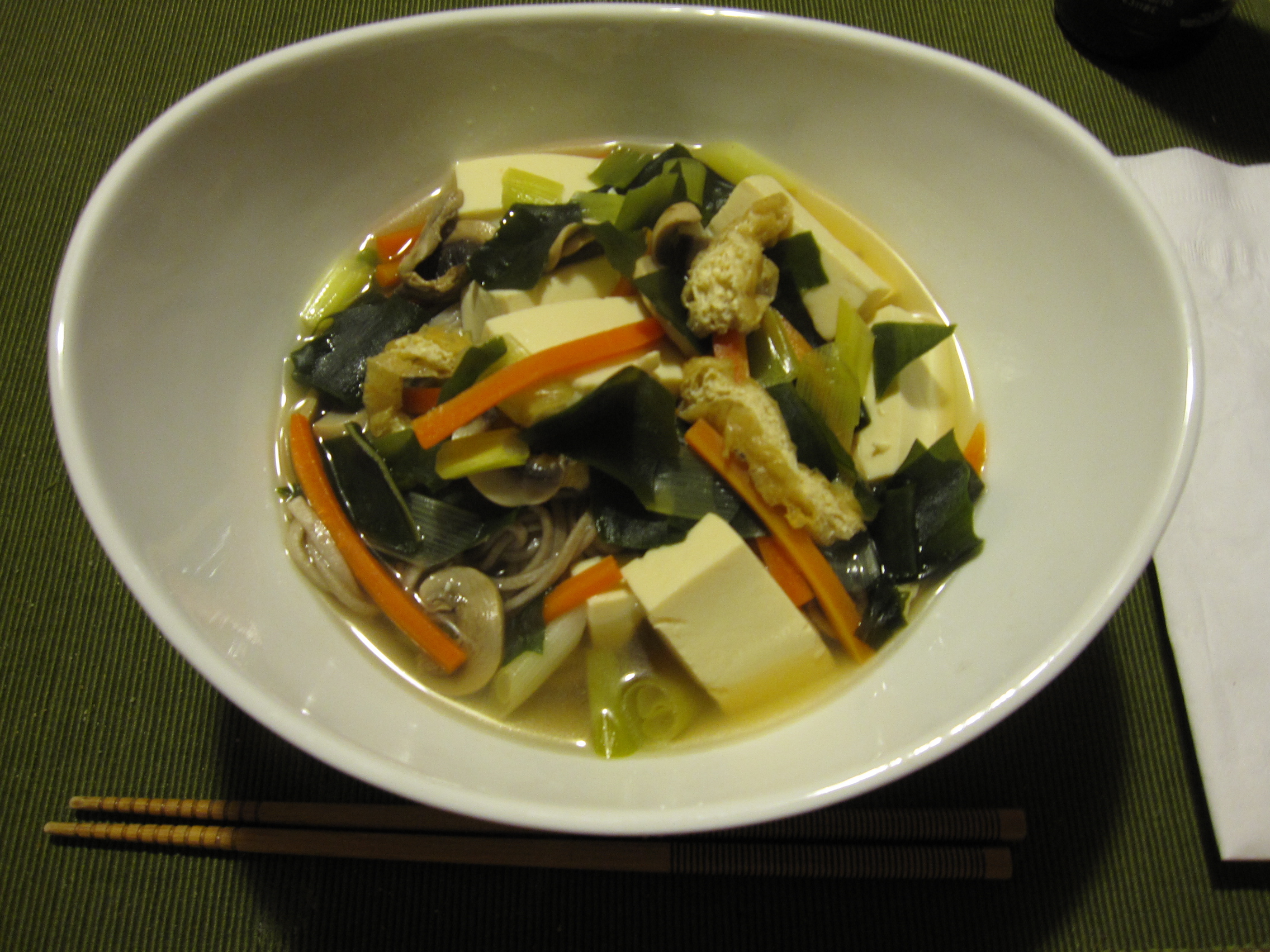
After eating an entire feedlots’ worth of animal Sunday night we really needed Meatless Monday. We tried to make this one as healthy and simple as possible in order to ease the recent strain put on our tummies. Soba noodles, being about as healthy as you can get in the way of carbs, seemed like a good route to go.

For this one we cut up some green onions, carrots, and mushrooms and added them to some boiling konbu dashi. Once they were cooked a little we added some aburage and dried wakame. It takes the wakame a few minutes to soften. Then we dropped in a block of tofu that was cut into smaller pieces.

To put it together we simply put cooked soba noodles in the bottom of our bowls then ladled the broth and veggies on top. A dash of togarashi, a beer, and you’ve got a light, healthy, satisfying dinner.

Read Full Post »

Alright, back to the Land of the Rising Sun. Better known as Japan. Yuki was at a gathering with a bunch of her friends one of the Saturday nights we were there last November. Instead of hanging out with her parents, whom I love to spend time with, I met up with an ex-coworker of hers that I am also friends with, Reiko-chan, who moved back to Tokyo. We decided to meet up at the Ebisu train station and then head to one of the many Izakaya in that neighborhood. Izakaya are Japanese-style bars. Much different from what we’re used to they usually have a great chef that focuses on creative small bites that match with different types of alcohol. I had done some research and found this great little Izakaya called Ippo that focused on seafood and sake, my drink of choice.

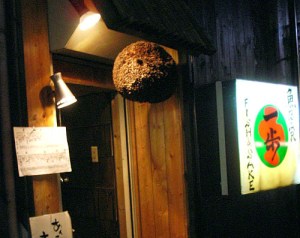
Ippo is an extremely hard place to find. We walked all over the neighborhood for about 30 minutes trying to find it. Since Reiko is Japanese, and being Japanese speaks Japanese, I left it to her to ask various retail stores for directions. No one seemed to know exactly where it was even though we had an address. About to give up and go to a different Izakaya, I turned around and noticed the big Fugu hanging in front of the door. Finally! I needed some sake!
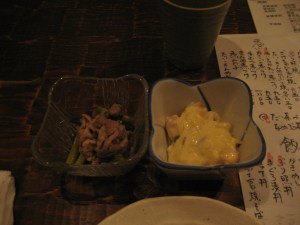
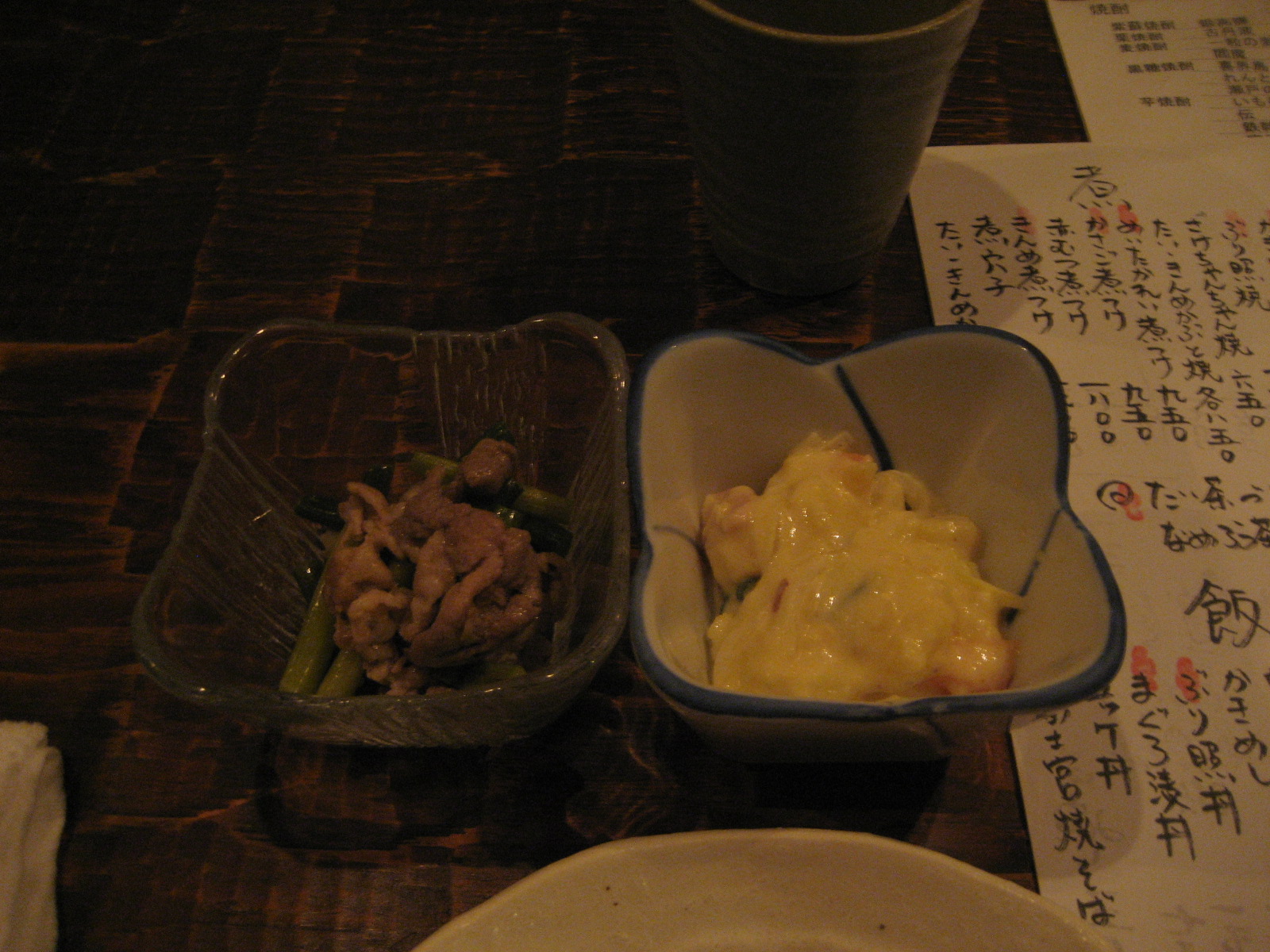
When we sat down the bartender handed us each a couple of little starters. One was a cold pork and green bean salad, the other was a macaroni salad in a mayonnaise dressing. Nice little starters, good with either a beer or sake.

Speaking of sake, their list was over fifty long, all written in Japanese. I had no idea where to start. Luckily, one of the bartenders lived in Las Angeles for a while and spoke fluent English. He also knew that sake list off the back of his hand. There were all varieties of sake from brewers both large and small as well as from every region of Japan that produces it. I honestly can’t remember what all I drank, but throughout the night I ended up putting back 4 cups of different sake, all delicious in their own way. Some more floral, some herbal, some sweeter, all fantastic selections. When I say 4 cups I don’t mean those little sake cups we’re used to getting at sushi joints, I mean 4 12oz cups filled to the rim! Love it!
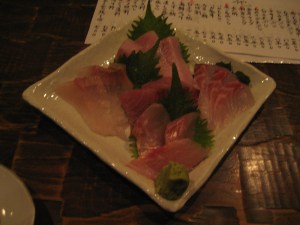
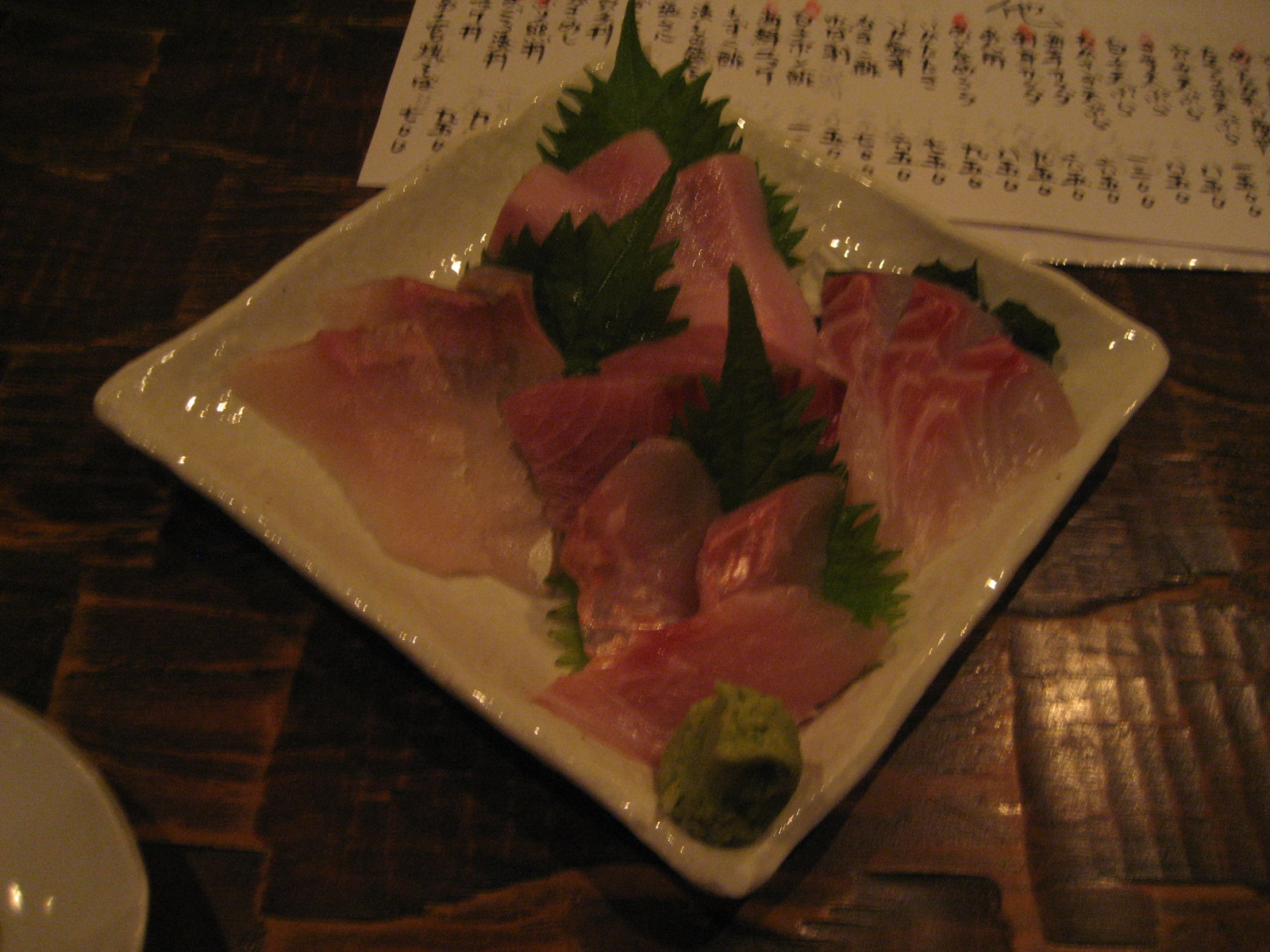
We started off with a plate of sashimi. I don’t know all of the different types, some of the communication was lost in translation, but there were two kinds of tuna and three different kinds of hamachi. I do remember that they were all fresh as can be (they get their fish every morning from the Tsukiji Market) and cut by a chef who knows how to cut a piece of fish. You can’t get sashimi that good here in Chicago.

After the sashimi we got a plate of the house specialty, Namero. It’s basically a tartare of mackerel in miso, ginger, and scallions. Mackerel is a strong-tasting fish with a lot of natural oil, but this was incredible! The miso and ginger masked the strong fishy smell and fit the flavors perfectly. I can see why this is a house specialty as it was probably the best match with sake I’ve ever had.

Then we got the Daigaku Imo, candied sweet potatoes. These were prepared different than normal though. They’re usually deep fried and then coated in a sweetened soy sauce with black sesame seeds. Here, they lightly coated them in batter that had black seseame seeds mixed in before frying, basically tempura style. The were sweet enough that they didn’t need any added sugar. Served only with some grated daikon they were a great snack to eat at a bar.

Kaki was next up. Some of the biggest, juiciest oysters I’ve ever seen on a plate! Removed from the shells and grilled all the chef did was add some herbs to them. With a squeeze of lemon they’re ready to go. If you’re a fan of oysters, you’d love these. If you hate oysters, you’d still probably love these.
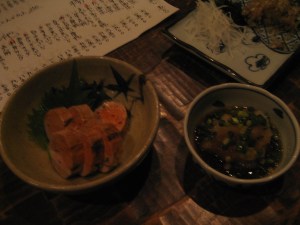
After the Kaki we ordered up some Ankimo. Steamed monkfish liver served with grated daikon, ponzu, and green onions this is one of the great delicacies of Japanese cuisine. It’s called the foie gras of the sea, but in all honesty, I think foie gras should be called the ankimo of the land. It’s so soft and creamy. If not for the next dish I’d call it Japan’s greatest contribution to the world of food.

Here it is, one of the greatest things in the world. An item that will make most Americans sick to their stomach but makes my mouth water…Shirako. The king of seafood. Meaning “white children” in Japanese, shirako is the soft roe of male fish, usually monkfish, cod, or fugu (pufferfish). Basically, it’s the male fish’s genitalia. You read that right, it’s a fish sperm sack! You may be wincing at the thought of eating that, but think about it, you eat caviar don’t you? Well, this is the male counterpart to caviar. It’s extremely soft and delicate with a slightly sweet briny taste that literally melts in your mouth (and it’s not sticky!). Ippo serves it raw with ponzu, scallions, and sesame seeds. It can also be steamed. Any way you look at it, I luz me some fish balls!

My experience at Ippo really makes me sad that we have nothing like this in Chicago, or really anywhere in America for that matter. Sure, there are a handful of Izakaya-style bars throughout the country (mostly on the west coast), but nothing quite like Ippo. Just a long bar in a hidden space that serves up some of the best quality seafood and sake one could ever ask for. Why are we stuck with bars that serve nothing but big greasy burgers (not that there’s anything wrong with that), frozen wings, and chicken fingers? Let’s get some creativity into the American bar scene! Great chefs don’t need to be in a white cloth atmosphere to shine. We’d all be better off for it there were Izakayas scattered throughout the country.

Read Full Post »

Another Donna (from Aqua Safari) recommendation. This place is called Parrilla Mission. The Mission group has two restaurants in Cozumel. One of them is in the heart of touristville, this other one is a 10 minute walk down the street. Same food, same high quality, half the price.

We started off with just their salsa and a beer. Pretty good salsa, not too spicy at all. All of the sudden, after one particular bite, my head started to throb, my mouth went up in smoke, and I instantaneously started to hiccup. I didn’t see anything in the salsa that would suggest caliente. Maybe some jalapeño was hidden among the cilantro? Would’ve been the hottest damn jalapeño ever! Before we took another bite I explored the rest of the salsa only to find this little bugger hiding within the tomatoes…habanero! That thing was intense! I’ve eaten raw habanero before, but I was always ready for the hurt. This one snuck up on me. A few minutes, a keg of beer, the flame eventually died down.

For my entrée I ordered the shrimp shish kabob. Nice juicy shrimp perfectly grilled with slices of green pepper, onion, and tomato. Half of a baked potato with crema drizzled on top, some Mexican rice, and steamed carrots and chayote rounded out the dish. The dish wasn’t outstanding by any means, but everything was fresh, properly seasoned, and properly cooked. It was very delicious.

Yuki ordered the garlic shrimp. Same accoutrements as my dish, but her shrimp were butterflied shell-on and sautéed in butter and garlic. Those were outstanding! Seriously though, how can fresh shrimp sautéed in butter and garlic not be outstanding?

No dessert that night as the entrees filled our bellies, along with the beer. It definitely pays off to head to restaurants away from tourist traps and cruise ship docks. You’ll find more authentic food usually with fresher ingredients at a fraction of the cost. You’ll also meet more of the local characters than you will at Senior Frogs, Coconuts, The Hard Rock, or Margaritaville. Best thing to do is ask people who work at the hotel you’re staying at where they eat when they go out. They’ll usually send you to some memorable meals.

Speaking of which, I have one more from Cozumel that’ll be up soon. Then we head to Merida. Or, I may throw another Japan joint up. Or, maybe I’ll get lazy and wait for the next Meatless Monday. At any rate, keep checking back.

Read Full Post »
Another Meatless Monday in the books. I had some veggies and tofu I needed to use up so I made a vegetarian version of Mapo Tofu.

I chopped up half of an onion and sautéed it for a few minutes. Then I added a half-inch piece of ginger and two cloves of garlic, both grated. After a few minutes I threw in some green beans that I cut down to smaller pieces. A few more minutes and I added some diced baby eggplant  and some chopped mushrooms.

While that was all sautéing, in a hot skillet I poured in a couple tablespoons of vegetable oil and scrambled two eggs. The hot oil cooks the eggs up nice and fluffy. Once they were almost finished I put them on a plate off to the side.

Back to my veggies. I seasoned with salt and a lot of freshly ground Sichuan Peppercorns, that’s what will give it the numbing burn you need with a good Mapo Tofu. Then I added about three tablespoons of water just to deglaze some of the garlic and ginger bits on the bottom of the pan. After that I added three or four tablespoons of soy sauce and a spoonful of Korean Chili Paste, any kind of chili paste will work for the most part.

Once the sauce was nicely mixed I added the scrambled egg making sure it was broken into smaller pieces. Finally, I added a block of diced silken tofu that I had drained the water from. To drain the water I lined a plate with a couple of paper towels, laid the tofu on top, then a couple more paper towels, a cutting board, and then something to weigh it down a little. That sat in the fridge for about 45 minutes.

When the tofu was coated with the sauce and heated through the dish was ready, about 5 more minutes. I simply served it with plain white rice and a cold beer. Oh, right before I served it I threw in some chopped parsley. I did this only because I had some in the fridge and thought it would add a nice freshness to all the spice. It did.

Read Full Post »

chen

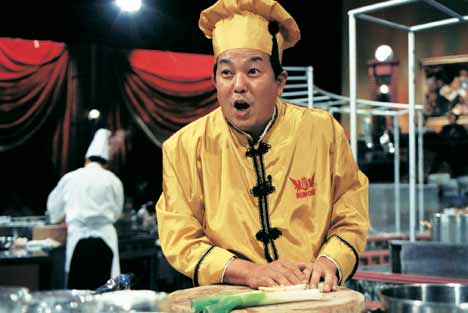
Friday night Yuki’s mom went to a concert with a friend, so it was up to me to decide where we went for dinner with her dad. In my quest to eat at every Iron Chef’s restaurants I was able to convince him that we should head out to one of Chen Kenichi’s joints. It wasn’t a hard sell. So, the three of us hopped on the train to Roppongi where Chen has one of his four places.

There were a handful of pre fix options, but none of them really had what we wanted, so we ordered a bunch of dishes in typical Chinese family-style dining.

IMG_1141

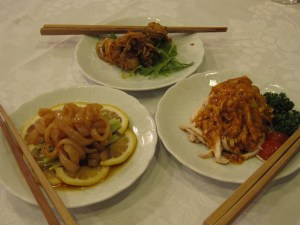
First up was a trio of cold appetizers. On the top were Scallops cooked with chili peppers. Not too spicy, just a nice, slow, gentle burn on the back of the throat. Bottom right was shredded chicken with a sweet miso sauce. Bottom left jellyfish in a light soy. All three were very complimentary of each other and made for a great start to the meal.

IMG_1143

Next up was Shark Fin Soup. Not the most politically correct dish, but hey, a little shark fin never hurt anything. A lot does, but a little doesn’t. The broth was a thick soy flavor and it had thin slices of pork in it alongside the shark fin.

IMG_1144

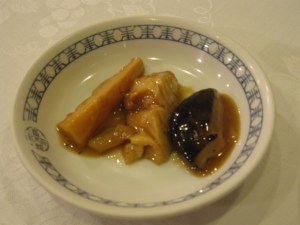
Then came Abalone, one of the sea’s finest of all creatures! Served with shiitake and bamboo shoots it was truly delicious. Judging by Uichiro’s (Yuki’s dad) reaction when he first bit into it, I’d say it was his favorite part of the meal, next to the beer.

IMG_1145

After that we had mixed seafood served on rice cakes. The restaurant manager poured the hot seafood on the rice cakes making it sizzle, much like the classic sizzling rice soup commonly found in American Chinatown restaurants. I need make a correction, I think Uichiro liked this dish more than the abalone. Hard to argue, the shrimp, scallops, and squid were cooked to perfection with all of the natural sweetness brought out.

IMG_1146

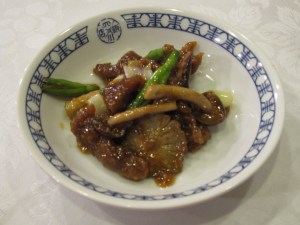
Next was probably my favorite dish of the meal, beef with mushrooms and lilies in a thick ginger soy sauce. The beef was so tender it almost melted in my mouth. The mushrooms and lilies were nice counterpoints to the salty soy. The only thing missing was white rice to balance a little more of the salt. This was definitely more of what Americans are used to than Japanese. Give me this dish and a cold beer and I’m a happy man!

IMG_1147

Here we go, the dish that brought me to Chen’s restaurant and the one that will make my brothers very envious, his famous mapotofu! There were two choices on the menu, Kenichi’s and Kenmei’s. Kenmei was Kenichi’s father, the one who brought true Szechuan cooking to Japan. It was a tough choice, but we opted for Kenichi’s since it was his restaurant and not his father’s. It wasn’t quite as hot as I expected, but it was definitely a hot and spicy dish! Packed with Szechuan peppercorns it gives an initial citrusy spice followed by a mouth-numbing burn. Yuki and I added some extra peppercorns to get the full experience, while Uichiro only ate a few pieces of tofu. I think it’s a little spicy for him. It was a little oily as it was douced in chili oil, but that’s what makes it so delicious. The funny thing is that in the middle of the night Tokyo experienced what it thinks was a small earthquake. It wasn’t an earthquake at all though, it was the effects of my trying to digest Chen’s mapotofu! I’m still not quite sure exactly what that dish did to my intestines, but it made a city of 16 million rumble a little. And somehow my chest got a little harrier.

IMG_1148

We followed the mapotofu with a mild pork and egg noodle dish. It had shiitake, green onions, chinese cabbage, sprouts, and bamboo shoots. It took a few bites to get the burn out of our mouths, but once it was gone this dish’s wonderful flavor stood out. It’s just too bad I couldn’t finish it all because we ordered one too many dishes I think. Oh well, what can you do?

IMG_1149

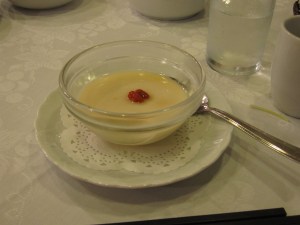
We thought we were finished when the manager brought us some complimentary dessert, Annin Tofu. Annin Tofu is a popular Chinese dessert. It’s basically just almond jelly. Very smooth, light, and creamy. It’s the perfect way to finish off a meal.

All in all, I have to say that I was a little dissapointed. After watching countless episodes of Chen creating some of the most amazing looking dishes anyone could ever think up, this meal was a very straight forward Chinese meal. Every dish was a classic that you can get at just about any Chinese restaurant. Granted, everything was perfectly balanced, but nothing was off the wall. I was kind of hoping for some Chen originals. This restaurant wasn’t the right format for him to create Iron Chef dishes. I have no regrets, but I wasn’t blown away like I was at other Iron Chef restaurants.

I have now been to three Iron Chef restaurants (4 if you count Bobby Flay, but I don’t consider him an Iron Chef and I never wanted to go to his place). I have done Sakai, Michiba, and now Chen. Next up….Kobe Masahiko.

Read Full Post »

IMG_0982

It’s starting to get damn cold here in Chicago. In Japan, when it gets cold out, they start eating Shabu-shabu which is a Japanese hotpot. It’s called Shabu-shabu because of the sound the thinly sliced meat makes when you slosh it around in the broth to cook. I didn’t make this one, this dish is one of my wife’s responsibilities.

To start, she had to make the broth. Typically it’s Konbu (kelp) boiled in water. We didn’t have any Konbu, so she used Niboshi, dried anchovies. A good handful boiled in water for a bit and you get a really nice healthy broth.

To the broth she added shiitake and enoki mushrooms, green onion, and shanghai cabbage. That was left to cook for about 10 minutes in the boiling broth. If I hadn’t forgotten carrots at the store she would have added them as well. Daikon also makes regular appearances in Shabu-shabu.

After the veggies cooked a little she added tofu and konnyaku, a firm gelatinous cake-like ingredient made from yam starch. Then the pot was brought to the table and left to simmer on our table-top propane burner (something every Japanese household has).

In our bowls we poured a little ponzu, a soy sauce product with yuzu citrus juice and a little vinegar mixed in, and a couple ladles of the broth. Then we picked and chose which veggies we wanted and dipped them in our bowls before eating. All the while taking slices of the pork (we picked up some thinly sliced kurobuta pork at Mitsuwa) and sloshing them around the broth to cook. A side of white rice to complete the chow.

This a the perfect winter dish to have with a cold beer. It’s fun, delicious, and very healthy since there are no added oils or anything. Just make sure your meat, whether using pork or beef, is very thinly sliced so that it cooks quickly in the broth.

Read Full Post »
IMG_0590

Here’s my first attempt at making Gyu-don, Japanese simmered thinly sliced beef with onions on rice. It’s surprisingly simple to make, yet full of flavor and easy on the wallet.

The trick is to get the beef sliced as thin as deli meat. You can get it at Mitsuwa, but I’m not sure where else to get good quality meat in this fashion. I’m sure it’s available. I do know that it’s near impossible to get such even thin slices at home with a knife no matter how sharp it is.

So, take put a little oil in a medium-sized pot and cook some ginger and garlic for a minute or two. Then add an onion thinly sliced and sweat it for a few minutes. Add a couple cups of water, a quarter cup each of soy sauce and mirin, a few pinches of sugar and let it come to a simmer. Then add your beef and let it cook until the liquid is reduced by 3/4’s.

All you have to do then is put some white rice in a bowl and top it with some Gyu-don.

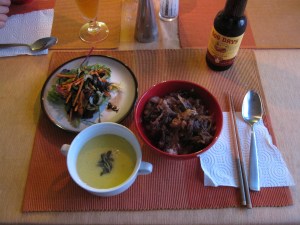
I served it with a simple corn soup garnished with Thai basil and a salad that Yuki made. She tossed some mixed greens, julienned carrots, celery, and cucumber (I left the cucumber out of mine, vile phalis!) in a homemade hijiki vinaigrette. All washed down with a cold beer.

Read Full Post »

« Newer Posts