Feeds:
Posts
Comments

Posts Tagged ‘white rice’

Mapo tofu is a Szechuan dish typically made with ground pork. However, last night being Meatless Monday, I diced up some shiitake mushrooms to take the place of the meat.
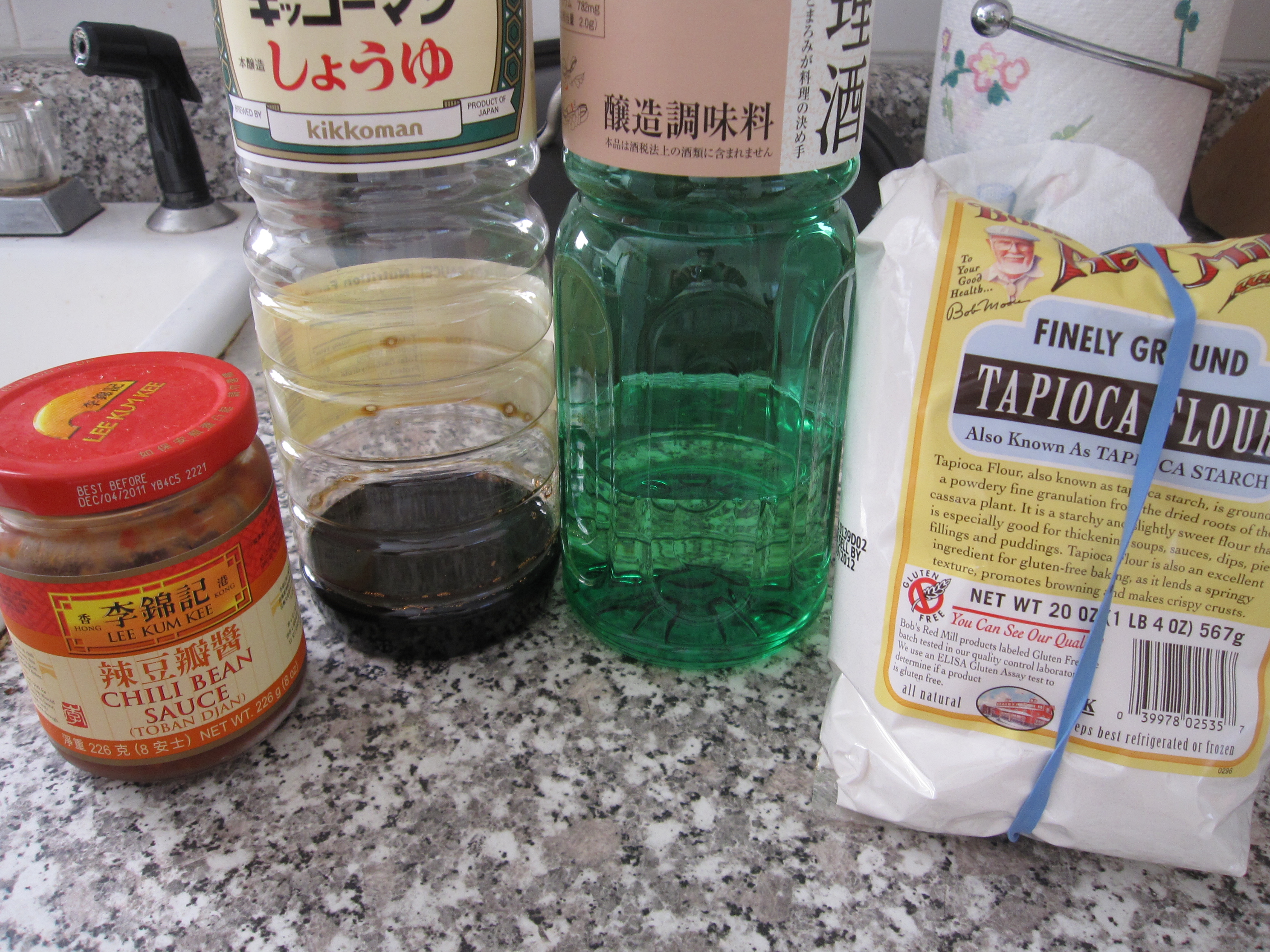
To start, I made the sauce. I used 2 heaping tablespoons of toban djan (a szechuan chili and fermented bean sauce, its spicy but this dish is supposed to be very hot), 1/4 cup of soy sauce, 1/8 cup of sake, and 2 teaspoons of tapioca flour to thicken it up a bit. I mixed it all together and set it aside.

I used a 3.5 oz package of shiitake, about 6 oz of haricots vert cut into thirds, a carrot cut into matchsticks about 2 inches long, 8 green onions chopped into 1 inch pieces, 3 minced garlic cloves, 2 tablespoons minced ginger, 1 red bell pepper cut into thin slices and then halved, and 1 package of firm tofu. I prefer silken tofu, but there wasn’t any at the store. Oh well, what can you do? I pressed the water out of the tofu for an hour in the fridge and then diced it.

In a hot pan I poured in about 2 tablespoons of sesame oil and then fried the garlic and ginger for about a minute. Then I added the haricots vert. About 3 minutes later I tossed in the carrot and pepper. I let that go for about 3 more minutes and then the shiitake and green onions went in. Once the shiitake were softened a bit, about 3 or 4 minutes, I poured in the sauce (I mixed the sauce thoroughly again to make sure the tapioca didn’t form any clumps). This was the first time I’ve ever used tapioca flour as a thickening agent and it worked a little better than I expected. The sauce almost immediately thickened up on me in that hot pan. To remedy that I poured in about 1/3 cup of water and that thinned it out nicely. I needed it a little thinner so it would evenly coat the tofu which went in right after I stirred the water in. I let the tofu heat through for about 4 minutes over medium heat and then served it all up with some white rice and drank it down with a cold beer.
Read Full Post »

I was perusing my Charlie Trotter cookbook the other day and came across a recipe that uses a very similar marinade to one I often use. Since he’s the great Charlie Trotter I thought I’d give his a try. Oh, and yakigyu is simply Japanese for grilled beef.

His marinade consisted of 1/2 cup of tamari which is probably the most ancient style of Japanese soy sauce as it contains no wheat and is a little richer than regular soy (it is the byproduct of making miso), 1/4 cup of mirin, 1.5 tablespoons of sesame oil, and 2 tablespoons of grated ginger. Once I mixed up the marinade I set 3 tablespoons aside and then thinly sliced 3/4 pound of sirloin and threw that into the marinade. I covered it with plastic wrap and let it sit in the fridge for 2 hours.
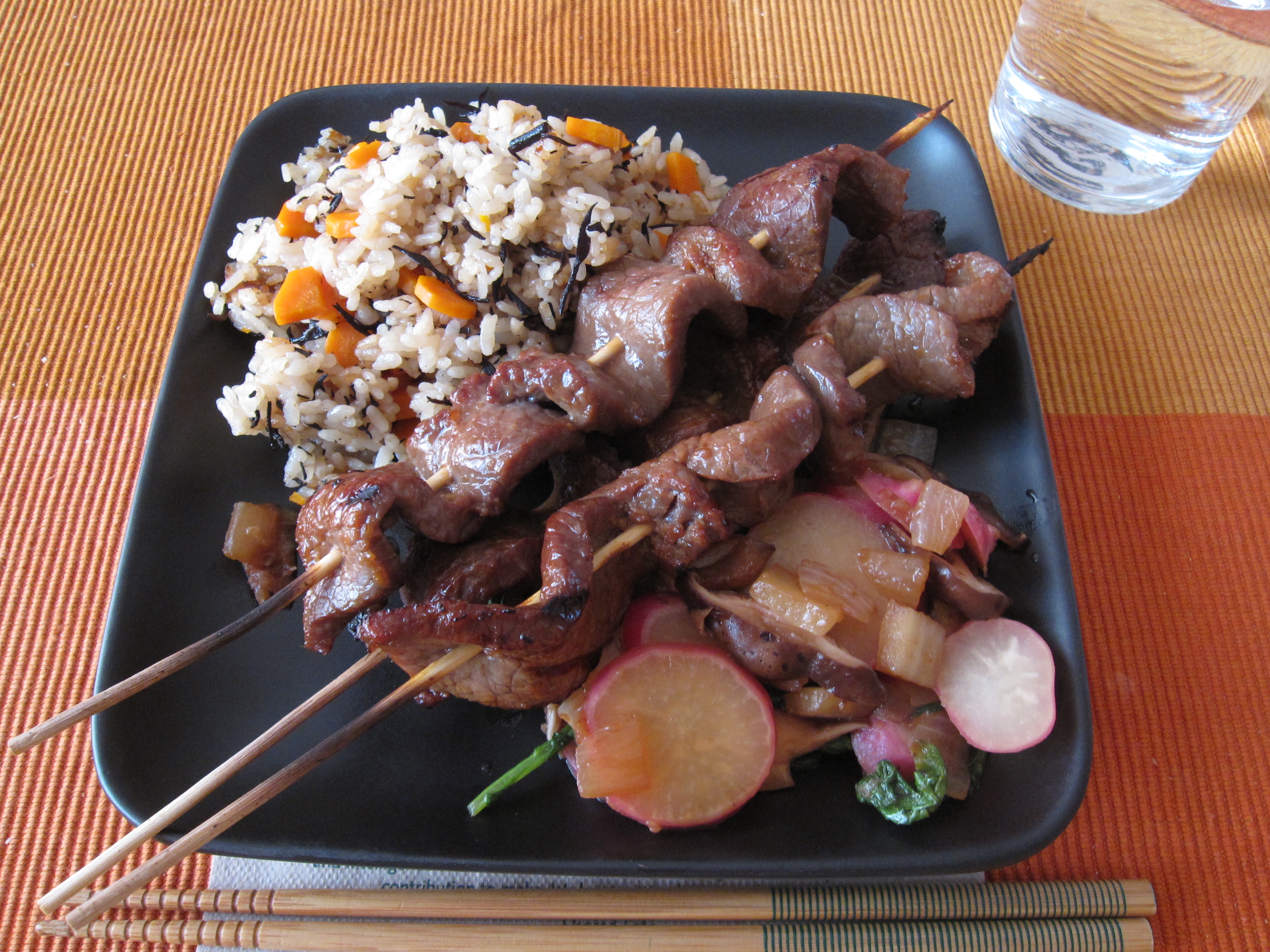
Then, using some bamboo skewers that I soaked in water for an hour, I threaded the meat and got it ready for the grill. Since the meat was thin it only needed about 2-3 minutes on each side over a medium-hot grill.

To accompany the meat I made a quick vegetable saute of 5 shiitake sliced, half an onion large diced, and 5 radishes. I separated the greens from the radish and thinly sliced the radishes with my mandolin slicer. I could have used my knife, but the wife was wondering why I got a mandolin slicer if I never use it. So, there you go sweetheart, I used the mandolin.
In my hot pan I poured 1 tablespoon of soy oil and sautéed the onion first for about 5 minutes. Then I added the shiitake and let that go for about 4 minutes. After that I tossed in the sliced radishes. Those cooked for about 4 minutes until I poured in the reserved 3 tablespoons of marinade. I let that boil down for a few minutes and then added the radish greens. Once the radish greens wilted down, about 1-2 minutes, I turned of the heat as this was ready to go.

Instead of regular white rice I made hijiki and carrot rice, a recipe that Yuki taught me a long time ago and has become one of my favorite rice preparations. First, I took a heaping tablespoon of dried hijiki and soaked it in some cold water for about a half hour. I also diced up a small carrot. Once the rice was washed and in the rice cooker bowl (I only made one cup of rice) instead of regular water I poured in 2 tablespoons of soy sauce, and 1 tablespoon each of sake and mirin. Then, the get the right amount of liquid I used the hijiki soaking water to fill it up. Once the liquid was at the right level I threw in the hijiki and carrot. Hit the on button and a half hour later my rice was ready.

I have to say I was very disappointed in Trotter’s marinade. Tamari is a little bit stronger in flavor than soy sauce and it really made the beef salty. Too salty for Yuki’s taste and almost too much for mine (I tend to like food a little saltier than she does). Old Chucky Boy should know better than to have used so much tamari. I would have been much better served to have used the classic marinade I usually do, 3 parts soy, 2 parts sake, and 1 part mirin (1.5 tablespoons of sesame oil is ok). Besides the soy being a little lighter in flavor, cutting back on the amount and replacing it with sake (or vodka if you like) adds a little more depth the marinade. A little grated garlic wouldn’t have hurt either. While I have had good luck with some of his recipes in the past, this is one I will not be using again.

Read Full Post »

I was at the store the other day unsure of what I wanted to make for dinner. I saw some beautiful fresh lemongrass stalks I immediately knew that dinner was going to be lemongrass chicken. I’ve made lemongrass chicken a hundred different ways before, and the possibilities to make it are endless, so I just kept looking at what looked fresh and built my dinner from there.

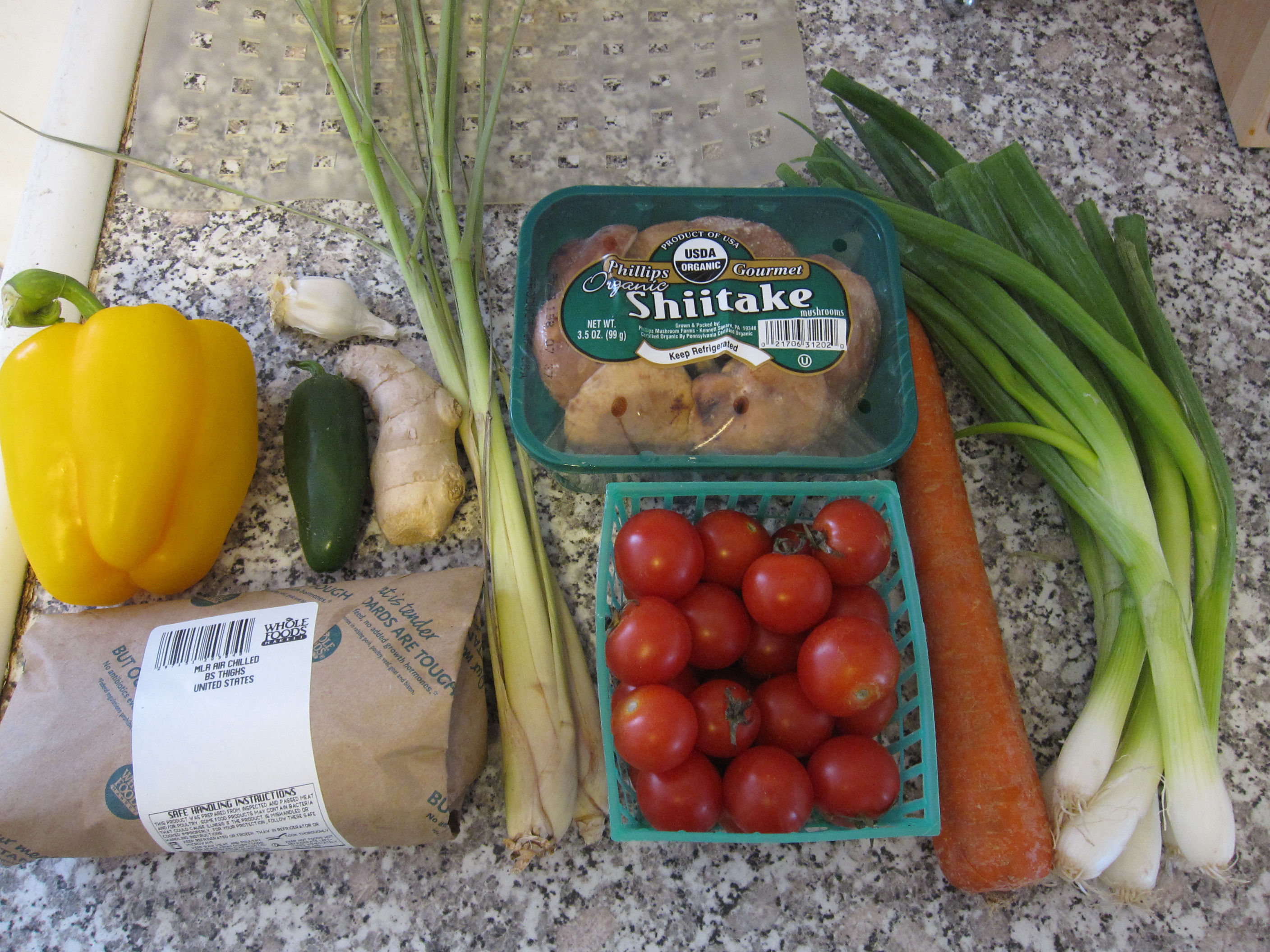
I grabbed a yellow bell pepper, just shy of 1 pound of skinless/boneless chicken thighs, a jalapeno, 4 garlic cloves, a piece of ginger, two lemongrass stalks, some shiitake mushrooms, cherry tomatoes, a carrot, and some green onions. The pepper got chopped up, the chicken thighs cut down into bite sized pieces, the jalapeno diced, the ginger and garlic minced, I removed the outer layers of the lemongrass and sliced up the soft white inner part, I sliced up 6 of the shiitake, halved 12 tomatoes, and chopped up the carrot and 6 green onions.

In a hot pan I poured in 1 tablespoon each of soy oil and sesame oil and then tossed in the ginger, garlic, and lemongrass. I let the go for about a minute until they became very fragrant. Then I added the green onions and carrots. About 3 minutes later I tossed in the bell pepper and jalapeno. I let that all cook for about 6 minutes before adding some salt and pepper. Then I added the chicken. That took about 6 minutes to cook almost completely. About 1 tablespoon of fish sauce went in to add that distinctive Southeast Asian aroma and flavor. After the fish sauce cooked for a couple of minutes I added the shiitake. About 4 minutes later the tomatoes went in. I let everything come together for about 3 minutes and turned off the heat.

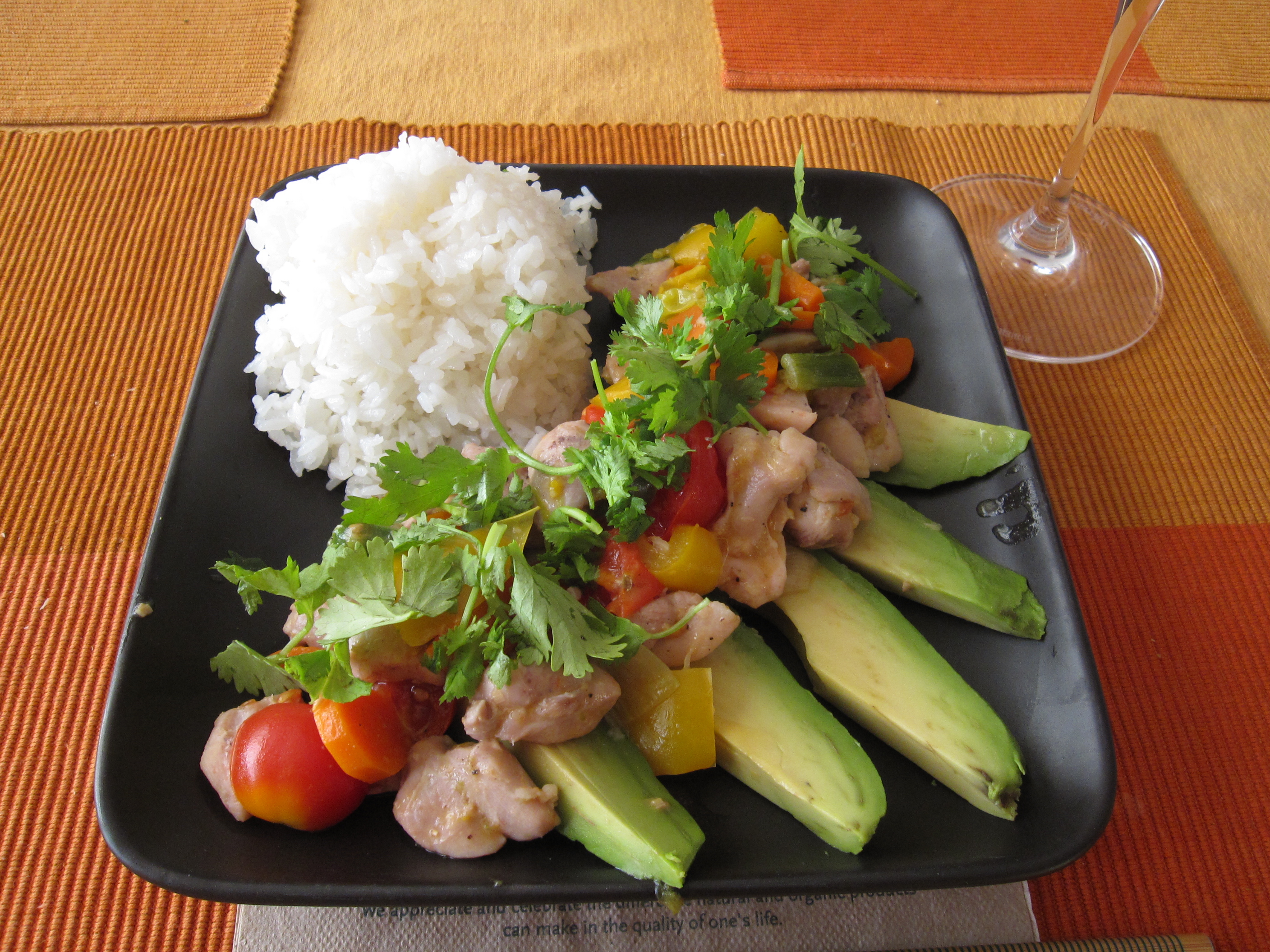
To serve, I put some white rice on one corner of the plate and then fanned out a half avocado on the other half. I put the lemongrass chicken down the middle. For garnish I tore up some cilantro. There was enough leftovers for Yuki’s lunch yesterday, so this was a 3 portion recipe.

Read Full Post »

Last night I did a riff on one of Yuki’s recipes. She commonly makes ground chicken dumplings similar to these patties in the winter when we eat nabe (Japanese hot-pot). So, I took her idea and made my own Japanese flavored dinner.

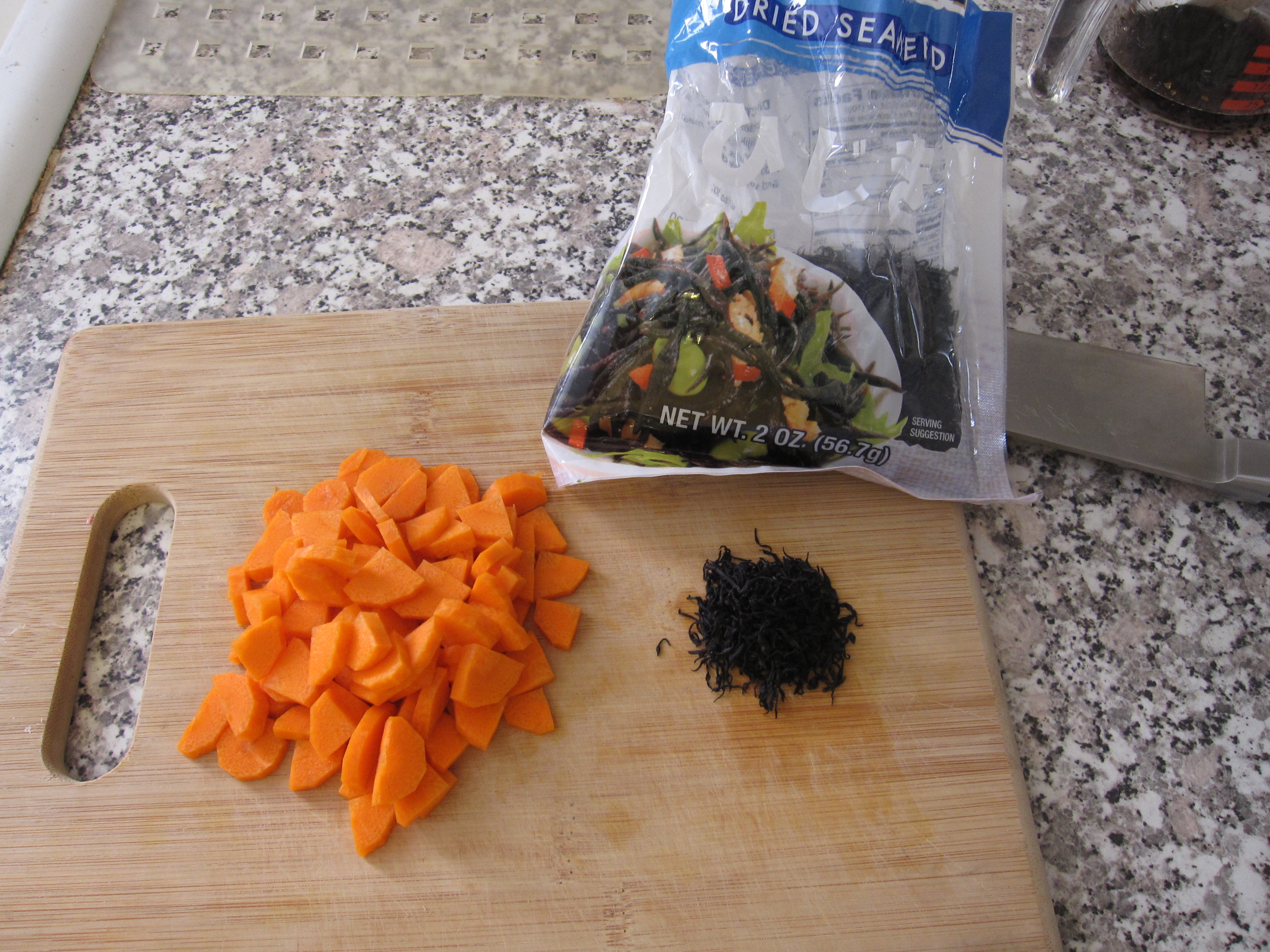
The ingredient list for the patties were 3/4’s pound of ground chicken thigh, 1 block of tofu that I had pressed the water out of, one egg scrambled with 1 tablespoon of soy sauce, 1 carrot cut into a small dice, 3 garlic cloves and 1 inch of ginger that I minced, and 1 tablespoon of hijiki seaweed. The hijiki comes dried and is available in most Asian sections of your grocer. I put 1 tablespoon of dried hijiki in a couple of cups of cold water and let it sit for about a half hour. Then I strained it, reserving the liquid for the miso soup.

I mixed it all together, with about a tablespoon of nanami togarashi (a Japanese red pepper spice mix, there are various kinds of togarashi that are also usually available in the Asian section) until the tofu was completely broken down and everything was mixed well. Then, on a lightly oiled baking sheet, I laid 8 patties (two patties per serving, leftovers for lunch). I let it cook in a 375 degree oven for about 20 minutes.

Before cooking the patties I got my miso soup ingredients ready to go. I cut 2 negi (Japanese green onions, larger than regular green onions, not as big as leeks) into 1 inch pieces, hiratake (oyster mushrooms), and wakame seaweed. Wakame can be bought dried or fresh. Fresh comes heavily salted to preserve it. You need to soak it really well in water and cut it into smaller pieces as it expands once the salt is rinsed off.

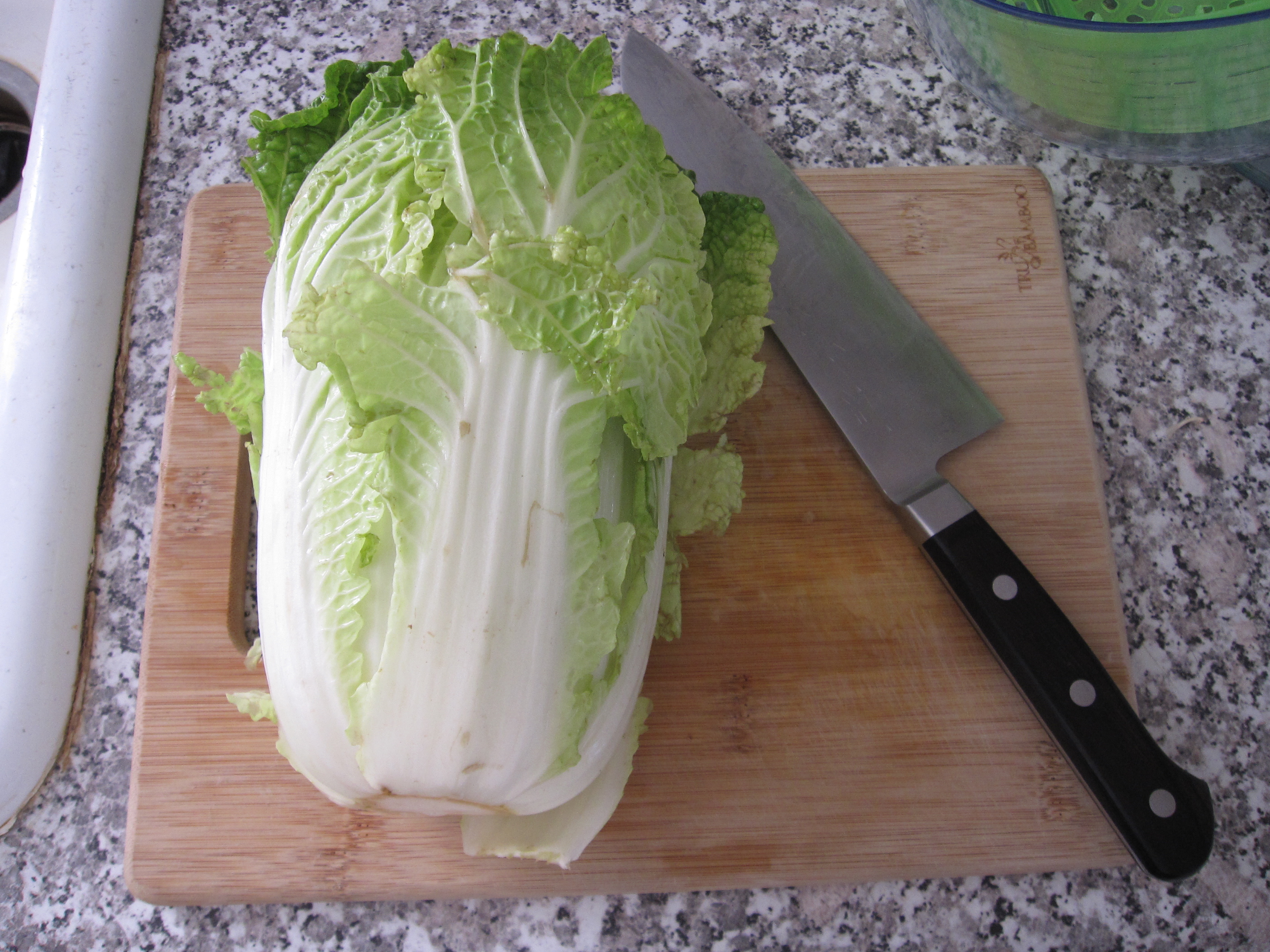
I also chopped up a small head of napa cabbage to cook as a side.

Once I put the patties in the oven I melted 1 tablespoon of butter in a skillet and heated up the hijiki liquid in a pan along with one more cup of water, 1 teaspoon of dashi-no-moto (instant dashi), the negi, and the mushrooms. I let the soup simmer while working on the cabbage. Once the butter was melted I added 1 tablespoon of soy sauce and then the cabbage. I let the cabbage wilt in the soy butter for about 10 minutes and then turned off the heat.

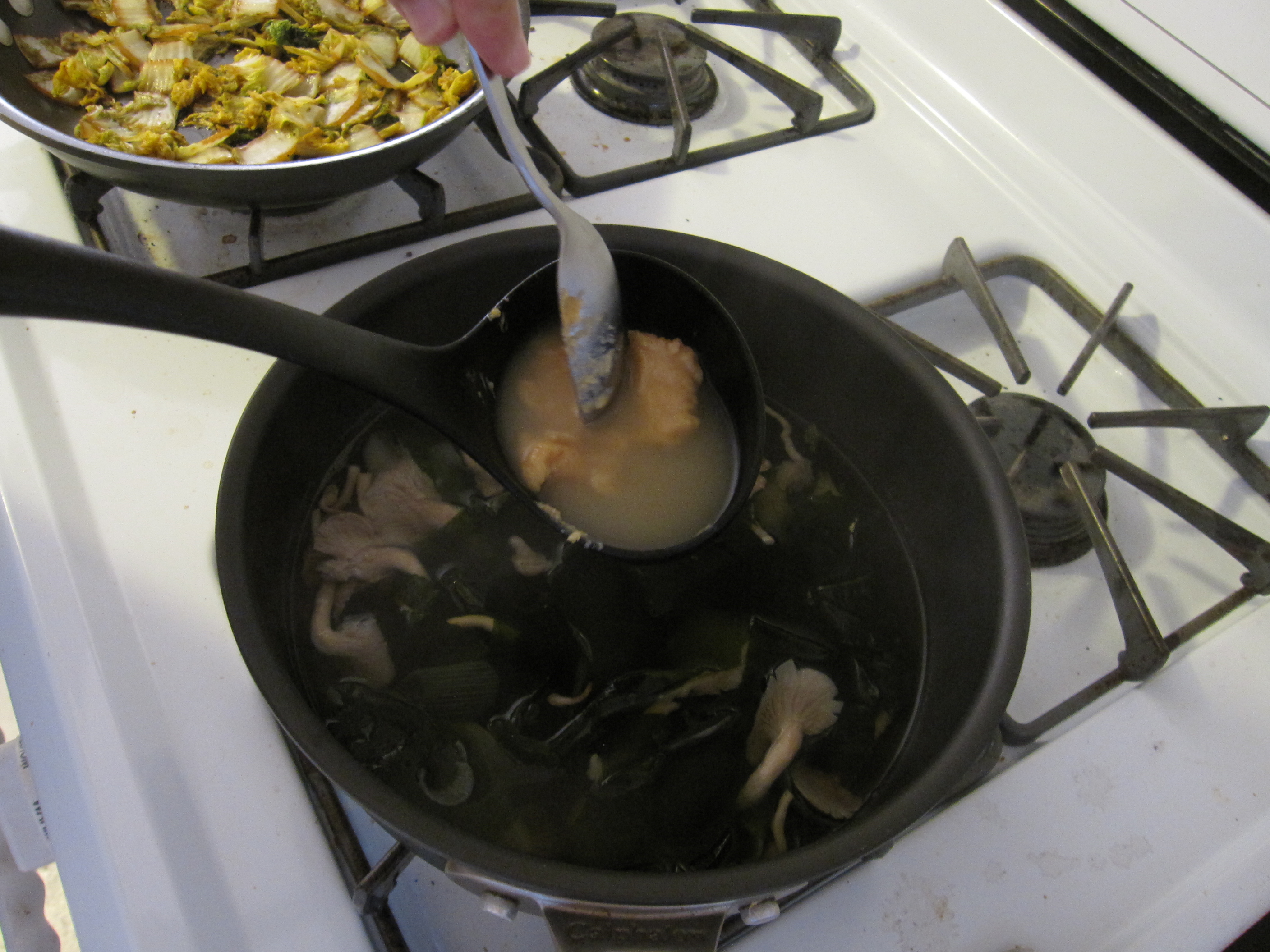
After the cabbage was ready I added the wakame to the soup and then the miso. The best way to add the miso is to take a heaping spoonful and swirl it around in a ladle that is just slightly in the soup. This allows the miso to incorporate slowly keeping it from being lumpy.

I served everything with some white rice. I poured just a little ponzu on top of the patties to add a touch of acidity and help keep them moist. To keep with the Japanese flavors it only seemed right to drink Asahi.

Read Full Post »

I had an eggplant left from my shopping excursion to the HMart that I wanted to use last night. Not wanting to do my typical grilled-eggplant or stir-fry I decided to stuff it instead. Ground lamb seemed like the perfect partner.

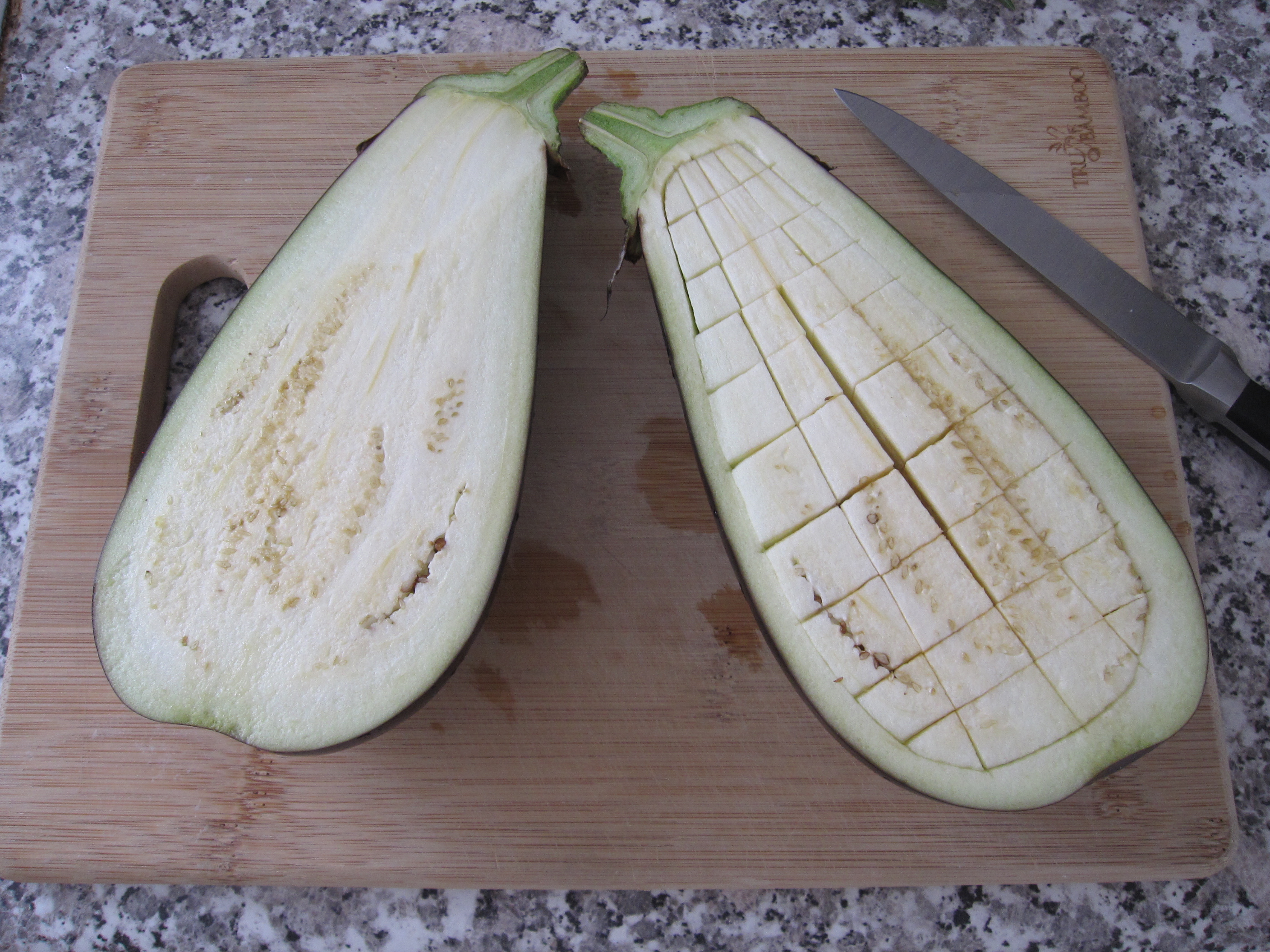
Hollowing out an eggplant is a pretty easy thing to do. First, you have to cut it in half length-wise. Then, I took my pairing knife and cut around the edges of the eggplant about a quarter-inch from the skin, carefully making sure I didn’t pierce the skin. After that I cut a bunch of lines through the width and length.

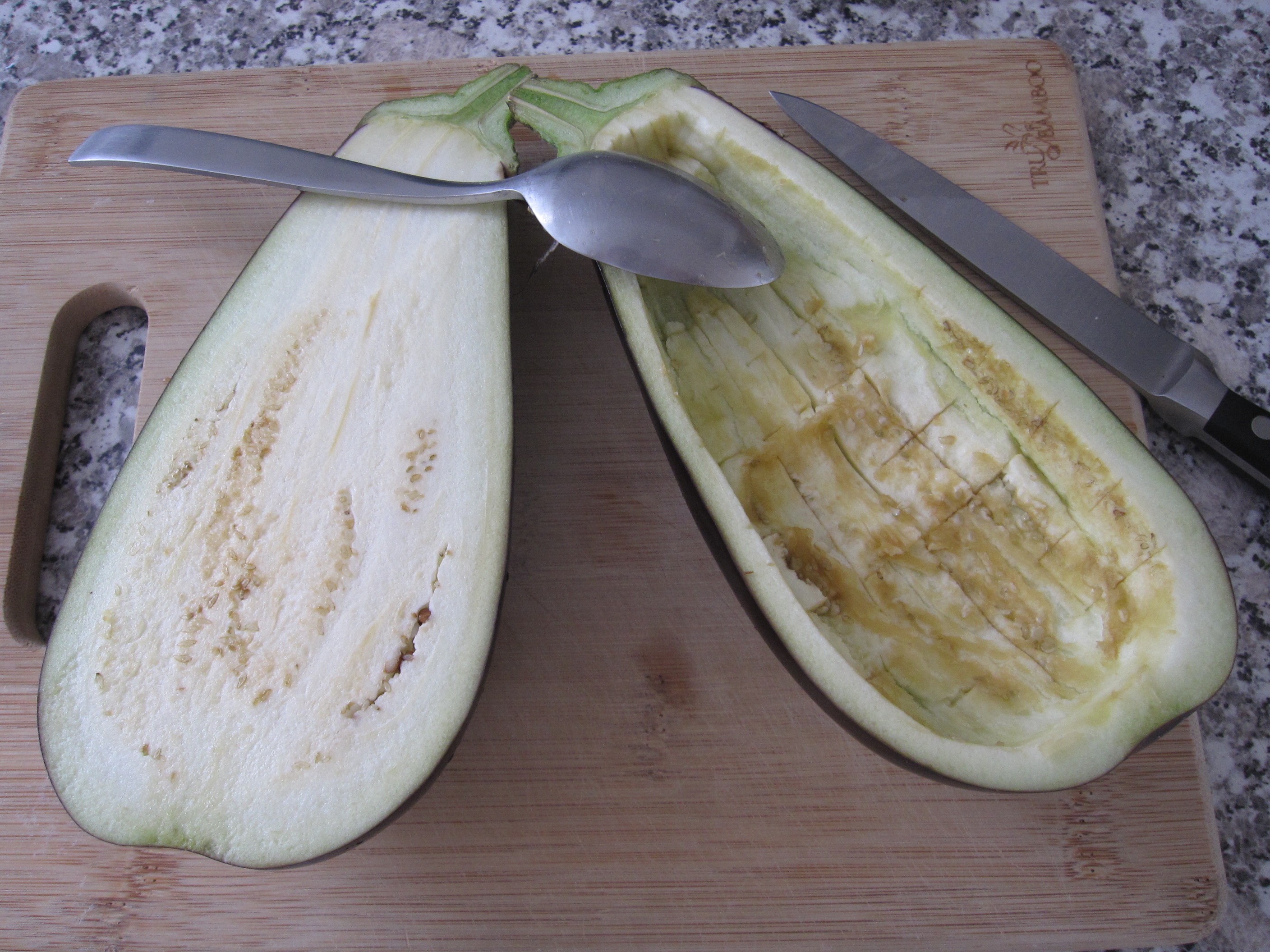
With a small spoon (a serrated grapefruit spoon would work great, but don’t worry if you don’t have one, I don’t and I made it work with a regular spoon) carefully scoop out the flesh. Save the flesh as it’s going to be used later on. I sprinkled some salt all over the inside of the eggplant and then let them drain in a colander for about a half hour while I prepped the rest of the ingredients. This removes some of the bitter juices.

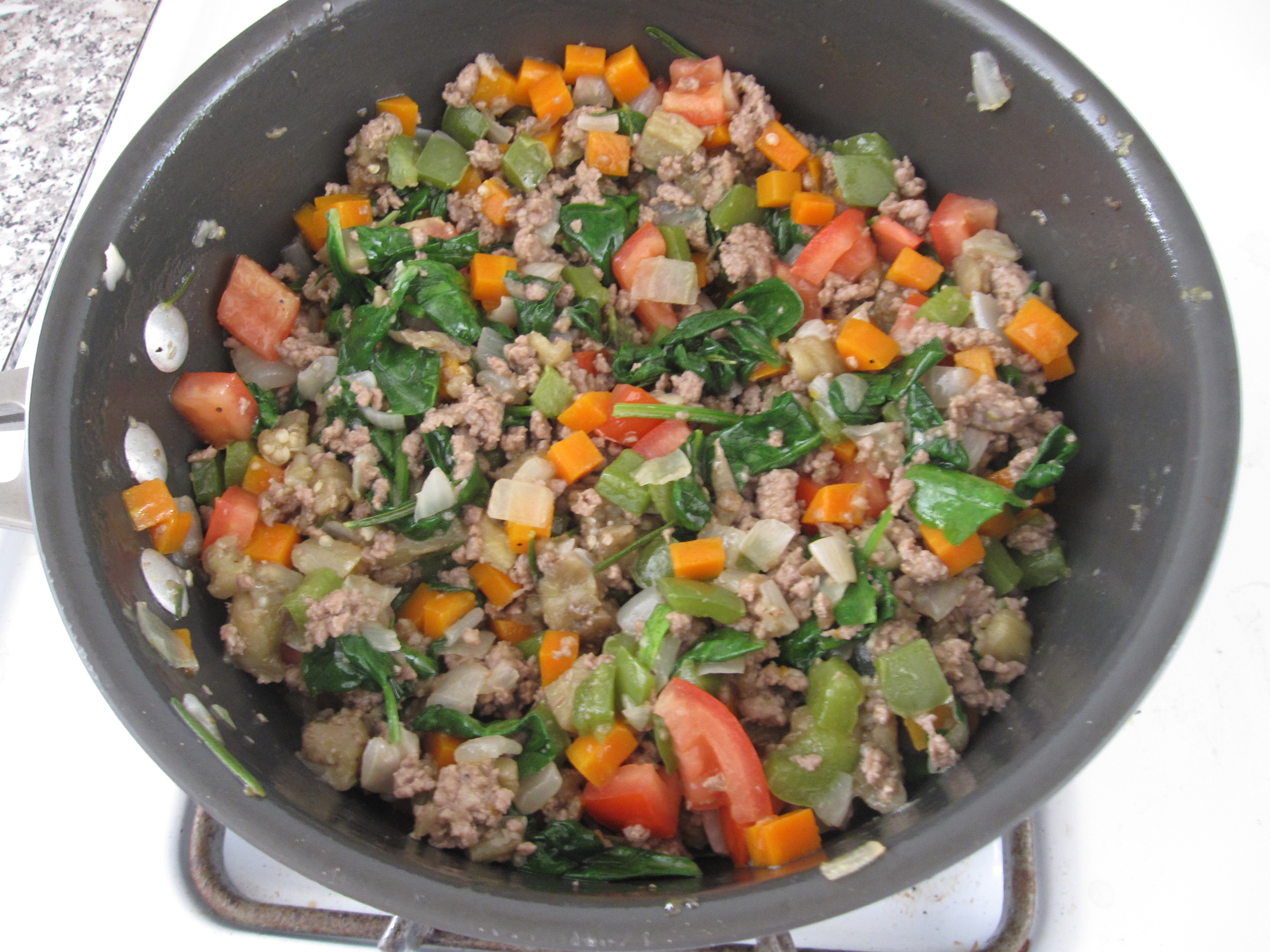
For the stuffing I diced up a green pepper, half an onion, a carrot, one tomato (I scraped out the seeds), some spinach, the eggplant flesh, three cloves of garlic, some rosemary from my back porch, a quarter cup of white wine, and 2/3’s pound of ground lamb.

I started off by sautéing the onion, green pepper, carrot, and garlic in a quarter cup of olive oil. Once the vegetables were slightly translucent, about 7 minutes, I added the eggplant flesh and let that cook down for another 7 minutes. Then I seasoned with salt and pepper and added the lamb. It took about 5 minutes or so for the lamb to be fully cooked. Once the lamb was broken down I poured in the wine, let it come to a boil, and let it simmer for another 5 minutes. Then I turned off the heat, added the rosemary, spinach, and tomato, and stirred it all together.

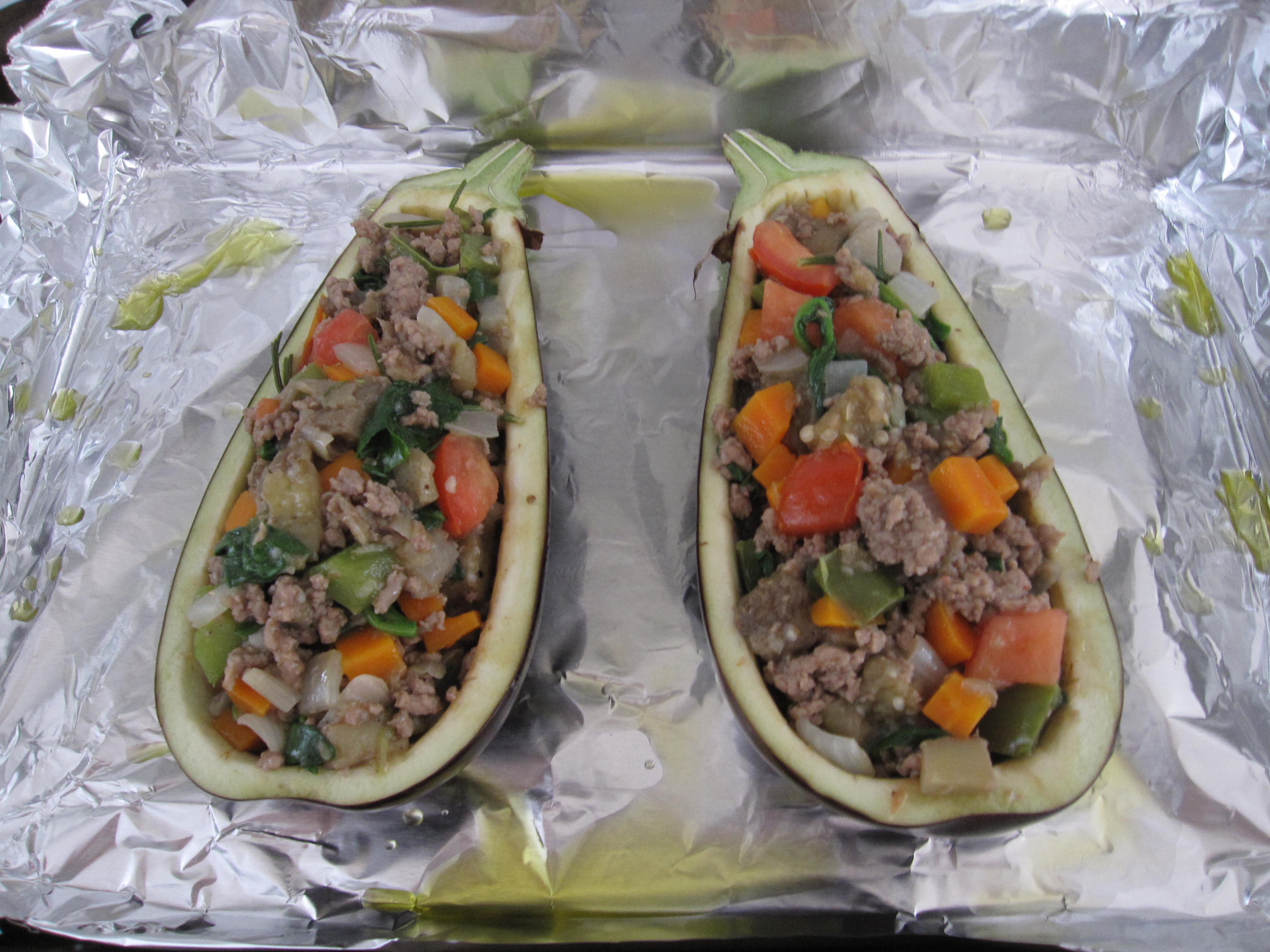
I wiped the salt out of the eggplant skins before stuffing them with the lamb mixture. Fill them up over the top, as much as you can before it all falls out. There will be extra stuffing, just put it in the fridge and toss it in some pasta or something for lunch the next day. I laid the stuffed eggplant halves in a lightly olive oiled baking pan and threw it in a 375 degree oven for about 30 minutes.

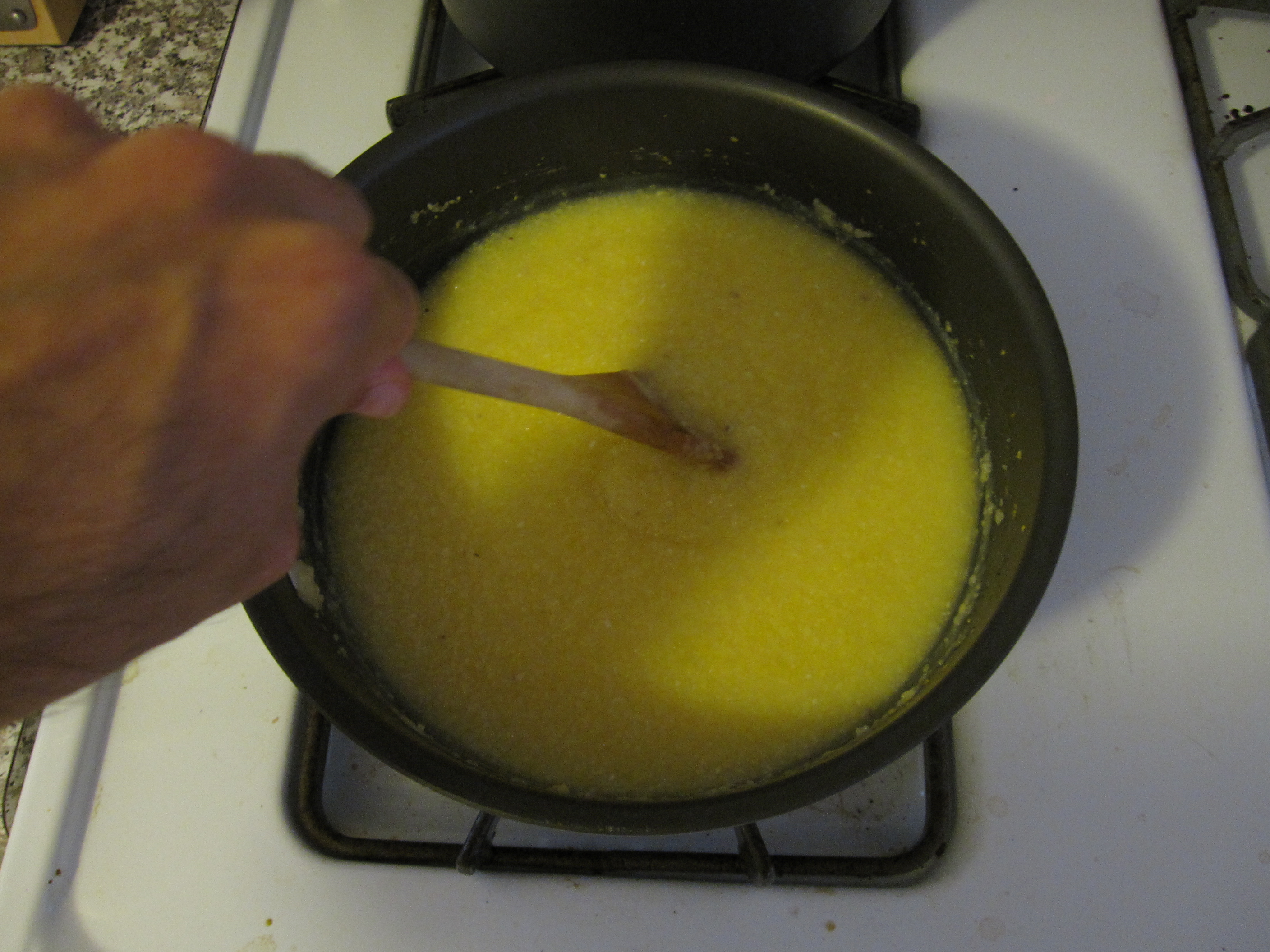
I had just enough time to make creamy polenta while the eggplant cooked. In a stock pot I poured in 4 cups of water, some salt, a bay leaf, and 1 cup of polenta. That’s enough for 4 portions. I brought it up to a boil over high heat. Once boiling I slowly poured in about a quarter cup of olive oil and turned the heat down to medium. I continuously stirred for about 25 minutes, until the polenta started to pull away from the sides of the pot. At that time the eggplant was done and I was ready to serve.

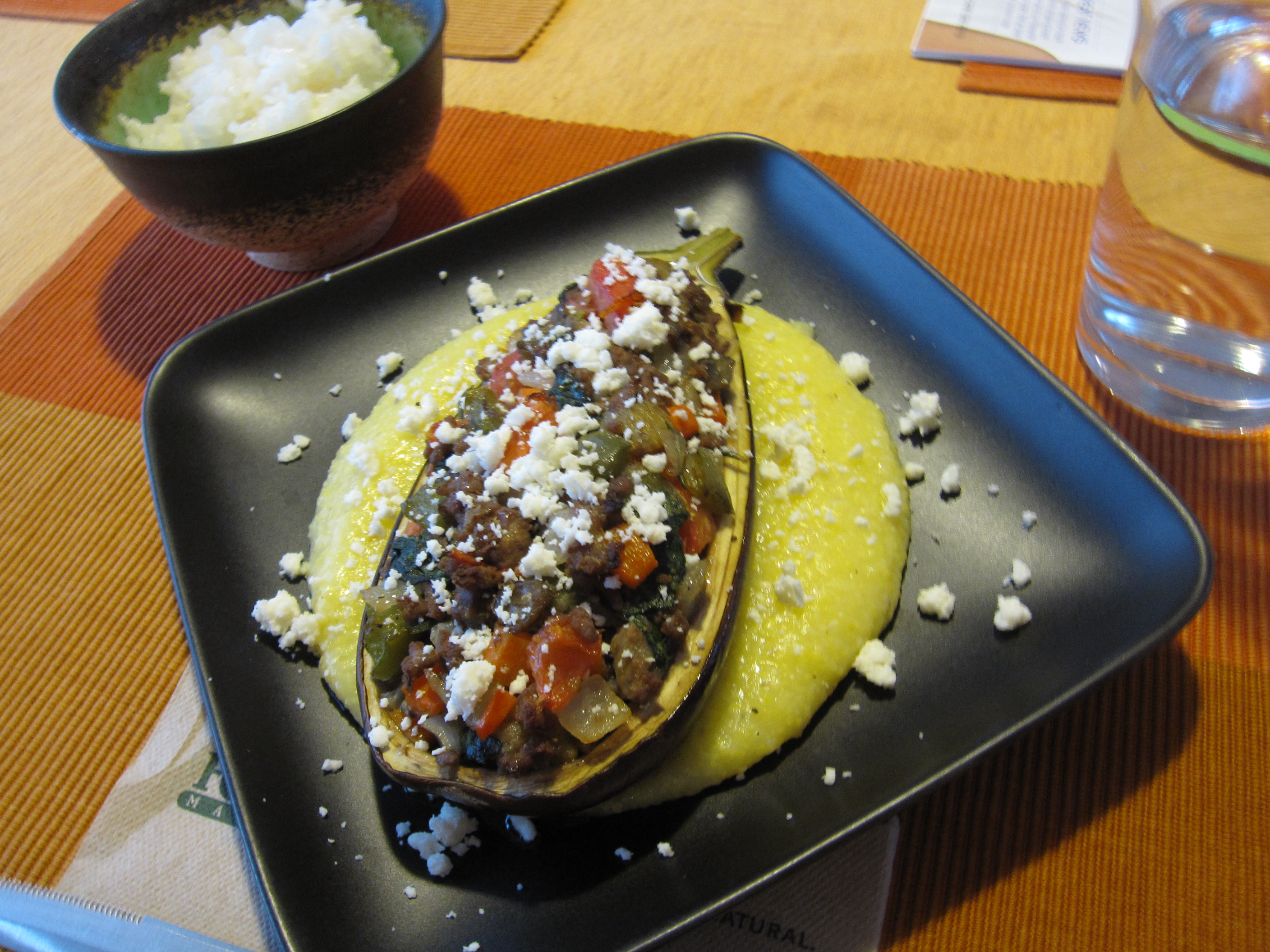
I poured some polenta in the middle of the plates, put an eggplant on the polenta, and topped it all with some crumbled cotija cheese. I served some white rice on the side.

Overall this dish was delicious. If I ever make it again I would make a couple of changes though. First, I’d add some spice to the lamb mixture, maybe some cumin, or turmeric, or garam masala. Second, I wouldn’t put a bay leaf in the polenta. That was the first time I used bay in polenta. It gave it kind of a medicinal taste. Yuki said it tasted like Walgreens. It wasn’t that bad, just not what I wanted. Otherwise I’d keep everything about the same.

Read Full Post »

Monkfish, quite possibly natures ugliest creation (not including Ann Coulter’s morality). However, I’m a firm believer that the uglier the animal, the better it tastes. Monkfish is truly one of the best tasting fish in the sea. Called the poor man’s lobster because of a similar stringy texture it is a much more affordable way to go than lobster. Hence, the name. One thing to keep in mind with monkfish, the tail is covered in a membrane that needs to be removed prior to cooking and eating. It’s easy to do, all you need is a sharp knife. However, let the fishmonger do it for you so your garbage doesn’t stink like rotten fish the next day.

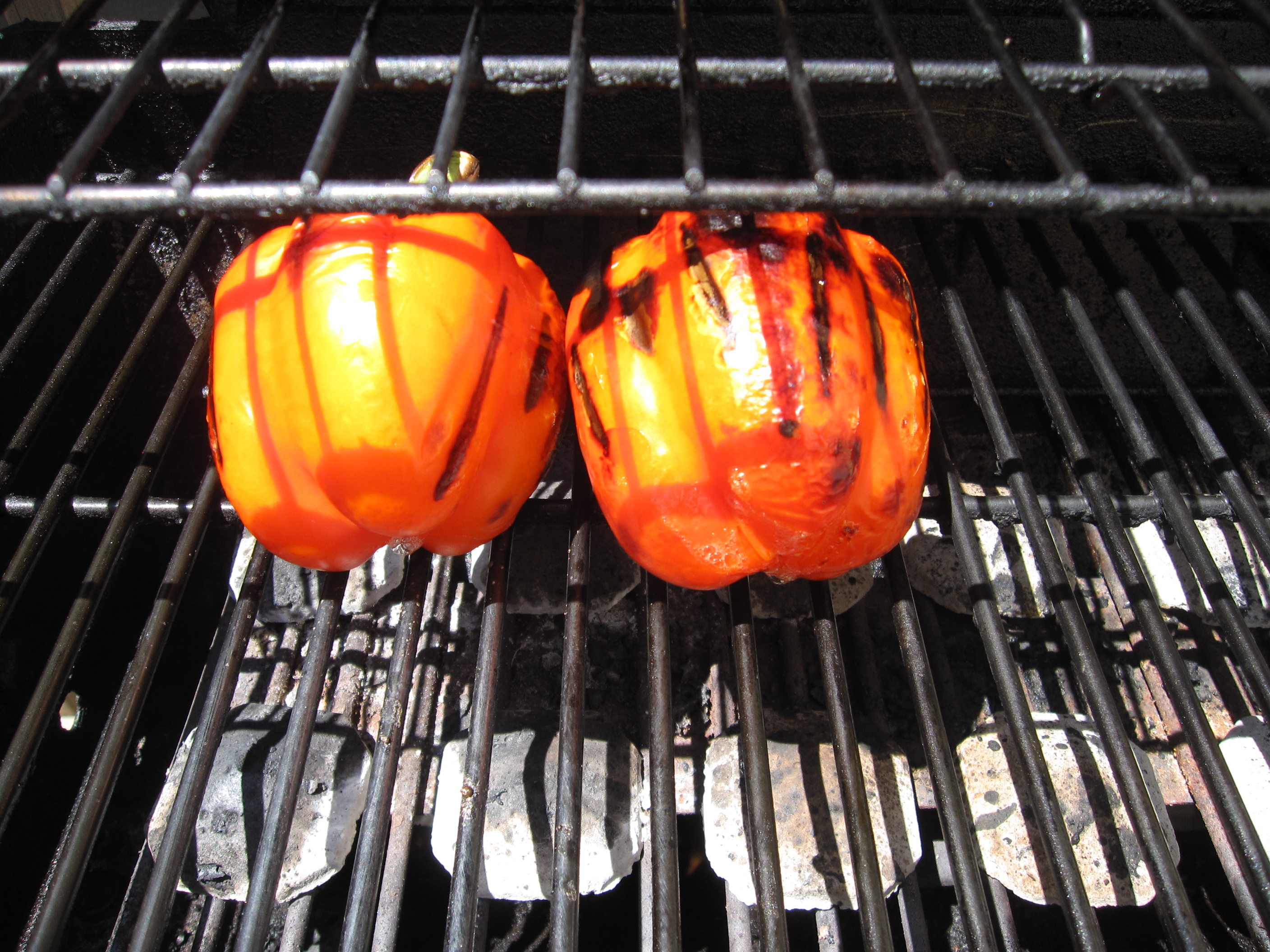
The first thing I did was make the sauce. I took two red bell peppers and grilled them (I guess it’s technically not a roasted red pepper sauce) until the skin was nice and charred. I kept turning them around to make sure the entire pepper got charred. You can do this under a broiler or on the gas stove top if you don’t have a grill. The grill does add a nice smokey element to the peppers though that you don’t get on a range.

Once the skin was good to go I put them in a bowl and covered them in plastic wrap. I let them cool down in their own steam for about a half an hour. This not only allows the peppers to cool down for easier handling, but it helps the skin separate from the flesh. Then, keeping the peppers over the bowl, I rubbed off the skin and discarded it along with the stem. I opened them up and removed the seeds as well. I kept them over the bowl to catch the flavorful juices. Once the flesh was clear of seeds I put them in my small blender and pureed them along with the juice from the bowl.

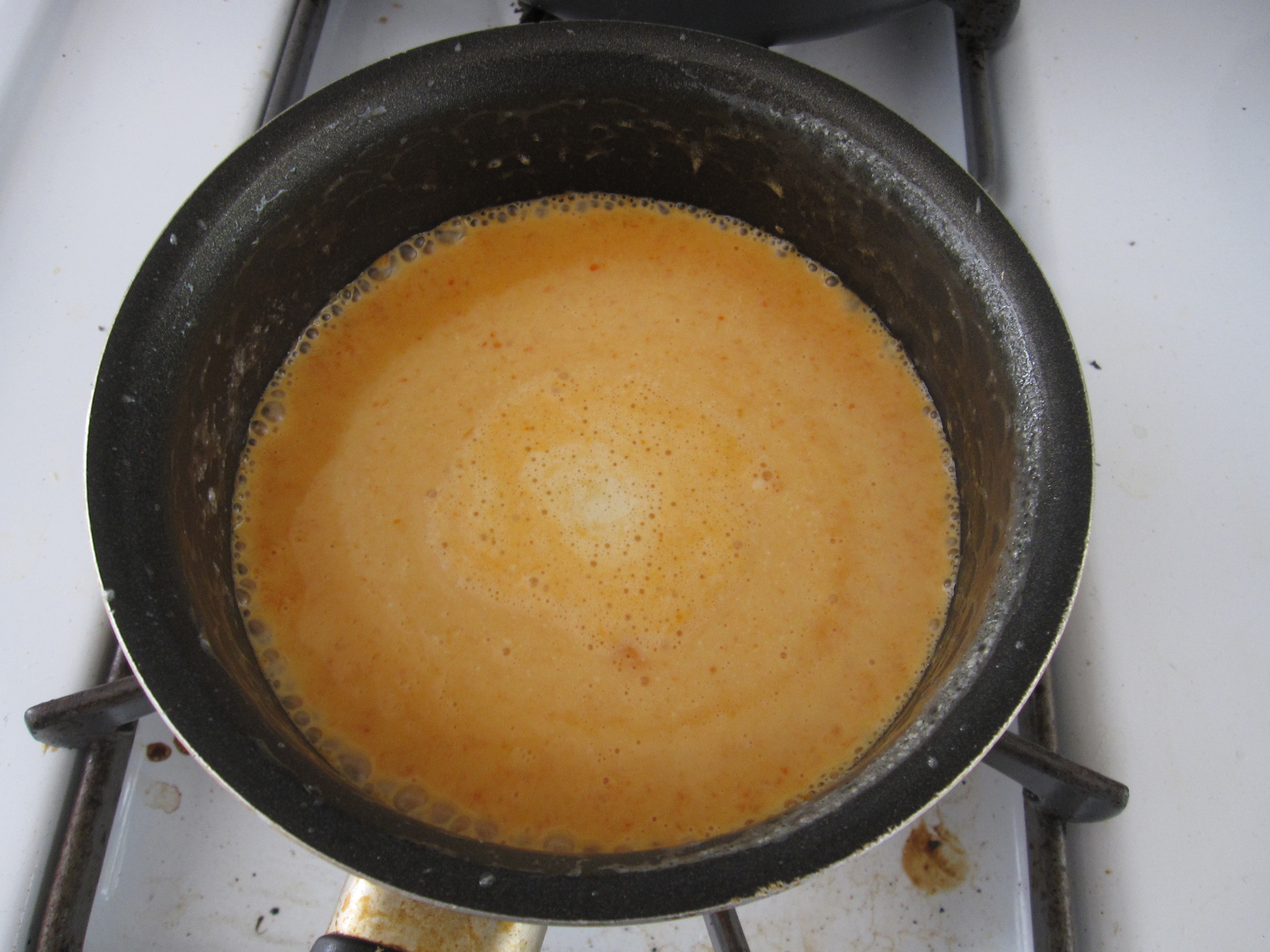
In a small saucepan I melted 1/2 tablespoon of butter over high heat and poured in about 1/3 cup of white wine. I let that boil until it reduced by half, approx 7 or 8 minutes. Then I poured in about 2/3 cup of cream. Once that started to boil I turned the heat down to med-low to keep the cream from boiling over. I let that reduce by half as well, another 10 minutes or so once it started to boil. After it reduced I poured in the red pepper puree and let that come to a boil. Again, I let it reduce by about half, another 10 minutes. Then I turned off the heat, covered the pan, and let it sit until service.

Thinking about vegetables that go well with red peppers I decided to use a zucchini, two baby eggplants, and an onion. I also cut some rosemary from my backyard and cut up a couple of garlic cloves.

I chopped up the vegetables and tossed them with olive oil and the rosemary in a roasting pan. In a 400 degree oven I let them cook for about 20 minutes. Then, I took them out and added the garlic. I didn’t want to garlic to burn which is why I didn’t include it to start with. I also seasoned with salt and pepper at this point and put everything back into the oven for another 10 minutes.

Then, I took it out again. I had cut the monkfish into 4 portions. I seasoned it with salt, pepper, and some paprika. The seasoned fish was laid on top of the veggies and then everything went back into the oven for another 15 minutes.

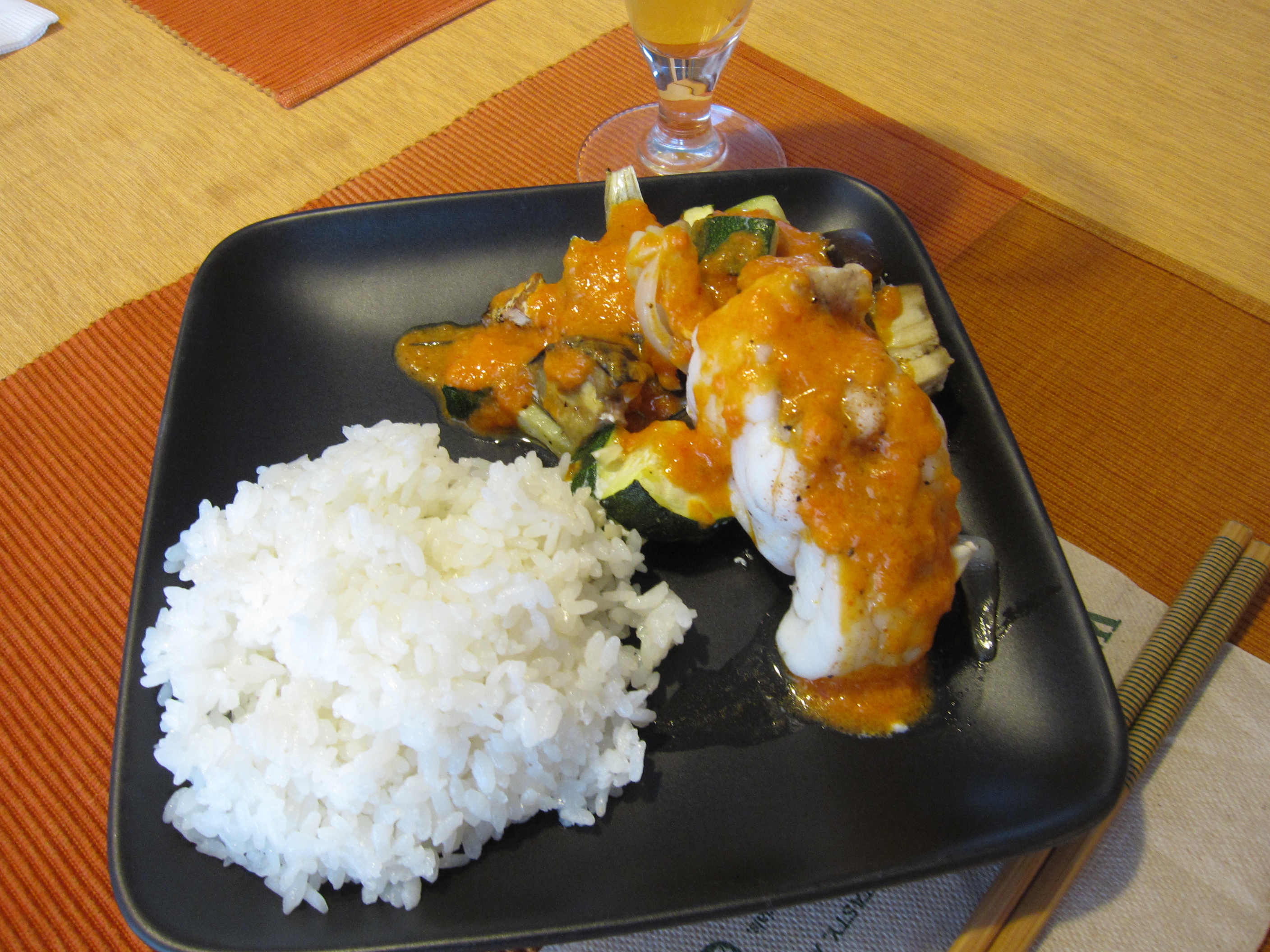
To serve, I put some white rice on the plate, scooped some of the veggies next to the rice, and laid a piece of fish on top of the veggies. I had re-heated the red pepper sauce and spooned it all over the fish and veggies. Delicious!

Read Full Post »

For Meatless Monday last night I made a Dahl, an Indian-style lentil stew. I had a handful of okra left from the farmer’s market this weekend, so I decided that this would be a good way to use them up.

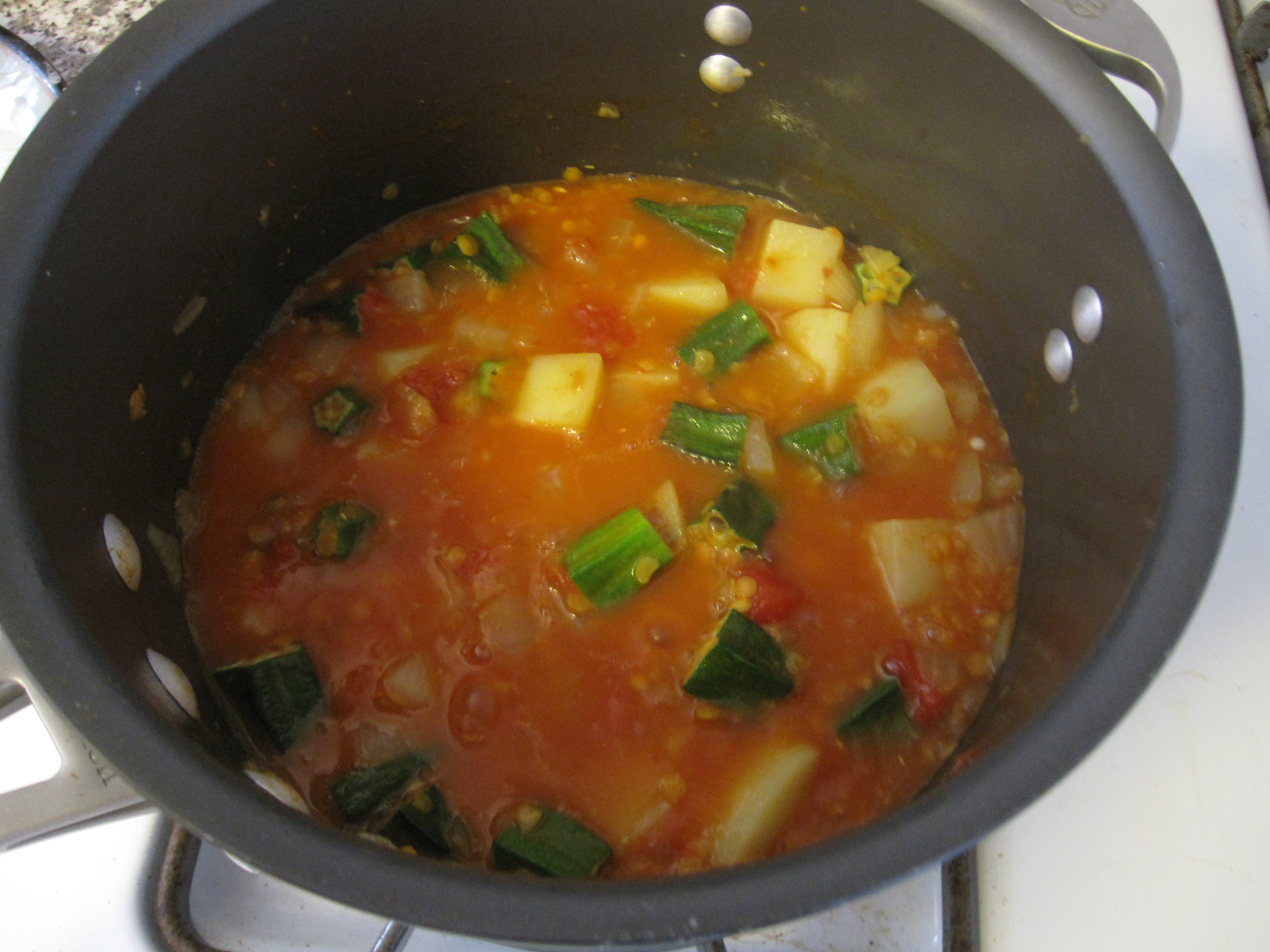
My ingredient list included the okra (cut into 1/2 inch slices), 1/3 cup of red lentils, a 14 oz can of diced tomatoes, one medium onion diced, an inch of ginger, two garlic cloves, and one medium russet potato that I skinned and diced. I also used one cup of water and about a teaspoon of turmeric along with salt and pepper.

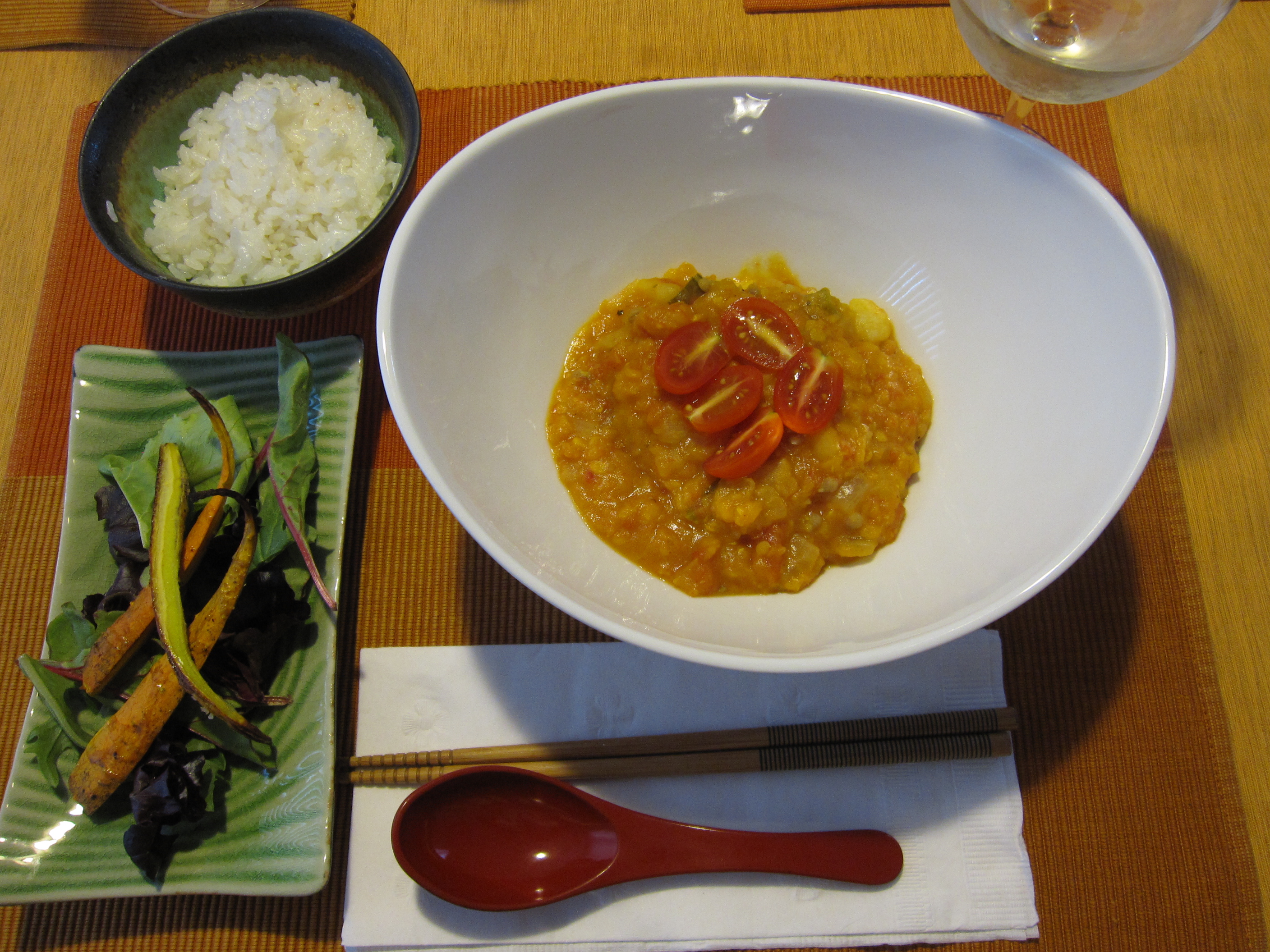
Over med-high heat I melted about a tablespoon of ghee and grated the ginger and garlic into it. Once they became fragrant, about 30 seconds or so, I added the onions. Those sautéed for about 5 minutes and then I added the potato. A few minutes later I stirred in the lentils just until they were fully coated with the ghee and then I poured in the water. I let the water come to a boil and then scraped up the garlic and ginger that stuck to the bottom of the pan. Then I added the turmeric, salt, and tomatoes and let that all come to a boil. Once boiling, I turned the heat down to med-low, stirred in the okra, covered the pan, and let it all simmer for about 30 minutes. After that, I added some black pepper and adjusted my salt. A garnish of halved cherry tomatoes and it’s ready to eat.

Besides the okra, I also had a few baby carrots from the farmer’s market that I needed to use up. Even though their skin was purple, the flesh was either orange or yellow. They were so tender and sweet, possibly the best carrots I’ve ever cooked with. I didn’t want to take away from their natural sweetness so I kept it really simple. After skinning them I quartered them length-wise. I drizzled some olive oil all over them, then sprinkled some cumin, salt, and pepper. I put them in the oven at 375 degrees for about 15-20 minutes. To serve, I just layed them on top of a mixed green salad.

As happens more often than not in my kitchen, white rice was served on the side.

Read Full Post »

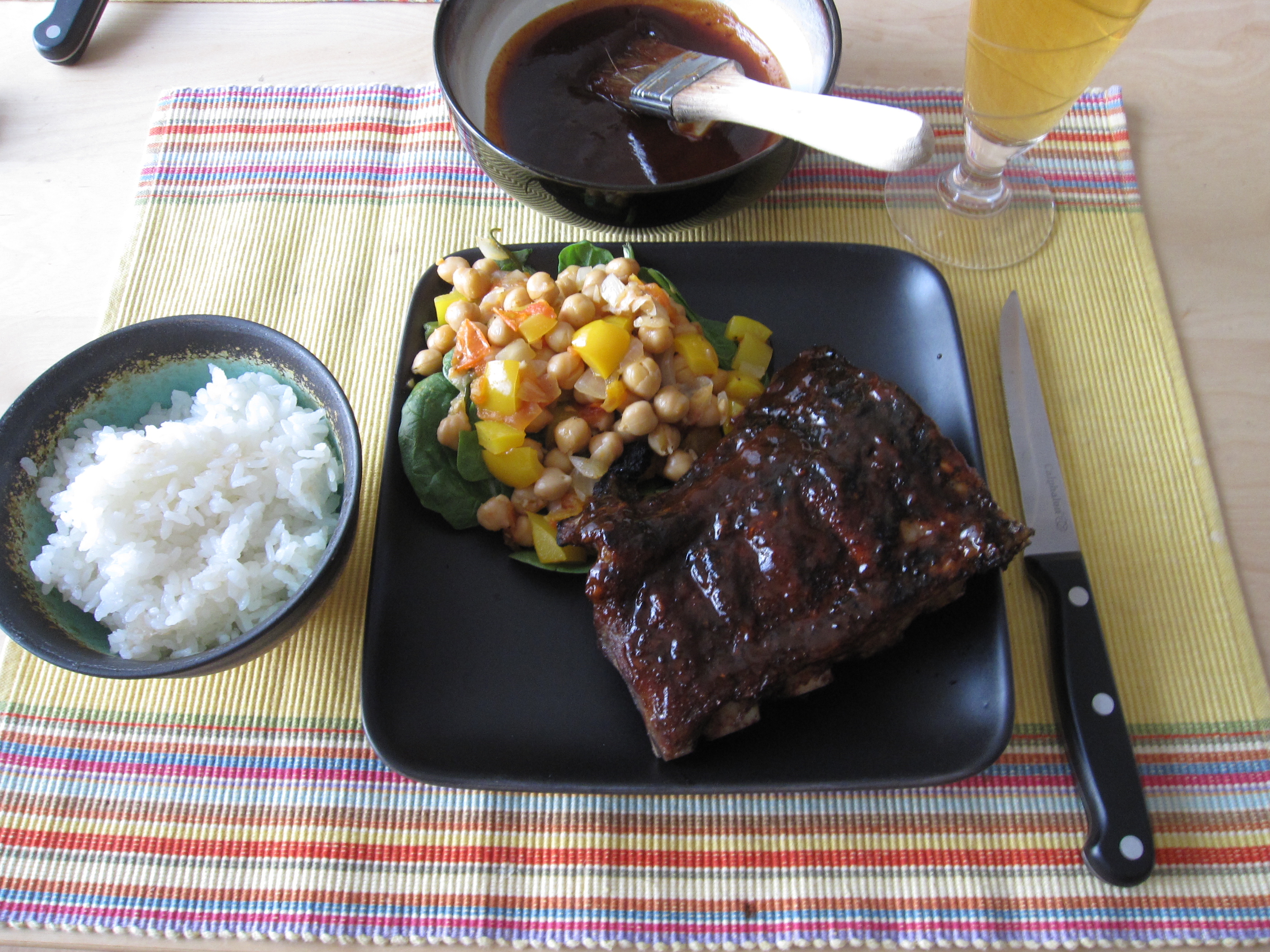
Whole Foods had some really nice baby back ribs on sale the other day, so I really had no choice but to get a slab. I only wish I had a smoker, but even without one ribs can be done with flavor and tenderness.

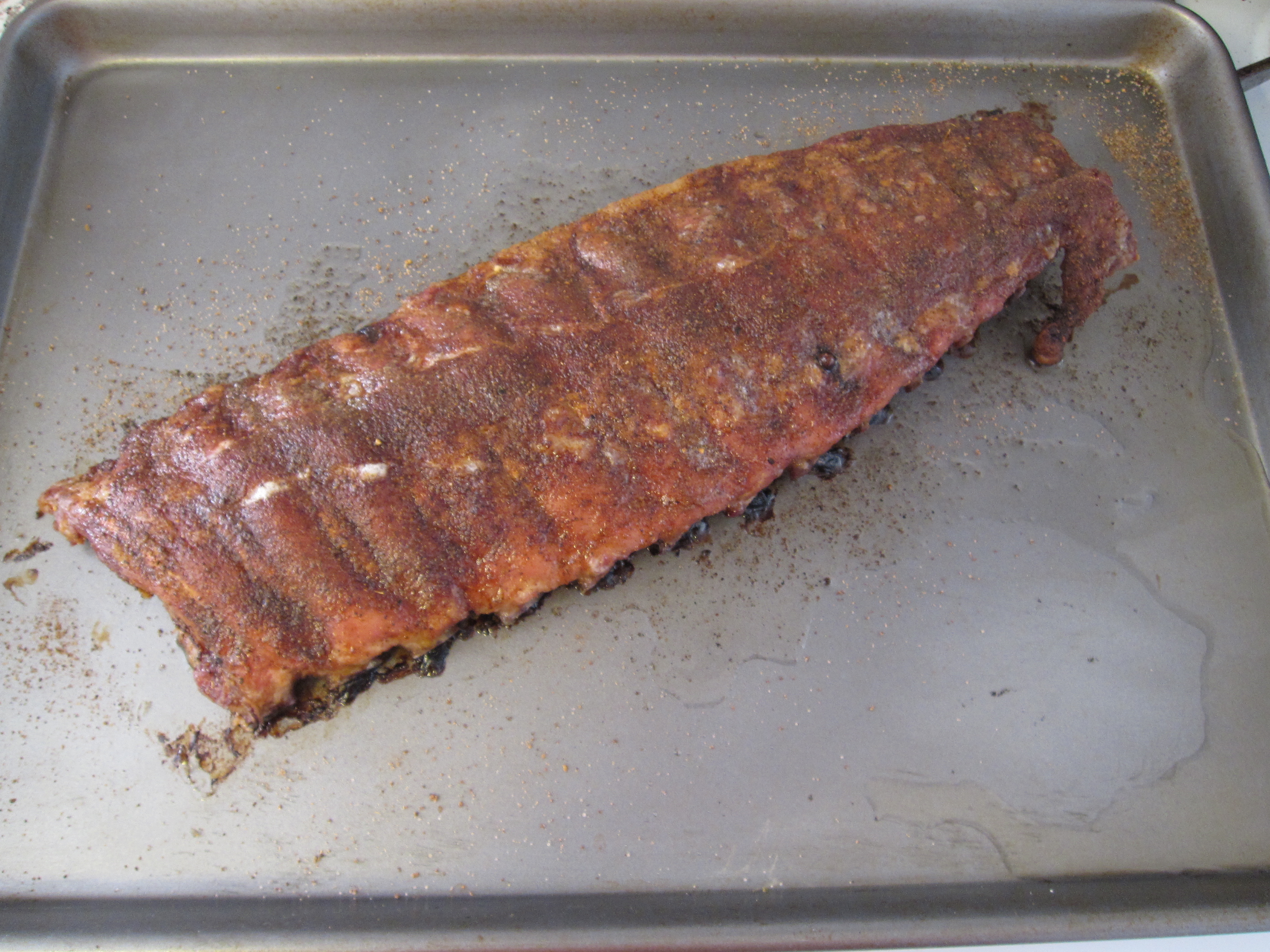
I started by coating the slab with a spice rub. I used a very basic mix for this slab. I mixed together about 1/8 cup of paprika, 1/8 cup of sugar, 2 tablespoons of black pepper, 2 tablespoons of salt, and 1 teaspoon each of cayenne, dry mustard, and white pepper. I let the rub sit for about an hour before throwing the slab into a 250 degree oven. I let it go for about 2.5 hours.

Once the meat was cooked through and tender I put it on the grill over about medium heat. I had some BBQ sauce in my fridge that I needed to use so I didn’t make any of my own. I brushed the sauce on both sides of the ribs and let them cook for about 10 minutes per side to get the sauce nice and carmelized.

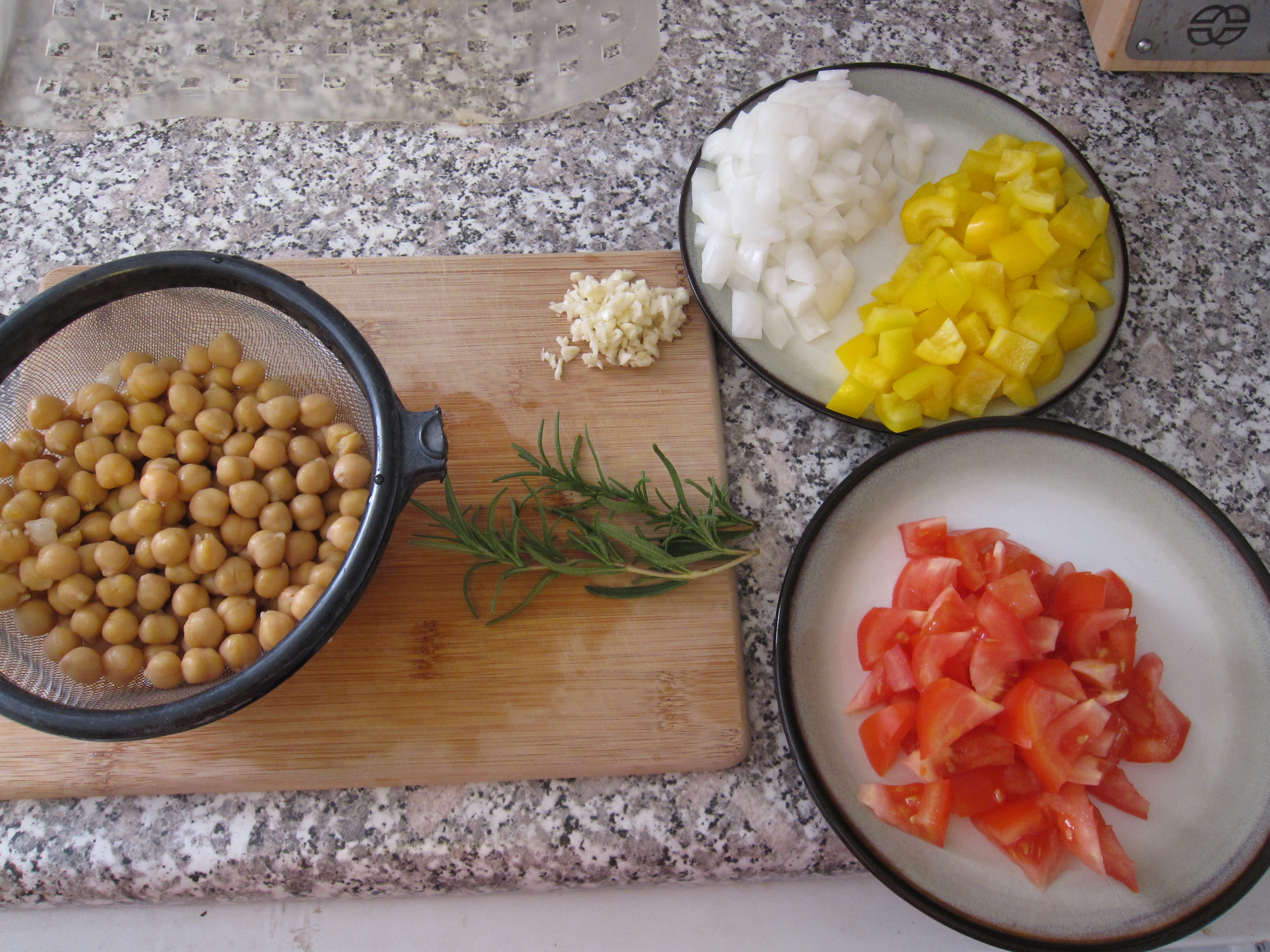
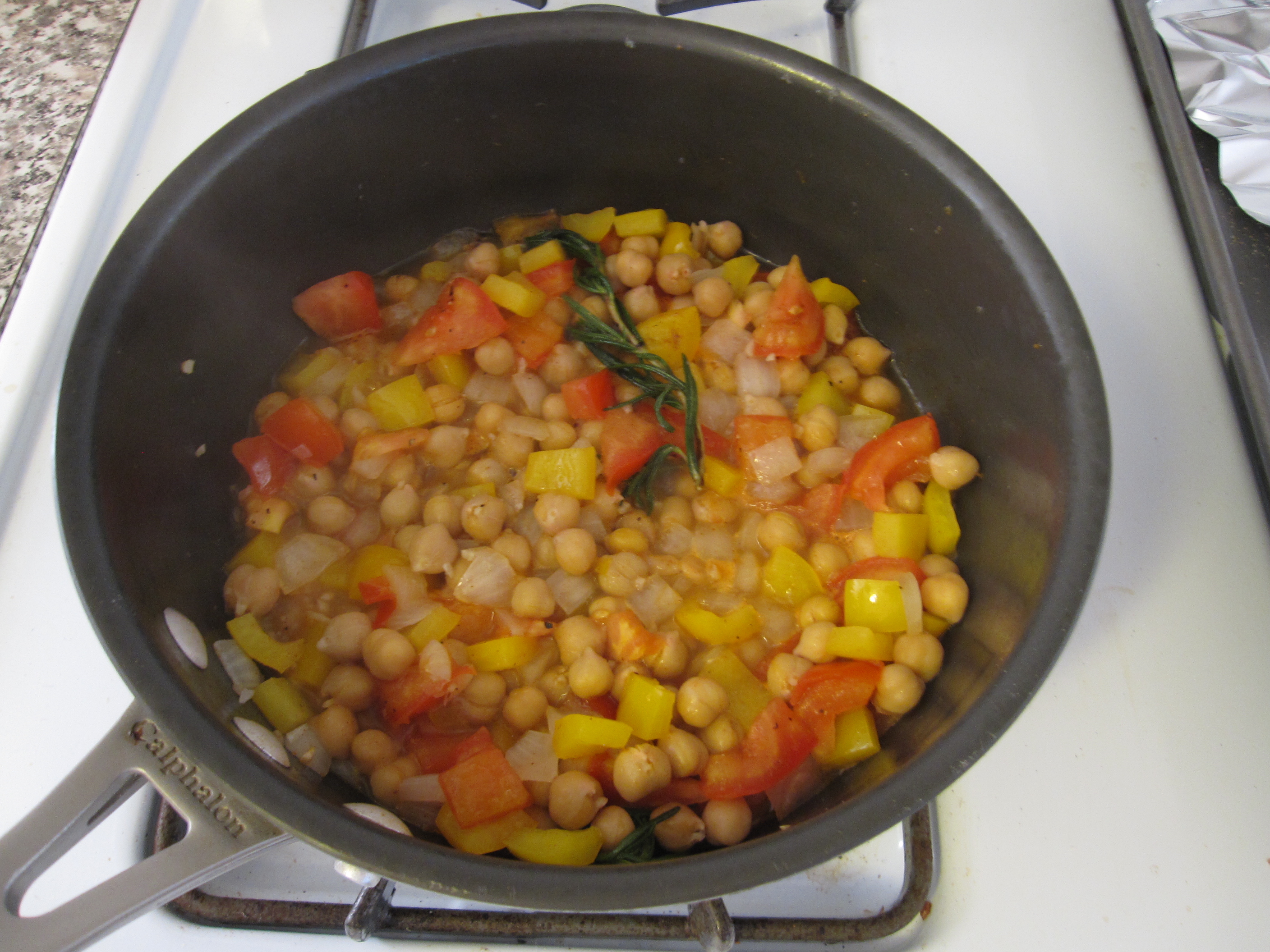
Besides white rice I stewed some chickpeas. I diced half of an onion, one yellow bell pepper, two tomatoes, and two garlic cloves. I also used one can of chickpeas and two sprigs of rosemary from our herb garden.

In some hot olive oil I sautéed the garlic for about 30 seconds before adding the onion. A few minutes later I added the yellow pepper and the rosemary sprigs. I let that go for about 7 minutes before adding the chickpeas and tomato. I poured in about a quarter cup of water and then seasoned with salt, pepper, a dash of cumin and a dash of paprika. I let the water come to a quick boil then covered the pot, turned the heat to low, and let it simmer for about 15 minutes. Once the chickpeas were fully heated I turned off the heat and squeezed in the juice from a half a lemon. That’s all, ready for consumption.

Read Full Post »

I made a quiche for Meatless Monday this week. I’ve never made one before, and while I really wanted to use some bacon, it turned out surprisingly delicious. Probably the best quiche I’ve ever eaten. Yuki, who is a big fan of quiche, thought so too.

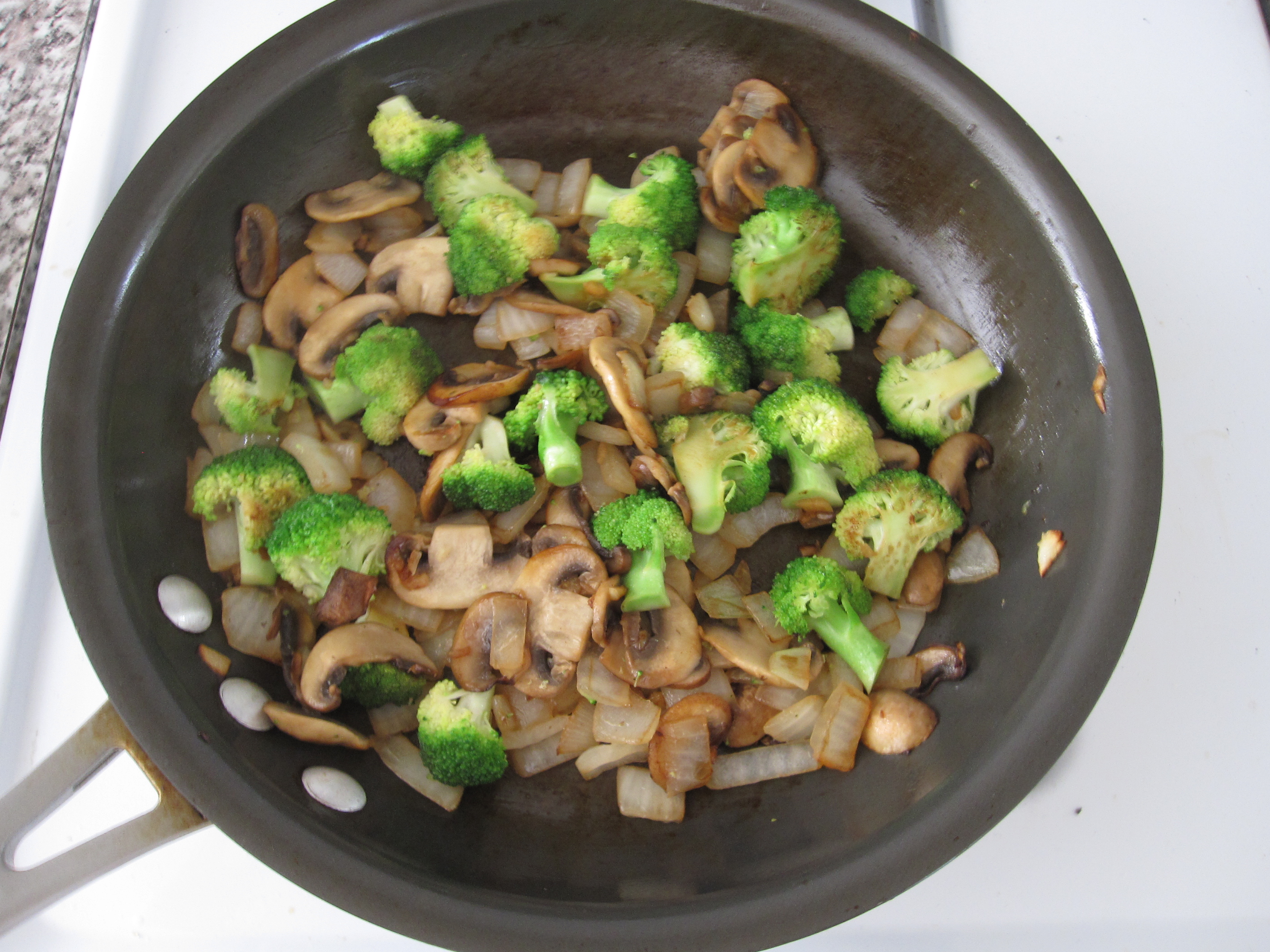
For my vegetables I slices up 5 button mushrooms and 5 cremini, I chopped half of a Vidalia onion, I cut one head of broccoli into small florets, and minced on clove of garlic.

I melted one tablespoon of butter in my saute pan and started with the garlic for about 30 seconds and then the onion for about 4 minutes. I threw the mushrooms in and let them cook down for about 4 minutes. Then I tossed in the broccoli and let that go for another 4 minutes. I let them cool on a plate.

While the vegetables were cooling I whipped up the egg batter. I used 4 eggs, 1/2 cup of soy milk, 1/2 cup of fresh grated Gruyère, some salt, pepper, and a teaspoon of nutmeg.

I rolled out a puff pastry so that it would fit nicely in my 9″er (a man can dream). I lightly buttered the pan then laid the pastry in and trimmed the edges. I laid the vegetables on the bottom so that they were evenly dispersed. Then I poured the egg batter on top. I rolled the sides of the crust dow till they were just slightly higher than the batter. I topped it all with some more grated Gruyère and threw it into a 350 degree oven for about 30 minutes, or until the top is slightly browned.

I let it sit for about 10 minutes after taking it out of the oven. The quiche needs to rest a little and it will lose some height as it settles.

I served it with some white rice and a mixed green salad. The salad had some tomatoes and a shiitake vinaigrette.

Read Full Post »

Personally, I think that fennel is one of the more underrated vegetables out there. Sure, you see it in Italian cooking. You also see its seeds in some Indian and Middle Eastern cooking. But you don’t see much of it outside of that. When I saw big, beautiful fennel bulbs at the store yesterday I just had to eat them.

The first thing I did after washing the fennel was to separate the fronds from the bulbs. I took a handful of the frond and chopped them up nice and fine. I threw them into a quarter cup of olive oil along with a finely minced garlic clove, a pinch of crushed red pepper flakes, and about a half lemon’s worth of zest. I slashed the skin on 6 bone-in skin-on chicken thighs and then coated them with the marinade. I covered it in plastic and threw it in the fridge for a couple of hours.

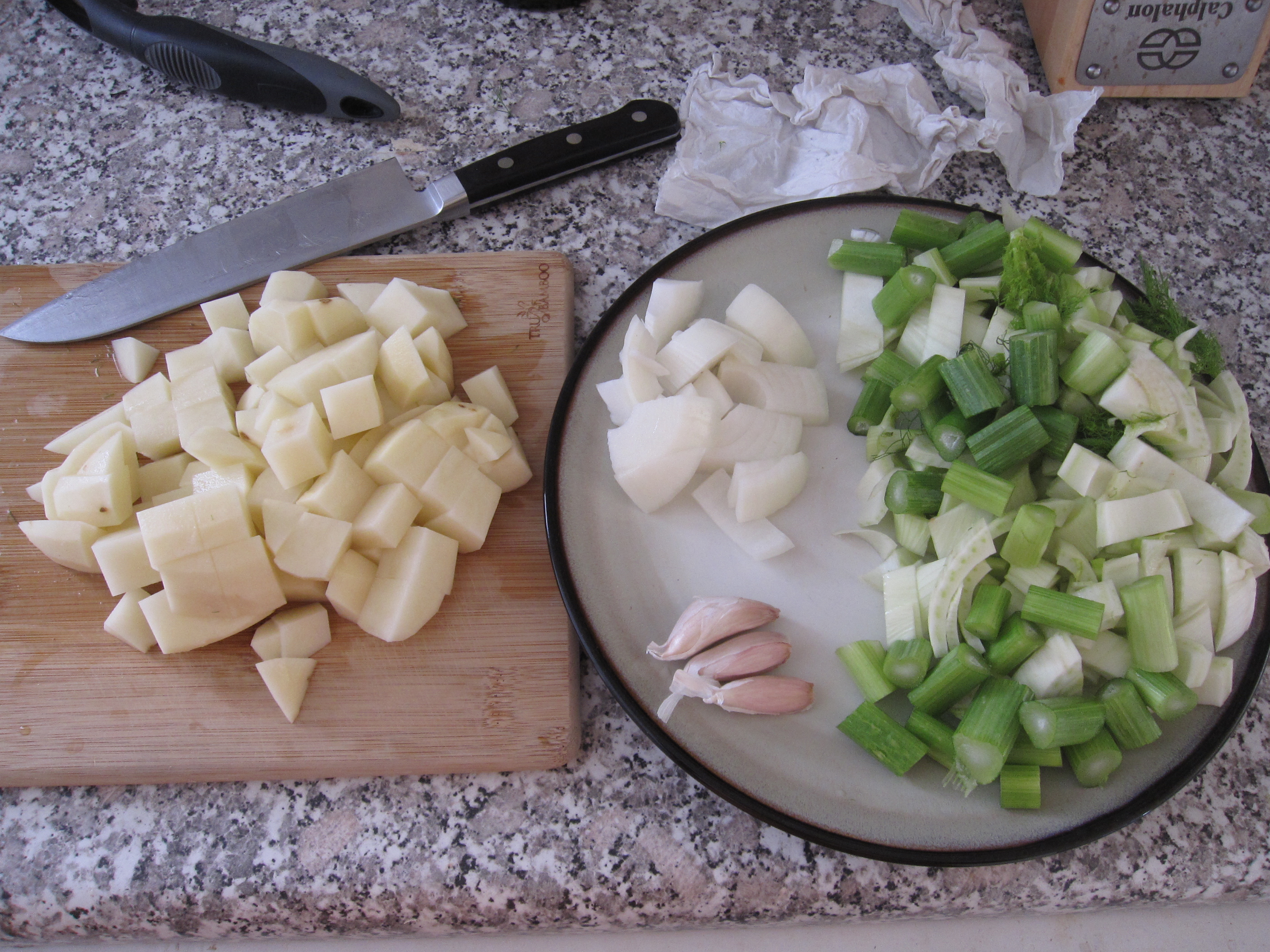
I coarsely chopped the bulbs along with half an onion, three garlic cloves, and two medium-sized russet potatoes that I skinned.

In a heated pot I melted 1 tablespoon of butter and then sautéed all of the vegetables for about 7 minutes. Then I poured in a quarter cup of white wine. I let that boil for a few minutes and then added 1 cup of chicken stock and seasoned with salt. Once that came to a boil I covered the pan and turned the heat down to med-low. I let that simmer for about 15-20 minutes until everything was nice and tender. At that point I turned off the heat and let it cool for a bit.

Once cool I poured it all into my blender along with a quarter cup of soy milk (would have used cream if I had any) and blended it to a smooth puree. Then I poured it back into the pot, checked the salt seasoning and added some black pepper. I let it sit until everything else was ready. At that point all I had to do was re-heat it.

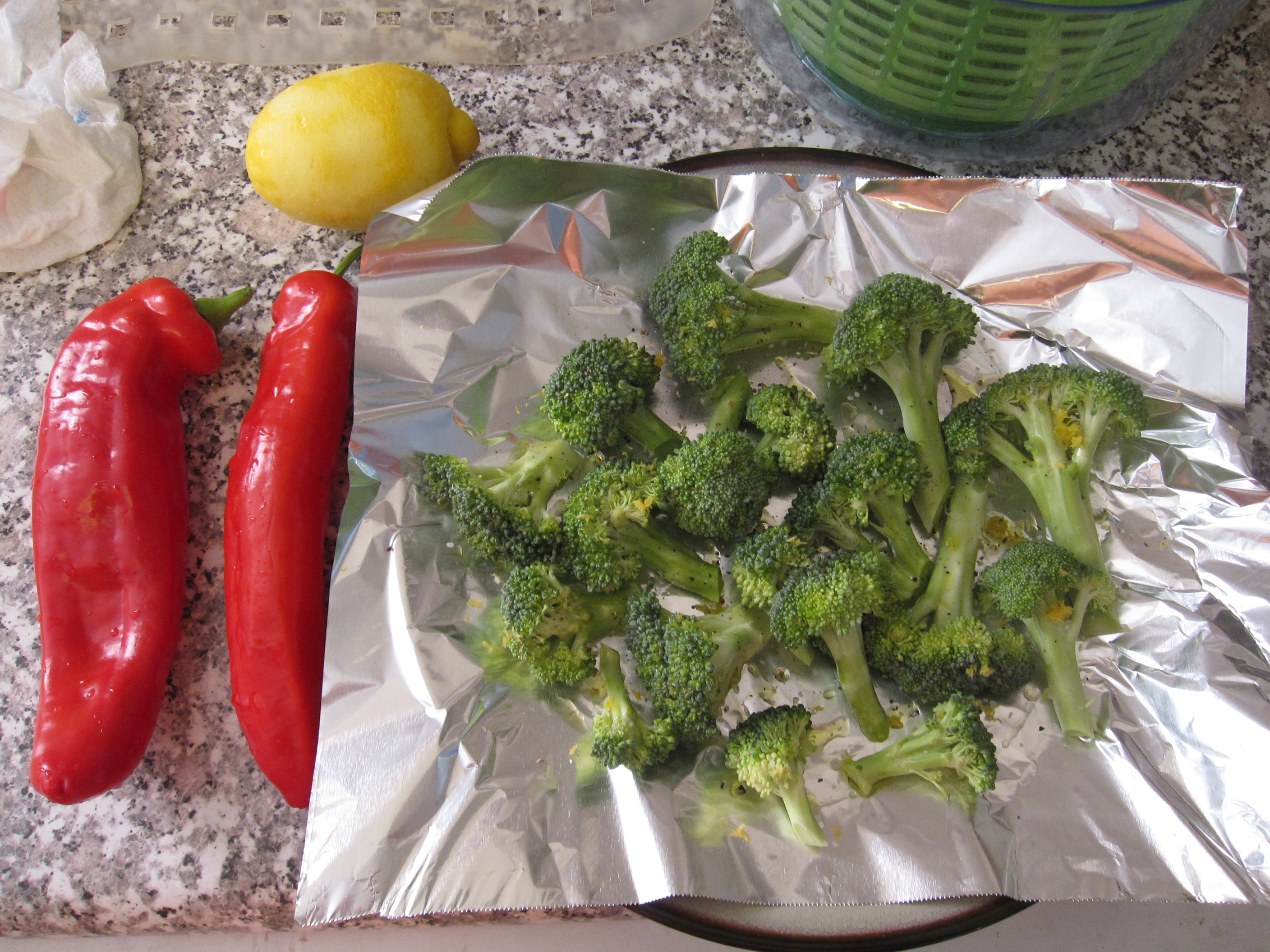
I took some broccoli and cut it down into florets. I laid that on some foil, drizzled it with olive oil, then sprinkled zest from the other half of the lemon over it along with some salt.

I took the chicken out of the fridge about a half hour before grilling to bring it to room temperature. I grilled the chicken skin-side down first to get a nice crisp skin. The broccoli was kept on the foil during grilling, this keeps it from falling through the grate and also keeps it from burning quickly. I also grilled a couple of big red sweet peppers.

To serve, I squeezed the lemon juice on the chicken after it was taken off the grill. Then I garnished everything, the soup included, with some more of the fennel fronds chopped up. White rice accompanied.

Read Full Post »

« Newer Posts - Older Posts »