Feeds:
Posts
Comments

Archive for the ‘Home Cooking’ Category

Braised yakitori, kind of a misnomer. Yakitori translates to “grilled chicken”. I didn’t grill anything for this dish. Braised typically means cooking something in liquid over low heat for a long period of time. I didn’t do that either. What I did was make a standard yakitori marinade and cook some chicken thighs along with green onions in it. Why did I call this “Braised Yakitori”? Honestly, I just don’t know what else to call it.
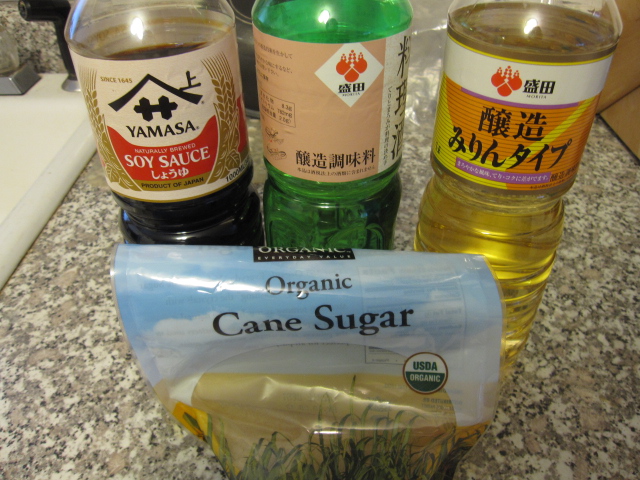
First thing I did was make the marinade. In a small saucepan I poured in 5 tablespoons of soy sauce, 4 tablespoons of sake, 1 tablespoon of mirin, and 1 tablespoon of sugar. I brought it up to a low boil and let it gently simmer for about 5 minutes or so. I just wanted the sugar to dissolve and the marinade to thicken up slightly. After that I turned the heat off and let it cool down for about an hour, until it reached room temperature.

I minced up 2 garlic cloves and chopped up 6 green onions and 6 skinless and boneless chicken thighs. I mixed them all together in a glass dish and poured to marinade over. Covered with plastic wrap I put it in the fridge while I got the veggies and miso soup ready.
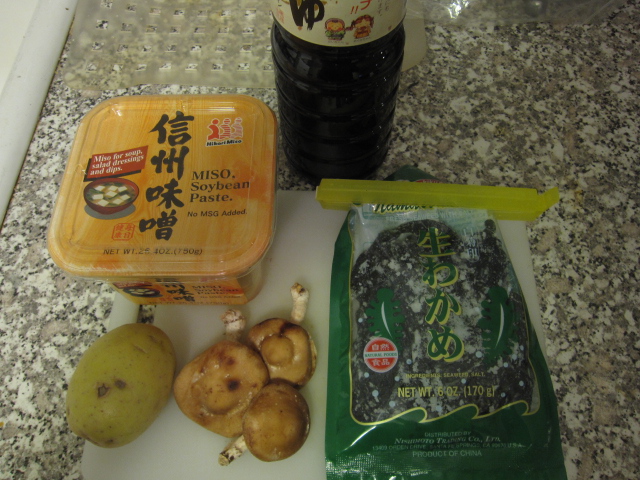
For the miso soup I only made 2 portions. We had some tomato soup leftover from Kasia’s that became lunch today, so I didn’t need to make too much. I used 1-1.5 tablespoons of miso, one yukon gold potato skinned and chopped, 3 shiitake sliced, 2 tablespoons of dashi flavored soy sauce, and some salted wakame. For the wakame, you have to rinse the salt off and then let it soak in cold water for about 10-15 minutes. I honestly cannot tell you how much I used, I just eye-balled it. You have to be careful though because it does get considerable larger as it absorbs the water.

In a small soup pan I poured in about 1.25 cups of water and added the dashi soy, potato, and shiitake. I let it simmer over a very low boil for about 20 minutes. That was just long enough for the potato to cook but not so long that it started to disintegrate.

Just before serving I put the miso in our little tea colander and swished it around for a few minutes until it all mixed into the soup. Using the colander keeps the miso from being chunky. But, this was right before serving (at which time I also added the wakame). Before I did this I made the veggies and cooked the chicken.
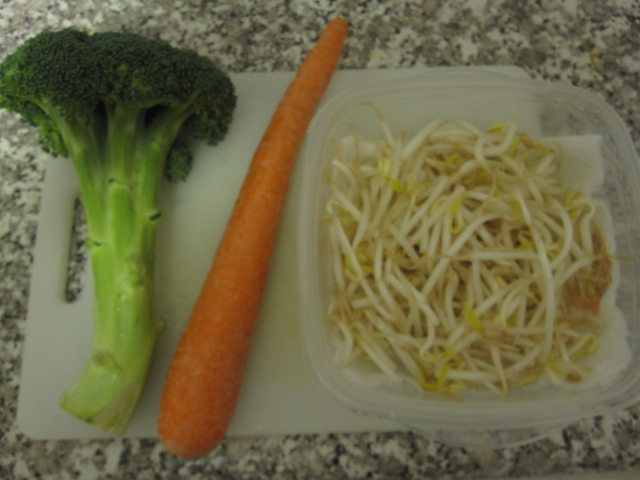
I kept the veggies very simple. I cut up 1 head of broccoli, sliced up 1 carrot, and rinsed about 2-3 ounces of bean sprouts. I got my steamer going and steamed the broccoli and carrot for about 5 minutes. After that I added the bean sprouts and let it go for another minute or so. A little sprinkle of salt and the veggies were ready.

To cook the chicken I heated up my pan and added about 2 tablespoons of sesame oil. When the oil was shimmering I just dumped everything in. It took about 9 or 10 minutes for the chicken to cook through and the sauce the thicken up a little. I seasoned with a little black pepper and that was all.

Of course, white rice accompanied the night’s chow.

Read Full Post »

After trying to connect with a couple of our friends for a while, with whom we usually try new Mexican restaurants with, we finally got this past Saturday night lined up. Nick and his wife invited us over for dinner this time. I told him I’d make some dessert. When he asked if ribs would be an acceptable dinner my response was “RIB ME!!!” You can’t beat slow smoking baby back ribs outside in 10 degree weather. All you can do is hope your cold beer is enough to warm you up until the ribs get in your guts.
At any rate, that’s what happened. Nick smoked some ribs, his wife made a couple of sides, and I brought a cake.

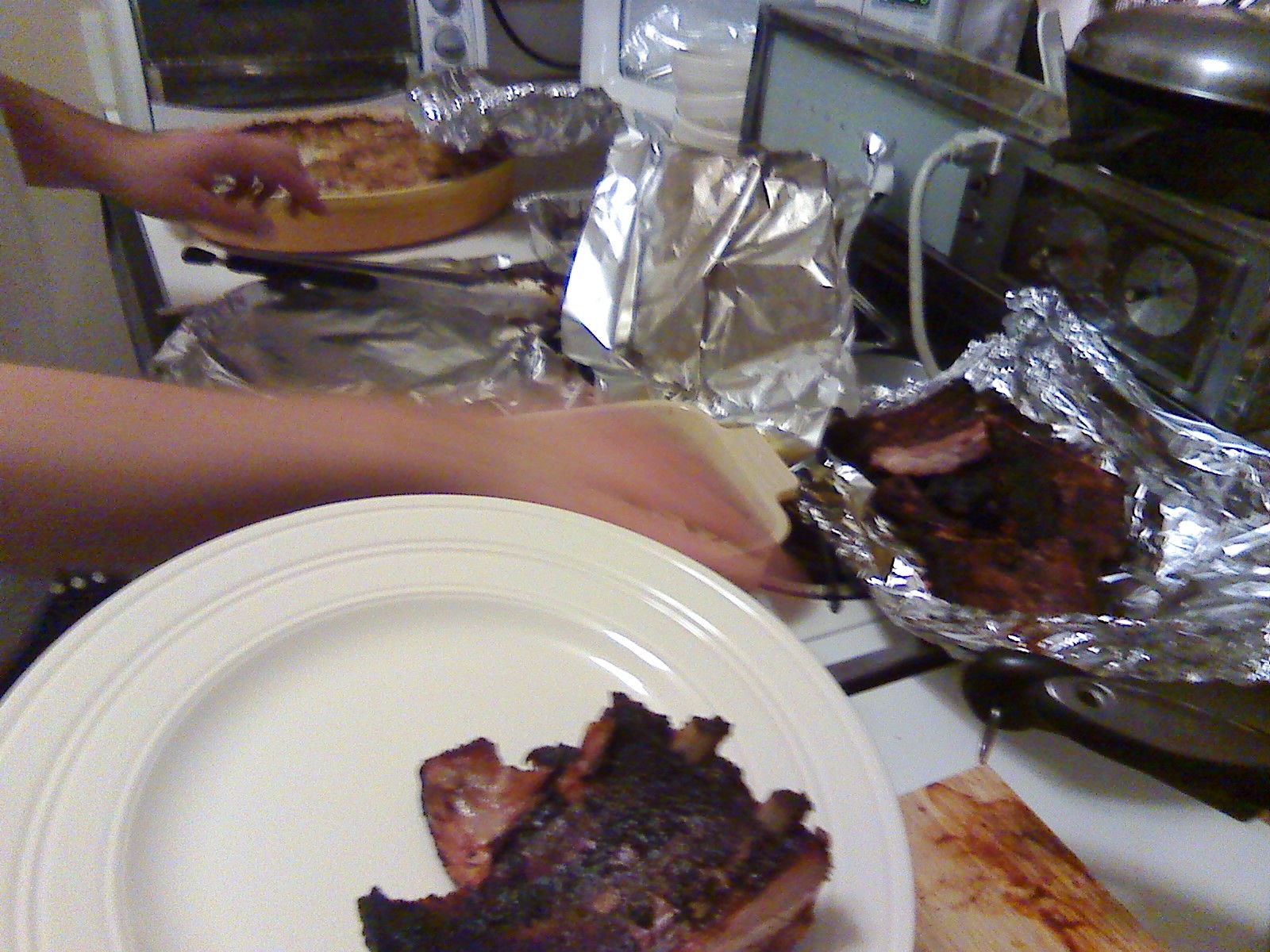
He did the ribs right. Not sure what his recipe was, but he made a nice spice rub and then placed his ribs on a rack in his grill. The hot coals were spread around the sides of the grill while he placed a drip pan filled with some cider vinegar in the middle. The indirect heat kept the ribs from burning, the cider vinegar evaporated into the meat adding some flavor and keeping the meat moist, and the rack allowed the ribs to kind of baste themselves. 3 hours under the hood and they were ready to go.

After some chips, carrots, and dip (along with some alcohol), dinner was served. Nick chopped up the ribs for us and served them with some really creamy scalloped potatoes and nice buttery brussel sprouts. Good ol down home cooking. What else should have been expected from a Kentucky-boy?

I have to say, the ribs were excellent! I’m not just saying that because he’s one of the few who actually reads all of my blog posts. They really were delicious. The meat was fall off the bone tender, the spice rub and his homemade bbq sauce set off the meat nicely. My comment at the dinner table was, “Nick, I’d eat your ribs for free over paying for Honey 1 any day of the week!”.  A couple other friends were there as well and between the 6 of us we could only muster enough stomach for about half of the fair. True to his good ol boy hospitality we were sent home with a half slab. Gotta love that!

For dessert I made this Orange Kefir cake. I’ve been on a baking-with-kefir kick and wanted to continue that trend with something simple and tasty. I found this recipe by The Barefoot Contessa herself for a Lemon Yogurt Cake. All I did was substitute the yogurt for kefir and the lemon for orange. It turned out great, nice and moist while not being too sweet.

All in all, Saturday night was a tasty feast. Any time my buddy wants to smoke up some ribs I’ll be there to help polish them off.

Read Full Post »

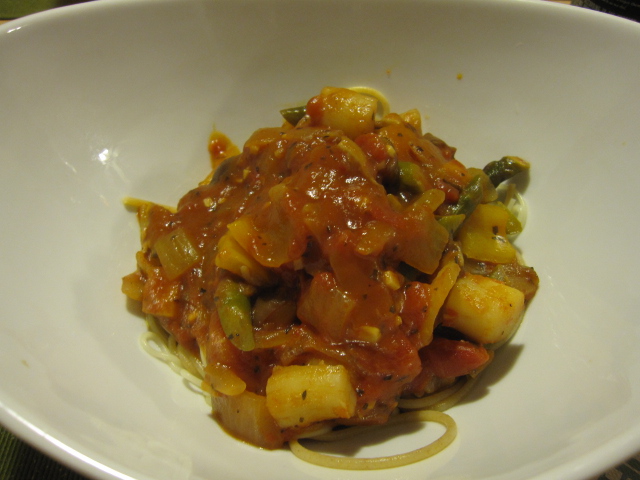
The other night I knew I wanted to make some spaghetti of some sort, but I wasnt sure what to do with it until I came across these beautiful little scallops. We haven’t had scallops in a while so I figured I’d just make a very simple tomato sauce with them and some vegetables.

Besides about 2/3 pound of scallops I chopped up 8 asparagus, 3 shiitake, 1/2 onion, 2 cloves of garlic, 1 yellow bell pepper, opened up 1 14oz can of diced tomatoes, and got out 1 tablespoon each of soy sauce and sake just to add a little umami.

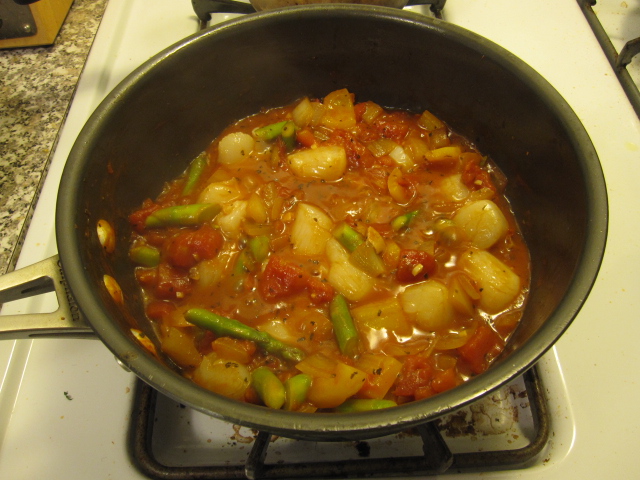
This is about is simple as cooking gets. While I was boiling some salt water for the noodles, I used half angel hair and half wheat noodles, I heated up my pan and poured in about 2 tablespoons of olive oil. I sautéed the onion for about 5 minutes before adding the garlic, I let that go for another minute. After that I added the shiitake, pepper, and asparagus and let them go for another 5 minutes. I added the soy sauce and sake, let them boil off for about 1 minute, and then dumped in the tomatoes. Once the tomatoes were at a low boil I turned the heat down to medium and added the scallops. Scallops can be a little tricky here because if you overcook them they’ll become a bit rubbery. On the other hand, they do give off a lot of liquid so you need to boil some of that excess off. I let them go at a very low simmer for about 10 minutes and it worked out perfectly, but each stove top is different so you have to keep a close eye on it. At the very end of cooking I decided to add a little dried basil along with some salt and pepper.

Once I drained the noodles I just ladled the sauce on top. I had some wheat dinner rolls to eat with it.

Read Full Post »

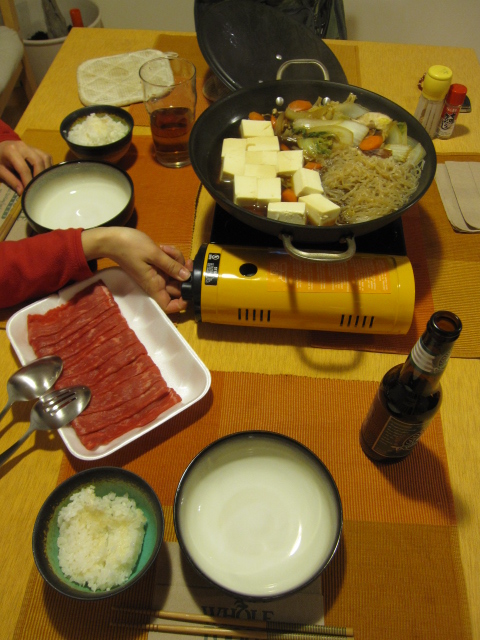
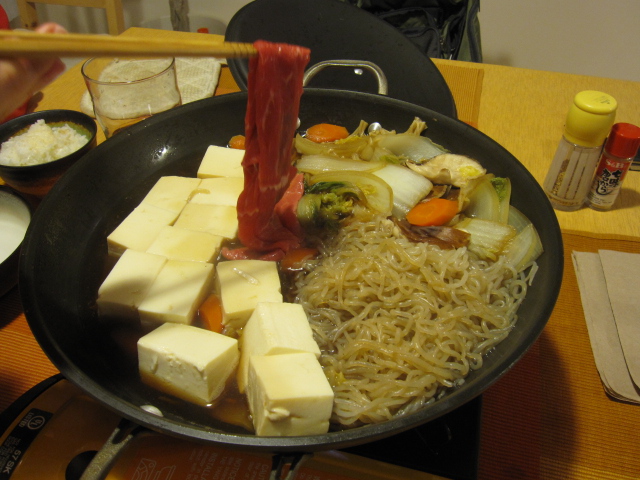
Just saying Yuki’s Sukiyaki is almost as much fun as eating it. Sukiyaki is a traditional family style one-pot meal in Japan. Vegetables are simmered in a sweet soy-based broth.

Then the pot is brought to the table and, over a table-top burner, thin slices of beef are swished around (similar to shabu-shabu) and cooked in the pot. Each individual has their own dish to put the beef and veggies in. It usually is mixed with a raw egg, but raw eggs aren’t good for prego so we omitted that.

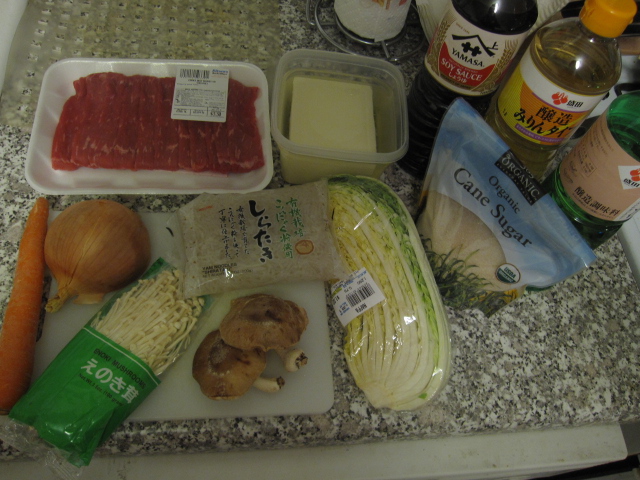
Ingredients for Yakiniku aren’t set in stone, what we used are pretty typical for the most part. I chopped up a carrot, quartered 1/2 onion, cleaned up 1 packet of enoki mushrooms, rinsed and cut up 1 packaged of konnyaku shirataki noodles, 2 large shiitake halved, 1/4 head of napa cabbage chopped, a little more than 1/2 pound of thinly sliced beef, almost 1 block of silken tofu large diced (I had previously used about 1/8th of it for miso soup, use as much as you like), about 5 tablespoons of soy sauce, 2 tablespoons mirin, 3 tablespoons sake, and 1-2 tablespoons of sugar.

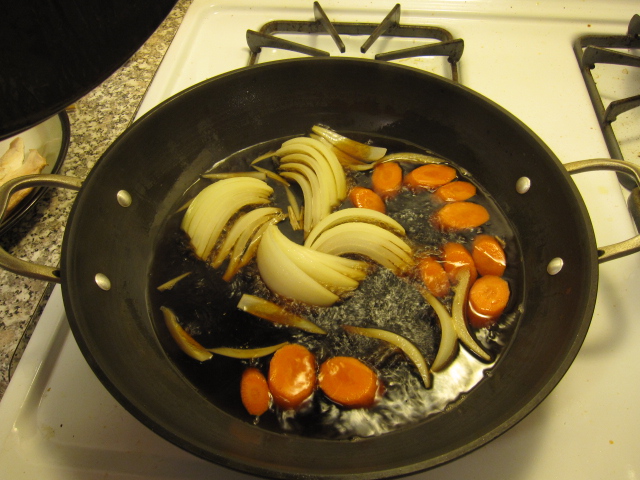
In our large pan Yuki poured in the soy, mirin, and sake along with about 1/4 cup of water. She added the sugar and brought it up to a simmer. The onion and carrot had the longest cooking time so they went in for about 5 minutes, covered.

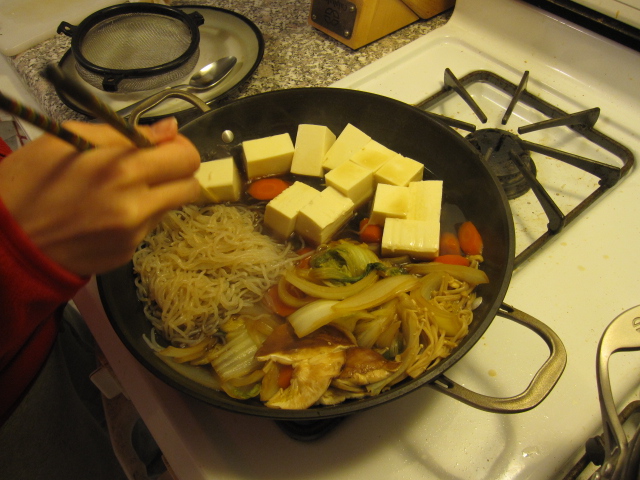
Then she added the rest of the ingredients minus the beef and let them cook for another 5 minutes or so. After that we moved the pan to our table-top burner and swished the beef in the boiling liquid. White rice on the side and cold beer in hand.

Read Full Post »

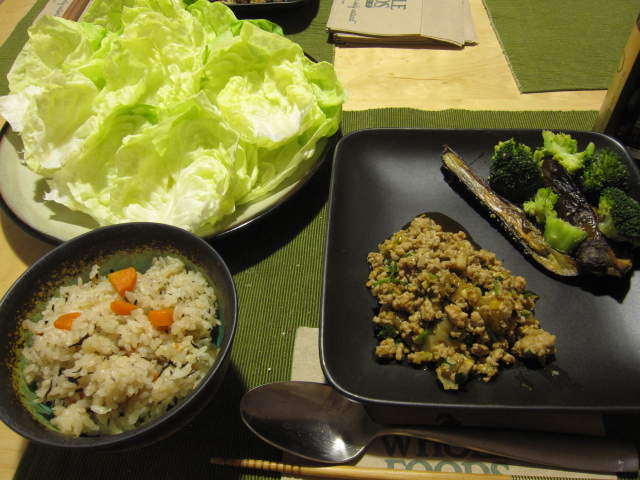
Stanley’s had these cute little Boston Lettuce heads for sale. The leaves looked perfect to make a wrap with. Then I remembered talking to Yuki about how we haven’t had ginger pork in a while, actually her craving for it. Sometimes I get it. Not often, but this time I did. What better way to put some ginger and pork together than in the buttery leaves of some fresh Boston Lettuce?

Laap is simply a Laotian ground meat dish. I can either be raw or cooked. This one is more of a Southeast Asian flavor instead of a typical laap. I used a handful of parsley chopped (cilantro would have been prefered, but I had to use up my parsley), 7 shiitake caps diced, 1 yellow bell pepper diced, 2 stalks of lemongrass tender innards thinly sliced, juice of 1 lemon (prefer lime but thought lemon would match parsley better), 1/2 inch ginger minced, 3 garlic cloves minced, 6 green onions sliced, 1 head of Boston Lettuce large outer leaves used for wraps while the small inner leaves were chopped up, 1 tablespoon fish sauce, 1 tablespoon of sesame oil, 1 tablespoon of sriracha, and 1.25 pounds of ground pork. I also used 1 tablespoon of soy sauce, but that wasn’t in the picture.

I heated up some vegetable oil and added the lemongrass, ginger, and garlic. I let them sizzle for about a minute and then added the pork. I broke the pork up as it cooked through, that took about 5 minutes. Then I added the shiitake, pepper, and green onion. I let those cooked down for about 3 minutes and then added the fish sauce, soy sauce, and sriracha. After the sauces cooked down for a few minutes I turned off the heat and stirred in the parsley, lemon juice, and sesame oil.  

For side vegetables planned on sauteing some baby eggplant and broccoli with garlic, but for some reason I ended up quartering the eggplant and roasting it at 350 degrees for about 20 minutes in sesame oil while steaming the broccoli with ground sesame seeds. I didn’t use the garlic.

The rice I made was Japanese style. Not really the best match, but not bad. In the rice cooker, once I rinsed 2 cups of rice and filled the bowl with the right amount of water I added 1 diced carrot and a few pinches of dried hijiki seaweed. I let it sit for about a half hour before turning the machine on. I made sure to mix the carrots and hijiki in well before serving.

Read Full Post »

Oden is Japanese home cooking at it’s finest as well as being a favorite winter-time treat. While the ingredients can vary, the basis of oden is to have a slightly salty dashi broth filled with fish cakes, daikon, konnyaku, hard-boiled eggs, and potatoes. Slowly simmered and warm in the belly, this is true comfort food. In Japan, it’s served at home, in restaurants, at street vendors, and you can even get it warm from vending machines (you can get anything in a Japanese vending machine, and I do mean anything!).

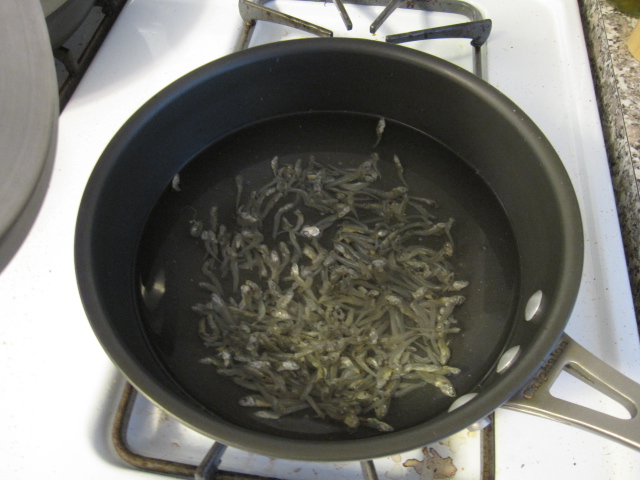
To start I made a good dashi broth. I used about 1/3 cup of dried anchovies, 3 tablespoons of mirin, 2 tablespoons of soy sauce, and 1 tablespoon of kosher salt. Most oden sets come with their own little packets of soy flavoring. They are usually pretty good, but it’s just as easy to do it yourself giving you more control over the flavor.

I let the anchovies simmer in 4 cups of boiling water for about an hour. I wanted every last bit of flavor out of the fish and into the broth.

I strained the broth and discarded the anchovies. Then I mixed in the mirin, soy, and salt.

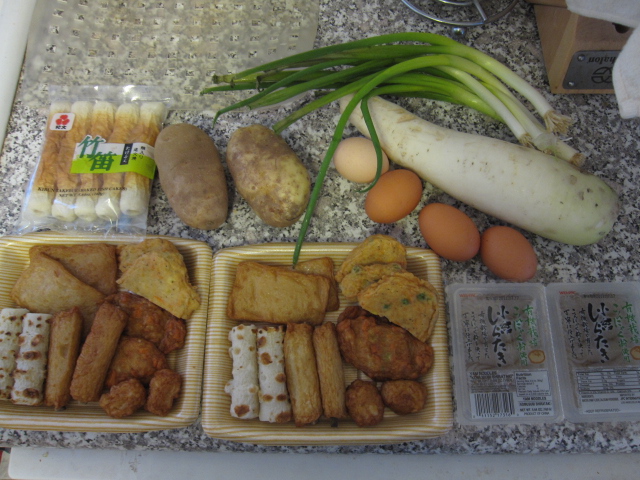
You can buy oden sets at any Japanese market and some Asian markets. We got two two-person sets that were on sale from Mitsuwa, each containing a variety of fish cakes. Some with carrot in them, some with burdock root, some grilled, most deep fried. We also had a package of chikuwa fishcakes that we used. I skinned and chopped two russet potatoes, medium boiled 4 eggs (just enough to peel the shell off, since they were going to simmer in the dashi for a while I didn’t want to overcook the yolk too much), 1 daikon skinned and chopped, a bunch of green onions chopped, and a couple packaged of shirataki konnyaku.

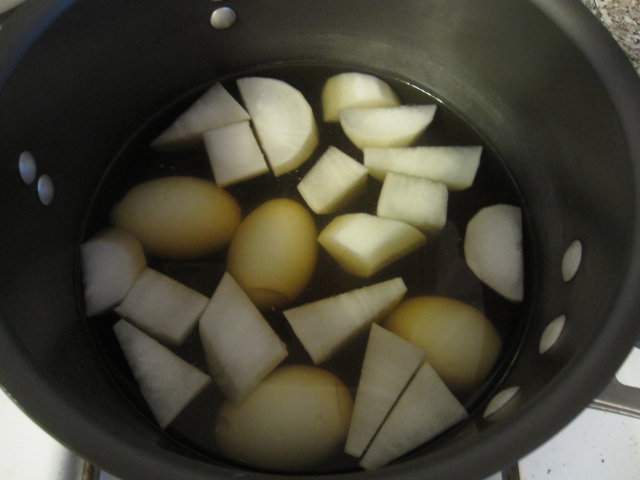
Once the dashi was ready I added the eggs and daikon and simmered them, covered, over a low heat for an hour. This allows both to absorb a lot of the dashi flavor.

Then I added the potatoes and konnyaku. If you boil the potatoes too long they will fall apart and melt into the broth. I only let them simmer for about 20 minutes. That’s also enough time for the konnyaku to take on some flavor. If you’re using sliced blocks of konnyaku instead of the shirataki noodles you’ll need to add them about 20 minutes earlier.

Since most of the fishcakes are deep fried before packaging they can sometimes have a little bit of grease residue. Because of that I boil and drain them seperately for a few minutes before adding them to the dashi, that gets rid of any unwanted oil. They also are fully cooked so just need to be heated up. After about 5 minutes in the dashi, along with the green onions, the oden is ready to go.

To serve it up I divied one of each for both of our bowls and then laddles some dashi on top. Oden is great with a cold beer and some white rice, I covered our rice with ground sesame seeds. I tell you though, oden is even better the next day. It is a stew, so once all of the flavors fully penetrate the ingredients you really have a special dish here. The daikon and egg for lunch today were outstanding!

Read Full Post »

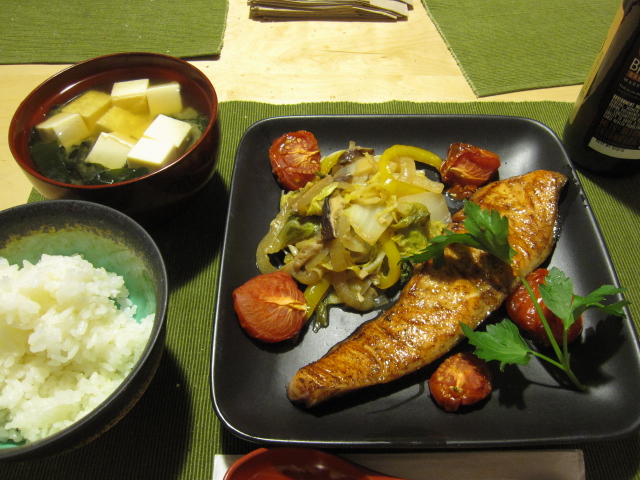
We journeyed up to Arlington Heights this weekend to stock up on Japanese ingredients, something we do at least once a month. At the Tensuke Market we saw this absolutely gorgeous salmon. They have the best seafood in town, hands down. This salmon was marbled like a real Kobe Ribeye, just made our mouths water. So, that was dinner last night.

We picked up a package of 3 quarter pound slices of filet (Yuki got lunch today, I didn’t get to enjoy that beautiful fish again). I made a quick marinade consisting of 1/2 tablespoon mirin, 1 tablespoon sake, and 1.5 tablespoons soy sauce. In a glass baking dish I let the salmon sit in the marinade while I got everything else ready.

For my veggies I used 1/2 onion sliced, 3 garlic cloves minced, 7 cherry tomatoes halved, 2/3 carton of shiitake sliced, 2 small yellow bell peppers sliced, and about 1/8 of a medium napa cabbage cut into chunks.

In a heated pan I melted about 1/2 tablespoon of butter and poured in 1 tablespoon of sesame oil. Once the butter was melted I added the onion and let it saute for about 5 minutes. Then, I added the garlic, shiitake, and bell pepper. About 5 more minutes and I poured in about 2 tablespoons of soy sauce and let that coat all of the veggies. Just before the soy was completely boiled off, about a minute or so, I added the napa cabbage. I let that wilt down a little for about 5 minutes, seasoned with a little black pepper, turned the heat to low just to keep everything warm, covered it, and let it sit while I cooked the salmon.

Oh, and during this time I had the tomatoes in the oven roasting at about 375 degrees, I did that for about 25 minutes. I also decided, at the last minute, to make a simple miso soup with some wakame and tofu. I just boiled some water with a little dashi seasoned soy, stirred in some miso, and added the tofu and wakame. That only takes a few minutes.

For the salmon I heated up my large skillet and melted a little dab of butter, just enough to lightly coat the surface of the pan. The salmon had enough fat that I didn’t want to add to much more, but I also didn’t want it to stick. So, a tiny amount of butter. I seasoned the salmon with some crushed white pepper and then seared one side for about 3 minutes. Then I flipped it all over and poured the marinade all over it. I let it cook for about 3 more minutes and then pur the salmon on a plate and served everything up, with white rice of course. I garnished with a piece of parsley (only because I have some in my fridge).

Read Full Post »

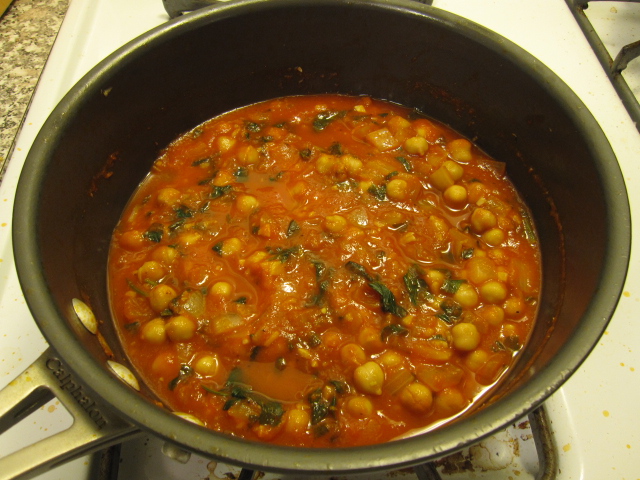
You can’t tell from the pic, but believe me, there’s a 1/4 lb cod filet under all of that chickpea and tomato sauce. This dish was based on a recipe from the old Jewish Ghetto of Rome called Tonne con Piselli. The original is tuna and peas.

For this dish I used a handful of chopped parsley, 1 tablespoon of coriander seeds ground, 1.5 cups of strained tomatoes, 1/2 onion diced, 5 garlic cloves minced, 14oz can of chickpeas, a bunch of haricots vert, 1 teaspoon of dashi-no-moto, and a 1 lb filet of cod.

I cut the cod into 4 portions and laid it in a glass baking dish. I sprinkled it with salt and pepper then let it sit while I prepared the rest.

In a hot pot I poured about 2 tablespoons of olive oil and then dumped the onion, garlic, coriander, and parsley in. I let that all saute for about 5 minutes before pouring in the strained tomato. I added the dashi-no-moto to 1/4 cup of hot water, let it dissolve, and then added it as well. You can use fish stock, but I didn’t have any, that’s why I used instant dashi. I let that come to a low boil, turned the heat down, and let it simmer for about 10 minutes. I drained the chickpeas, rinsed them off, stirred them into the sauce, and turned off the heat. I seasoned it with salt and pepper and then covered the fish with it.

I put it in a 375 degree oven for about 15 minutes. During that time I steamed the haricots vert. I served everything with white rice.

Read Full Post »

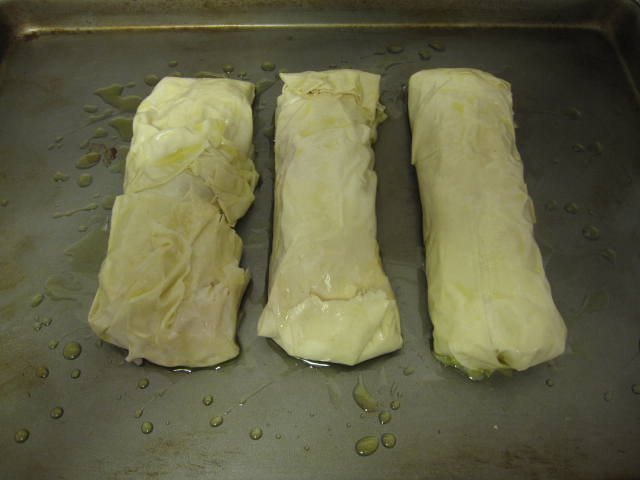
This recipe is based on an old Yiddish-a-bachur dish. I made a similar dish years ago at my old man’s house and thought it’d be good again. It was, but I might have made it a tad spicy for preggo’s taste buds. It’s that cayenne pepper I love so much. It didn’t turn out quite as pretty as I had wanted because the phyllo dough I had was pretty old and not as easy to work with as a fresh bought pack. I had to work faster than normal and didn’t get as many photos as I would have liked. Oh well, what can you do? It still tasted pretty damn good and that’s all that really matters.

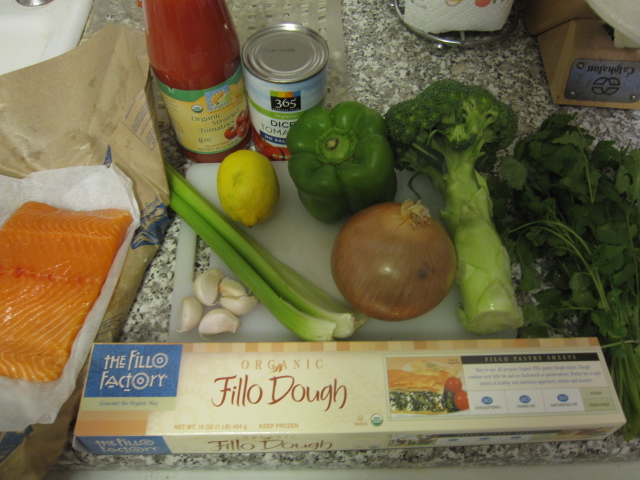
My ingredient list included 12 oz of skinned salmon that I cut into three portions (we only needed one lunch the next day instead of 2), 1/2 cup of strained tomato, 1 14 oz can of diced tomatoes, 5 garlic cloves minced, 2 ribs of celery chopped, the juice from half a lemon, 1 green bell pepper diced, 1/2 onion diced, 1 broccoli head broken down with stem skinned and chopped, a handful of cilantro chopped, and some phyllo dough (they spell it Fillo, take your pick).

Before I made the sauce I salted and peppered the salmon and then squeezed the lemon juice all over. I let it sit and rest while making the sauce. I heated up my sauce pan and added about 1 tablespoon of olive oil. I sweated down the onion, celery, and green pepper for about 7 minutes before adding the garlic and letting it saute for another 1 minute or so. Then I poured in the strained tomato and the canned tomatoes and let them boil down for about another 7 minutes. I grabbed my cayenne and ground cloves out of the spice rack and threw a few dashes of each in. Cut back on the cayenne if you want it less spicy. I seasoned with salt and pepper, turned of the heat, and stirred in the cilantro.

Working as fast as possible and using a moist dish towel to keep the phyllo from drying out I wrapped up the salmon. I layered 3-4 sheets on top of each other, topped it with a piece of salmon, spooned some of the sauce on top of the salmon, wrapped it all up, place it on an olive oiled baking sheet, and brushed more olive oil all over the phyllo to give it a nice golden color in the oven. I did this for all three pieces of salmon. Then, I put the sheet into a 400 degree oven for about 20 minutes.

I steamed the broccoli during the last 5 minutes of baking time and re-heated the rest of the sauce. To serve, I threw it all on a plate and slapped a bowl of white rice next to it.

Read Full Post »

Pregnant women need to snack. Fetus’s need nutrition. Fetus’s push against the digestive tracts of pregnant women. Sometimes you just need something to accommodate all three of these statements. That’s why I created this muffin yesterday. It’s packed full of healthy grains, probiotics, fiber…you know, things that keep the pipes running smoothly. And let’s be honest here though, these muffins aren’t just for pregnant women!

I used 1.5 cups of whole wheat flour, 1/2 pound of pitted prunes chopped up, 1/4 cup of sugar, 1/2 teaspoon of salt, 2 cups of plain kefir, 1.5 teaspoons of baking powder, and 1/2 cup of rolled oats.

In a large glass bowl I first mixed together all of the dry ingredients very thoroughly. Then, 1/2 cup at a time I stirred in the kefir until I had a nice smooth batter. After that I added the prunes and mixed them in. I poured them into my 12 muffin pan that had been lightly sprayed with baking spray and tossed them into a 400 degree oven. It took about 25 minutes for them to cook. I took a good night’s sleep for them to do their trick on me. I couldn’t be happier with the results of these muffins…both of the results.

Read Full Post »

« Newer Posts - Older Posts »