Feeds:
Posts
Comments

Posts Tagged ‘sake’

So, yesterday one of Yuki’s supervisors decided to take her crew out to dinner at Gyu-Kaku, a yakiniku joint downtown. That left me by myself to eat, drink, whatever. My plan was to meet up with a buddy of mine from the Playboy Pilot at Five Star for a couple of drinks, then pick Yuki up around 7 or so and grab a jumbo char dog from Portillo’s on the way home to absorb the alcohol in my stomach. Things didn’t work out as planned. About 7 I got a text that they JUST got to Gyu-Kaku! What? How long would I have to wait for a friggin char dog! Hungry, I took a couple of Chinese Steam Buns out of the freezer to tide me over for a couple of hours. Shortly thereafter I got a text asking me if I wanted to join them. Absolutely! So I cruised on down and got there as they were about to order dessert. Oh well, that didn’t stop me from eating some beef.

Since they were already drunk and I was a little drunk I didn’t really care what I ate. Doug, one of two white guys in Yuki’s group, ordered one of the Kalbi’s for me along with a beer. They’re having a Sakura Festival (Cherry Blossoms) special with $3 beer and 50% off harami skirt steak so I’m sure that’s what I got. All I know is that a dish with some beautifully marbled beef covered in sesame seeds showed up alongside a nice cold draft beer.

Then, the waitress showed up with some white rice, red leaf lettuce, and red miso so that I could eat the beef properly.

Since I was too busy helping Doug make fun of Eric, the other white guy in the group, Yuki grilled my meat for me. That’s how you know you got a good one…when she grills your beef so you can drink and have a laugh.

I took the lettuce, smeared some miso on it, topped it with the beef, and chowed down! Oiishii!!! No offense to Koreans, but the quality of the meat is so much better than anything I’ve had at a Korean BBQ. Tender and juicy, the way a good cow should be. I do have a groupon for Gyu-Kaku that I can’t wait to use so that I can eat other cuts of beef along with different animals, both with legs and with gills. Oh, some veggies too. Yuki told me that their ramen was pretty good too.

At any rate, the dessert they ordered were a bunch of different doriyaki ice creams. Bowls of ice cream with red bean paste served with pancakes and mochi that you grill. Good ice cream, but they burnt the mochi. (No Eric, it didn’t taste like shwag, it just tasted burnt)

As we were getting ready to leave another co-worker of theirs who wasn’t part of this group sent over two little bottles of sake for us. Between Doug, Eric, and myself it didn’t take long to polish those babies off. Mmmmm, sake!

The best part about Gyu-Kaku is that they use really strong down-draft ventilation systems for each grill. Those things suck that smoke right down. Unlike Korean BBQ’s what have over-table hoods, you don’t have to hop in the shower and wash your clothes immediately when you get home to rid yourself of the smoke. If you have a Jewfro sponge on your head like me, your hair will definitely appreciate that!

I do have a back story regarding Gyu-Kaku. It’s a chain that started in Japan and there’s one off of the train stop near Yuki’s parent’s house. A few of years ago Yuki and I had dinner there with her sister and brother-in-law. I remember the basil marinated chicken to be fabulous. I thought that this would do really well here in Chicago because all we had were Korean BBQ joints up on the northwest side of town. There wasn’t anything downtown. So, I went to their website and saw that they’ve already hit the west coast, that really got my hopes up that I could bring them here to Chitown. I sent them a nice long e-mail letting them know about the niche they could fill here, yada yada yada. I hear nothing back from them at all. A couple of years go by and Yuki texts me, “Gyu-Kaku is coming to Chicago”. Eh? Those bastards cut me out of the deal! That’s my idea! I felt like Kramer with his ocean cologne. The least they could do is feed me for free for life since coming here was my idea from the start. Oh well, what can you do. The food is good so I will definitely go back, especially since I’ve already paid for a groupon.

Read Full Post »

After a couple of nights eating out for Restaurant Week I decided to give our stomachs, as well as our wallets, a little bit of a break. Simple, cheap, and delicious, I made a stew with cod and vegetables. Warm stews like this are great for cold winter nights and are packed full of nutrients that won’t bulge your belly or bank account.

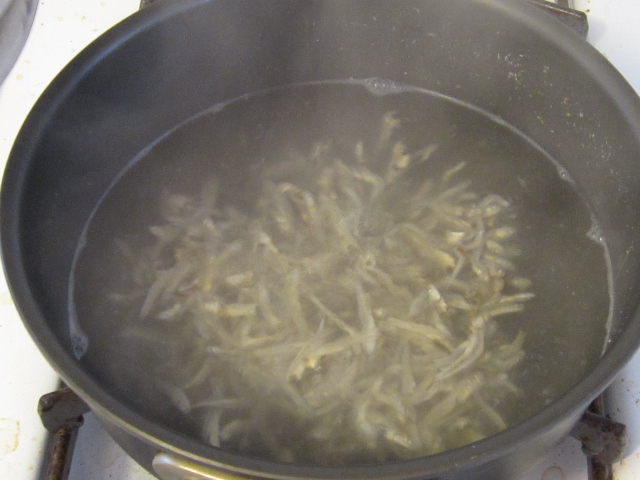
I started off with my typical dashi. I boiled 1/3 cup of dried anchovies in 3 cups of water for about 30 minutes and then strained out the fish. I really love making this dashi because it’s easy, healthy, and delicious.

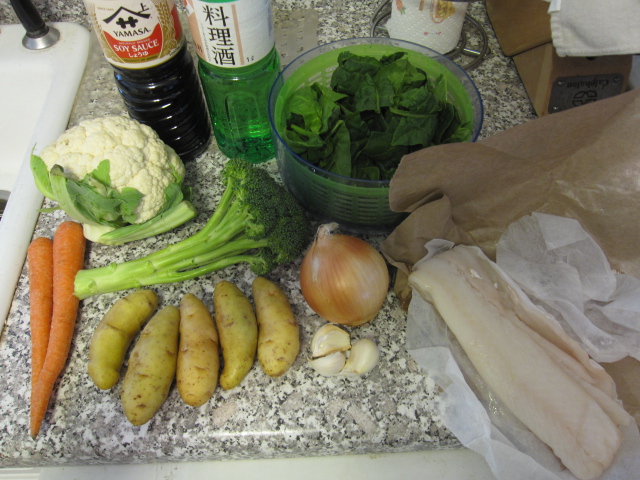
The rest of my ingredients included 2 carrots chopped, 1/2 head of cauliflower broken into florets, 1 head of broccoli broken into florets with the stem chopped, 5 large fingerling potatoes chopped, 1 onion large diced, 3 garlic cloves large diced, 5 ounces of spinach rinsed, 3/4 pound of cod cut into bite-sized pieces, 3 tablespoons of soy sauce, and 2 tablespoons of sake.

I heated up a stock pot and poured in about 2 tablespoons of olive oil. Once the oil was hot and shimmering I added the onion, carrot, and garlic. I let that all sweat down for about 3 minutes and then added the broccoli and cauliflower. About 2 minutes later I poured in the dashi, soy, sake, and a bay leaf and brought that up to a boil. Once boiling I added the potatoes and turned the heat down to med-low so that it could simmer for about 10 minutes. Then I added the fish and let it simmer for another 10 minutes before throwing the spinach in. Once the spinach was in I seasoned with pepper (no need for salt because of the soy in the broth), covered the pot, and let simmer for another 10 minutes. After that all I did was adjust the seasoning and serve it up with some white rice.

Just be gentle stirring after you add the fish, cod will flake apart.

Read Full Post »

Valentine’s Day…you gotta love holidays that are created for the sole purpose of capitalist pleasure. While the origins of Saint Valentine had absolutely nothing to do with lovers, today Hallmark sells millions of cards and Jared sells tons of ugly jewelry. Restaurants are always packed with their special Valentine’s prix fixe dinners. Extremely disappointed by every meal we’ve gone out for at Valentine’s this year I took the truly romantic way through the day of lovers and put my own hard work into a beautiful meal for the love of my life. I made a Japanese flavored Osso Bucco. Let’s be honest, is there anything sexier than slow-braised oxtails?

While I have never braised oxtails (actually cow tail, not an ox) the principles of braising are the same across the board. Brown your meat, saute your mise en place, and simmer it all together for a couple of hours minimum while keeping the braising liquid about 3/4’s of the way covering your meat.

To make this one Japanese flavored I used dashi and soy instead of beef stock and wine. To start I made my dashi. I put 3 cups of water and 1/4 cup of dried anchovies in a pot, brought it to a boil, covered it, turned the heat to med-low, and let it simmer for about a half hour. Then I strained out the anchovies and set the dashi aside.

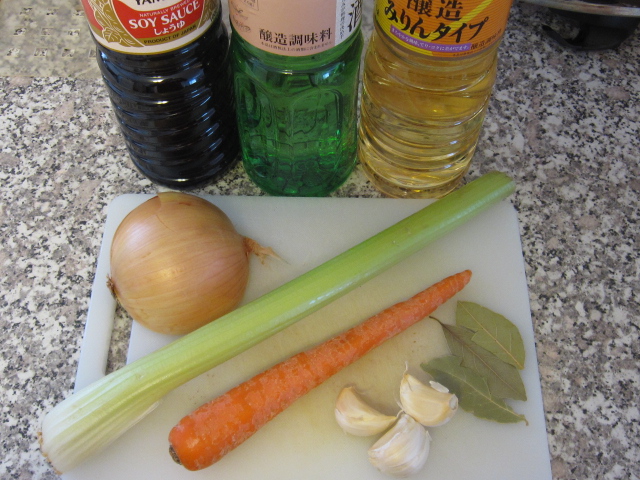
To flavor the dashi, my mise en place, I used 4 tablespoons of soy sauce, 3 tablespoons of sake, 2 tablespoons of mirin, 1/2 onion diced, 1 rib of celery diced, 1 carrot diced, 3 cloves of garlic smashed, and 3 bay leaves.

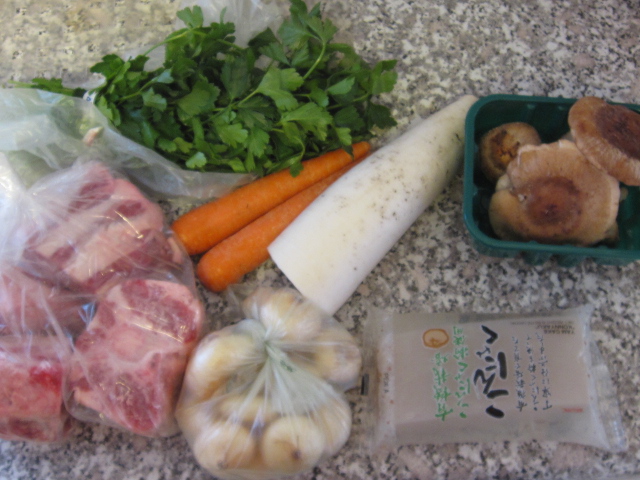
The ingredients I used to serve included 3 pounds of beef oxtail cut into 4 portions (have your butcher use his saw to get through the bone, I went to Olympic Meats for mine), about 1/4 cup of parsley chopped, 2 medium carrots chopped, 1 pound of daikon chopped, 12 cipollini onions skin peeled, 1 package of konnyaku, and 1 package of shiitake halved (large ones quartered).

To get started I heated up a few tablespoons of olive oil in my large stock pot. I dredged the oxtail pieces in flour (no need to season the flour since I used soy sauce, without soy sauce you’d probably want to season the flour with salt and pepper) and browned all sides for a couple of minutes. I did two at a time so as not to overcrowd the pot. I set the browned oxtails off the side.

Once the oxtails were all browned I added another couple of tablespoons of olive oil and added all of my mise en place. I sweated it all down for about 5 minutes. Then I put the oxtails in along with any accumulated juices on the plate and poured the reserved dashi in. Once the dashi came to a boil I let it rumble for a few minutes and skimmed the surface a few times for a clearer liquid. Once I finished skimming I added the soy, sake, and mirin. I covered the pot, turned the heat to med-low, and let it simmer for about an hour and 15 minutes.

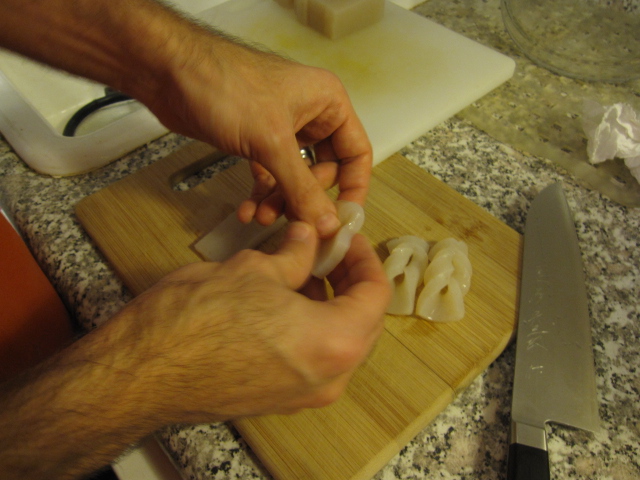
During this time is when I prepped all of my serving veggies. For the konnyaku I cut it in a very traditional Japanese way. I sliced the block into 1/4 inch strips. I put a slit in the middle of each and then folded inside of itself to make this braided shape. Not only does this add visual appeal, but I gives more surface for the konnyaku to absorb the flavors of the broth.

After the initial hour and 15 minute braising time I removed the oxtails and strained out all of the mise en place. With the back of a wooden spoon I squeezed out every last drop of flavor from the soft onion, celery, and carrot. I wiped out my stock pot, poured the strained broth back in, put the oxtails back in, put the serving veggies in, brought it up to a boil, covered the pot, turned the heat to med-low, and let it simmer for another 45 minutes. That was enough time for the daikon to absorb the broth flavors and become nice and tender.

To serve, I placed on piece of oxtail in a large bowl and surrounded it with broth and veggies. I sprinkled the parsley all over the top. On the side was white rice with ground sesame seeds and some seaweed salad (the same kind you get at your neighborhood sushi joint, I picked some up at the Mitsuwa Market).

As if I weren’t already in-love with myself, this dish made me fall heads-over-heals in-love with myself. I can only image what it did to my wife.

Read Full Post »

In order to solidify my role as a good Japanese housewife I decided to make another classic comfort dish from the Land of the Rising Sun. I haven’t made anything with squid in a long time and came across this recipe from a Japanese cook book that I have. Since I had a piece of daikon in my fridge that I needed to use, it all just seemed too perfect. And yes, I am perfect!

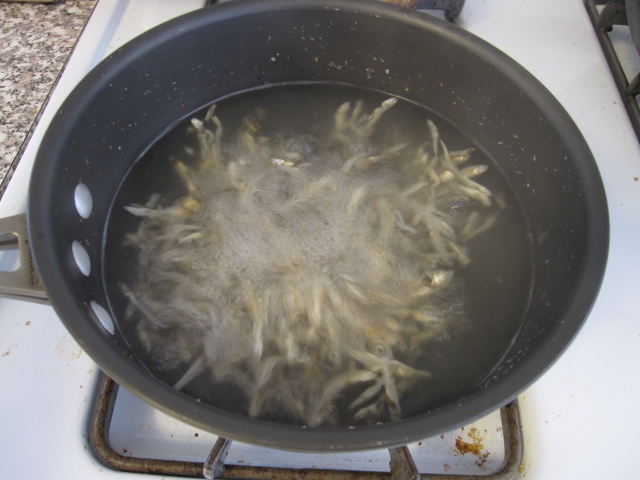
The first thing I need to do was make 3.75 cups of dashi. We don’t have any bonito flakes in our fridge, but we do have dried anchovy in our freezer that are also used for various types of dashi. In a soup pot I poured in a little more than 3.75 cups of water knowing that some would evaporate and added about 1/3 cup of the dried anchovy. I brought it to a boil, covered it, lowered the heat to med-low, and let it simmer for about 3o minutes. Then I strained out the fish and had a really nice flavorful dashi.

The rest of my ingredients for this dish included 4 tablespoons of soy sauce, 3 tablespoons of sake, 2 tablespoons of mirin, some lime zest, about 2 pounds of daikon, 1 pound of squid (body and tentacles), and 1 tablespoon of sugar.

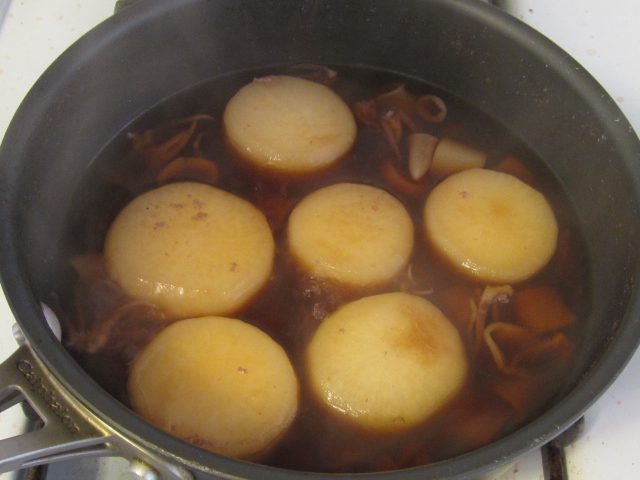
I cut the daikon into chunks about 1.25 inches thick and rounded the edges with a pairing knife. I’m not sure why they round the edges, maybe it allows the daikon to cook more evenly or maybe it’s just an aesthetics thing, but you probably don’t need to do it if you don’t want. Being the good Japanese housewife that I am, I went all out. I put the cut daikon into cold water then drained it just before cooking. That helps keep the texture firm. I sliced the squid bodies into 1/2 inch strips and cut the tentacles in half.

I put the daikon and squid into a heavy pot and poured the dashi in. I brought it to a boil and let it cook for about 5 minutes. Every 30 seconds or so I had to skim the surface to keep the dashi nice and clear. It’s amazing that 1 pound of squid seems to have more muck than a 3 pound chicken when boiling. So you really need to skim a lot.

Once the dashi cleared up I turned the heat to low and added the soy sauce, sake, mirin, and sugar. I covered the pan and let it simmer for about 45 minutes or so. Every few minutes I gave the pot a good shake to make sure the flavors of the dashi were well mixed.

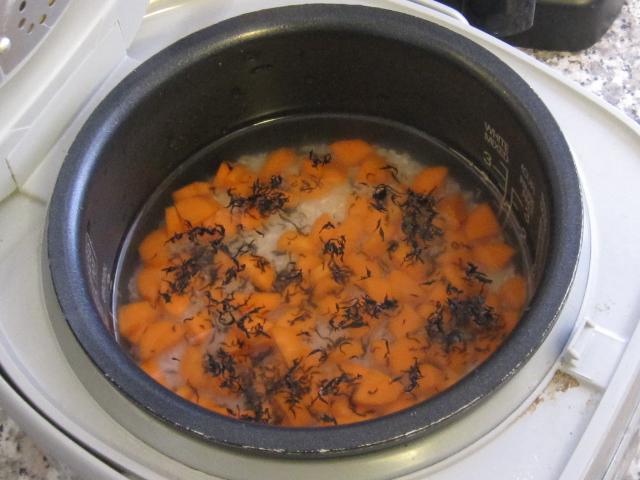
While the squid and daikon were simmering I made some hijiki-carrot rice. After rinsing 2 cups of rice and measuring out the liquid I added a tablespoon or so of dried hijiki and 1 chopped carrot. I let it sit for a half hour and then started the rice cooker. Actually, I had this ready to go before starting the squid and daikon. But I didn’t hit the start button until the simmering started for timing purposes.

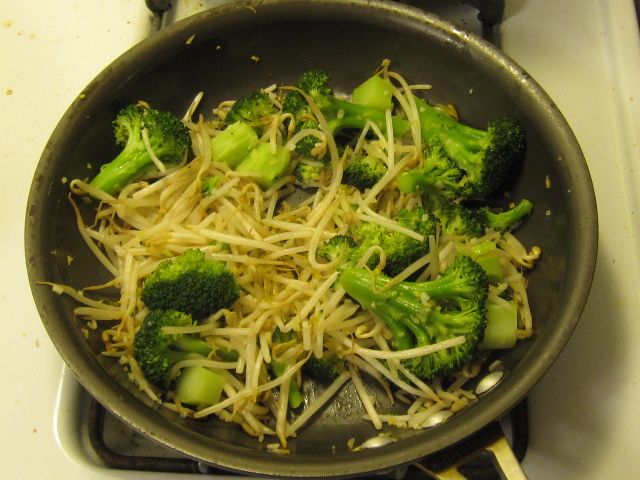
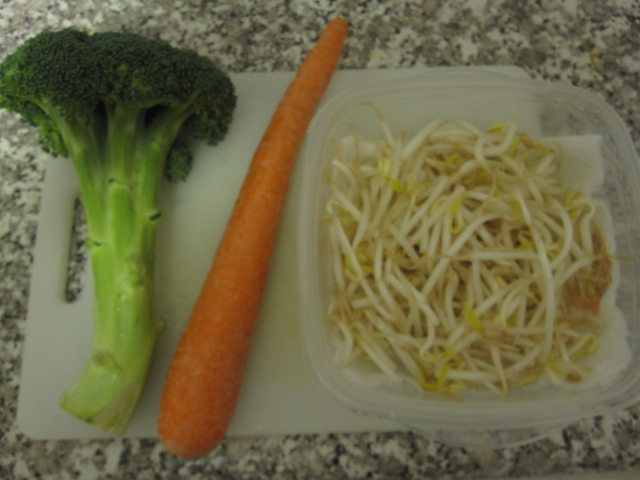
For a side dish to get more vegetables in the meal I made a simple stir-fry. I cut up 1 head of broccoli, had a couple of ounces of bean sprouts, 3 diced garlic cloves, and 1 inch of diced ginger.

I heated a skillet and added 1 tablespoon of sesame oil then added the garlic and ginger. After about 30 seconds I tossed in the broccoli and let it go for about 5 minutes before adding the bean sprouts. About 2 minutes later and it was ready to eat, just a sprinkle of salt and pepper was needed.

For serving I put some of the squid and daikon in bowls with some of the dashi. Then I grated some of the lime zest on top. Yes, as you can see in the picture I do have the hairiest arms you’ll ever see on a Japanese housewife…I hope. In Japan they’d use yuzu instead of lime, but I couldn’t find any yuzu at the store. The lime worked really well though. And the squid, oh brother the squid! It was so soft and tender it literally melted in our mouths. I haven’t had squid that good since we were in Nara, Japan over a year ago during squid season. And if you’ve never eaten daikon simmered in a soy-dashi broth you’re missing out on one of life’s finer flavors. This was the best meal I’ve cooked in a while. OIISHII!!!
Read Full Post »

Last night for dinner I made Japanese-style ginger pork with miso soup. The more I cook Japanese food the more I realize just how much healthier it is to American food. There is very little added fat and much more vegetable-to-meat ratio. Cooking Japanese-style food is extremely as well, not to mention delicious!

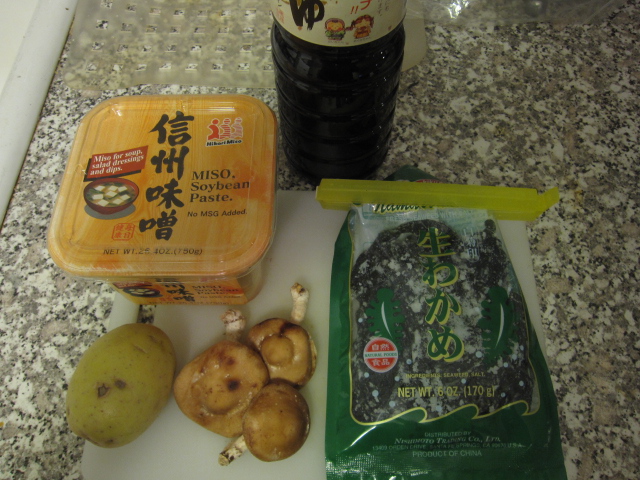
I first got my miso soup ingredients ready to go. I won’t go into great detail about making miso soup because I’ve done that a few times on this blog already. I poured about 3 cups of water into my pot and added 4 sliced shiitake, 3 chopped fingerling potatoes, 3 chopped green onions, and about 3 tablespoons of dashi soy sauce. I rinsed and soaked some salted wakame and added it to the soup at the end along with a large tablespoon of miso. The soup simmered over low while I cooked everything else, just enough time for the potatoes to cook.

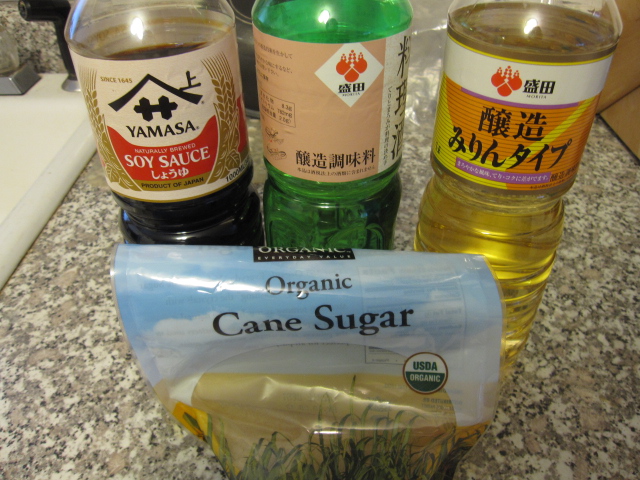
For the pork I used about 3/4 pound of snap peas, 3 ounces of bean sprouts, 1/2 onion sliced, 1 inch of ginger grated, 1 garlic clove grated, 2 tablespoons of soy sauce, 1 tablespoon of sake, 1 tablespoon of mirin, and 4 thin pork chops each about 3 ounces.

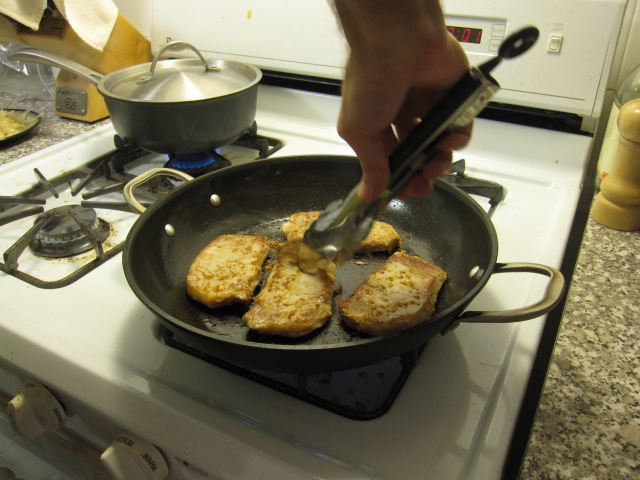
I mixed together the ginger, garlic, soy, sake, and mirin as the marinade. I let the pork sit in it for about 15 minutes or so. I heated up my large skillet and added about 1 tablespoon of vegetable oil and then cooked the onion for about 4 minutes. I took the onion out and rested it on a plate and then cooked the pork (reserving the marinade) for about 2-3 minutes per side. I rested the pork with the onion. I poured the marinade into the skillet to cook it down a little. I added about 4 tablespoons of water to help turn the marinade into a pan sauce and scrape up the bits from the pork, lots of flavor there you don’t want to lose.

Once the sauce had reduced a little bit, a minute or so, I added the snap peas and let them cook for about 5 minutes. After that I added the bean sprouts and the reserved onions.

I placed the pork on top, covered the skillet, and let it go for a few minutes while I mixed the miso into the soup. Then I plated it all up with some white rice. Yuki topped the rice with some ground sesame seeds.

So, we got 7 different vegetables into dinner with only 3 ounces of animal carcass. The only added fat was 1 tablespoon of vegetable oil split between 4 portions. No wonder America is a bunch of fat-asses while Japan is extremely fit and healthy.

Read Full Post »

Braised yakitori, kind of a misnomer. Yakitori translates to “grilled chicken”. I didn’t grill anything for this dish. Braised typically means cooking something in liquid over low heat for a long period of time. I didn’t do that either. What I did was make a standard yakitori marinade and cook some chicken thighs along with green onions in it. Why did I call this “Braised Yakitori”? Honestly, I just don’t know what else to call it.

First thing I did was make the marinade. In a small saucepan I poured in 5 tablespoons of soy sauce, 4 tablespoons of sake, 1 tablespoon of mirin, and 1 tablespoon of sugar. I brought it up to a low boil and let it gently simmer for about 5 minutes or so. I just wanted the sugar to dissolve and the marinade to thicken up slightly. After that I turned the heat off and let it cool down for about an hour, until it reached room temperature.

I minced up 2 garlic cloves and chopped up 6 green onions and 6 skinless and boneless chicken thighs. I mixed them all together in a glass dish and poured to marinade over. Covered with plastic wrap I put it in the fridge while I got the veggies and miso soup ready.

For the miso soup I only made 2 portions. We had some tomato soup leftover from Kasia’s that became lunch today, so I didn’t need to make too much. I used 1-1.5 tablespoons of miso, one yukon gold potato skinned and chopped, 3 shiitake sliced, 2 tablespoons of dashi flavored soy sauce, and some salted wakame. For the wakame, you have to rinse the salt off and then let it soak in cold water for about 10-15 minutes. I honestly cannot tell you how much I used, I just eye-balled it. You have to be careful though because it does get considerable larger as it absorbs the water.

In a small soup pan I poured in about 1.25 cups of water and added the dashi soy, potato, and shiitake. I let it simmer over a very low boil for about 20 minutes. That was just long enough for the potato to cook but not so long that it started to disintegrate.

Just before serving I put the miso in our little tea colander and swished it around for a few minutes until it all mixed into the soup. Using the colander keeps the miso from being chunky. But, this was right before serving (at which time I also added the wakame). Before I did this I made the veggies and cooked the chicken.

I kept the veggies very simple. I cut up 1 head of broccoli, sliced up 1 carrot, and rinsed about 2-3 ounces of bean sprouts. I got my steamer going and steamed the broccoli and carrot for about 5 minutes. After that I added the bean sprouts and let it go for another minute or so. A little sprinkle of salt and the veggies were ready.

To cook the chicken I heated up my pan and added about 2 tablespoons of sesame oil. When the oil was shimmering I just dumped everything in. It took about 9 or 10 minutes for the chicken to cook through and the sauce the thicken up a little. I seasoned with a little black pepper and that was all.

Of course, white rice accompanied the night’s chow.

Read Full Post »

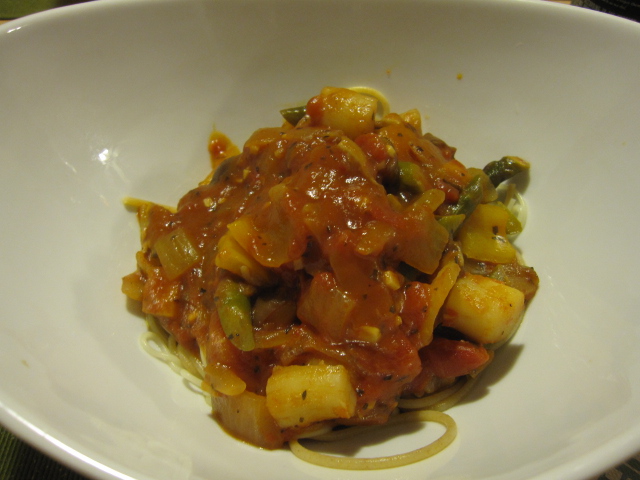
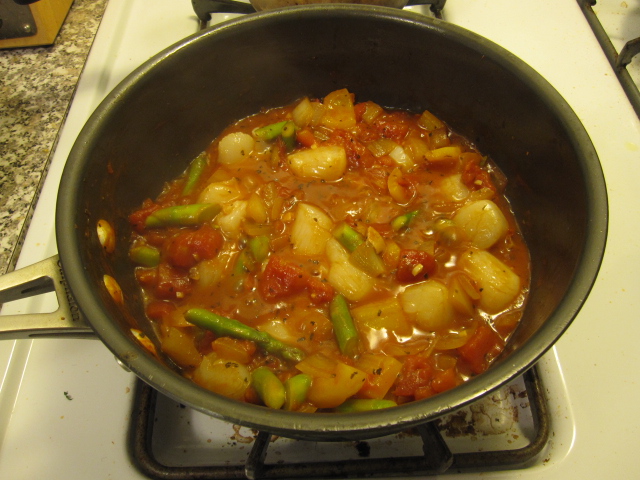
The other night I knew I wanted to make some spaghetti of some sort, but I wasnt sure what to do with it until I came across these beautiful little scallops. We haven’t had scallops in a while so I figured I’d just make a very simple tomato sauce with them and some vegetables.

Besides about 2/3 pound of scallops I chopped up 8 asparagus, 3 shiitake, 1/2 onion, 2 cloves of garlic, 1 yellow bell pepper, opened up 1 14oz can of diced tomatoes, and got out 1 tablespoon each of soy sauce and sake just to add a little umami.

This is about is simple as cooking gets. While I was boiling some salt water for the noodles, I used half angel hair and half wheat noodles, I heated up my pan and poured in about 2 tablespoons of olive oil. I sautéed the onion for about 5 minutes before adding the garlic, I let that go for another minute. After that I added the shiitake, pepper, and asparagus and let them go for another 5 minutes. I added the soy sauce and sake, let them boil off for about 1 minute, and then dumped in the tomatoes. Once the tomatoes were at a low boil I turned the heat down to medium and added the scallops. Scallops can be a little tricky here because if you overcook them they’ll become a bit rubbery. On the other hand, they do give off a lot of liquid so you need to boil some of that excess off. I let them go at a very low simmer for about 10 minutes and it worked out perfectly, but each stove top is different so you have to keep a close eye on it. At the very end of cooking I decided to add a little dried basil along with some salt and pepper.

Once I drained the noodles I just ladled the sauce on top. I had some wheat dinner rolls to eat with it.

Read Full Post »

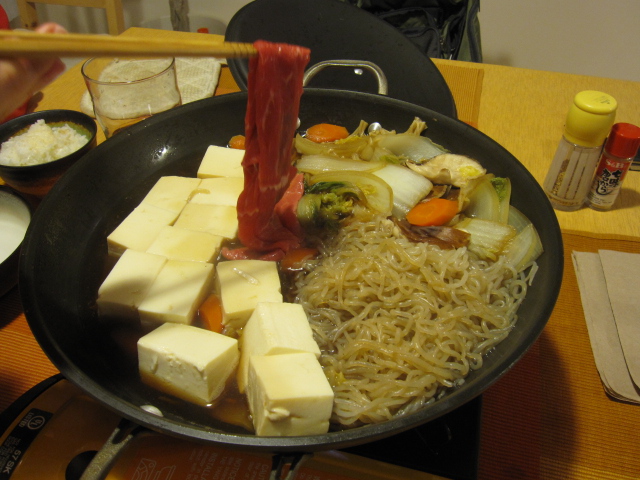
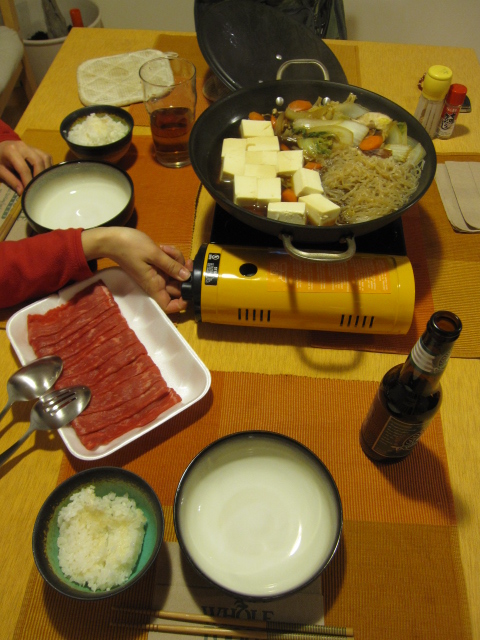
Just saying Yuki’s Sukiyaki is almost as much fun as eating it. Sukiyaki is a traditional family style one-pot meal in Japan. Vegetables are simmered in a sweet soy-based broth.

Then the pot is brought to the table and, over a table-top burner, thin slices of beef are swished around (similar to shabu-shabu) and cooked in the pot. Each individual has their own dish to put the beef and veggies in. It usually is mixed with a raw egg, but raw eggs aren’t good for prego so we omitted that.

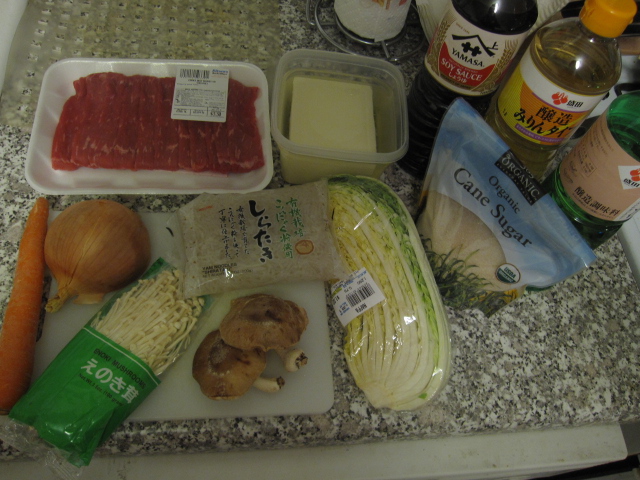
Ingredients for Yakiniku aren’t set in stone, what we used are pretty typical for the most part. I chopped up a carrot, quartered 1/2 onion, cleaned up 1 packet of enoki mushrooms, rinsed and cut up 1 packaged of konnyaku shirataki noodles, 2 large shiitake halved, 1/4 head of napa cabbage chopped, a little more than 1/2 pound of thinly sliced beef, almost 1 block of silken tofu large diced (I had previously used about 1/8th of it for miso soup, use as much as you like), about 5 tablespoons of soy sauce, 2 tablespoons mirin, 3 tablespoons sake, and 1-2 tablespoons of sugar.

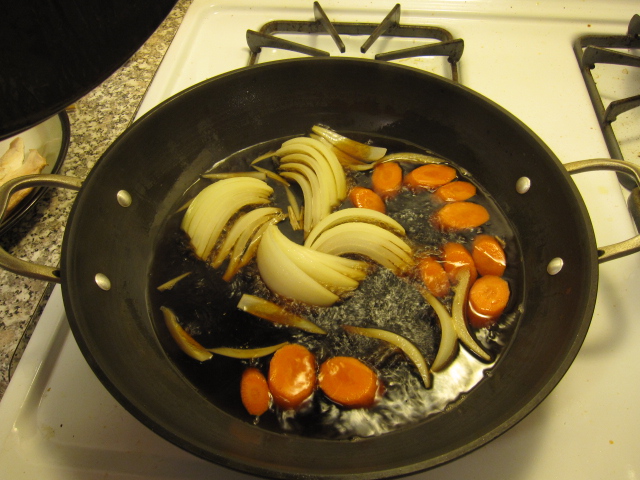
In our large pan Yuki poured in the soy, mirin, and sake along with about 1/4 cup of water. She added the sugar and brought it up to a simmer. The onion and carrot had the longest cooking time so they went in for about 5 minutes, covered.

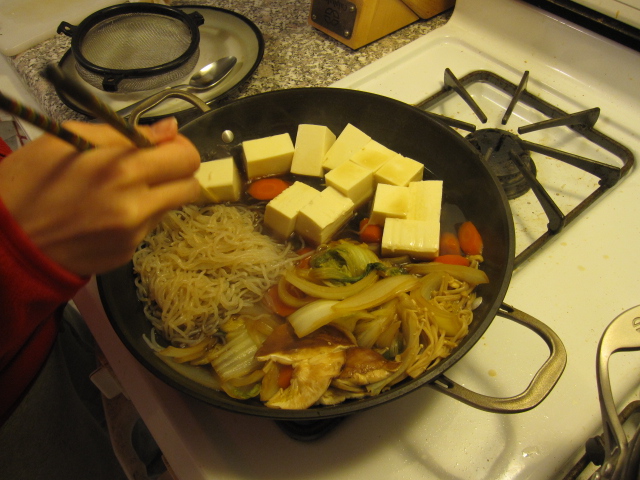
Then she added the rest of the ingredients minus the beef and let them cook for another 5 minutes or so. After that we moved the pan to our table-top burner and swished the beef in the boiling liquid. White rice on the side and cold beer in hand.

Read Full Post »

We journeyed up to Arlington Heights this weekend to stock up on Japanese ingredients, something we do at least once a month. At the Tensuke Market we saw this absolutely gorgeous salmon. They have the best seafood in town, hands down. This salmon was marbled like a real Kobe Ribeye, just made our mouths water. So, that was dinner last night.

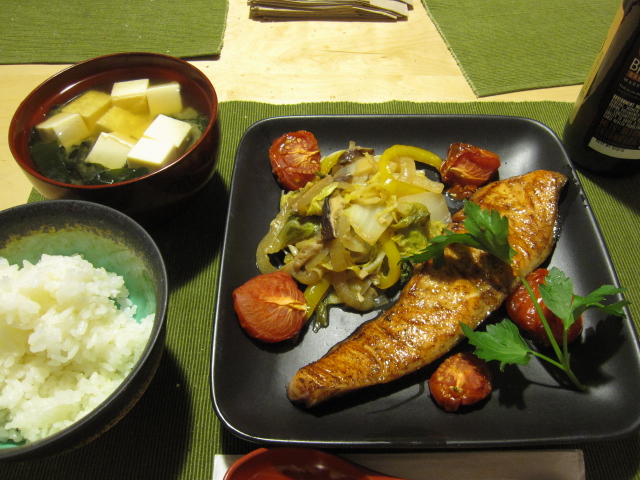
We picked up a package of 3 quarter pound slices of filet (Yuki got lunch today, I didn’t get to enjoy that beautiful fish again). I made a quick marinade consisting of 1/2 tablespoon mirin, 1 tablespoon sake, and 1.5 tablespoons soy sauce. In a glass baking dish I let the salmon sit in the marinade while I got everything else ready.

For my veggies I used 1/2 onion sliced, 3 garlic cloves minced, 7 cherry tomatoes halved, 2/3 carton of shiitake sliced, 2 small yellow bell peppers sliced, and about 1/8 of a medium napa cabbage cut into chunks.

In a heated pan I melted about 1/2 tablespoon of butter and poured in 1 tablespoon of sesame oil. Once the butter was melted I added the onion and let it saute for about 5 minutes. Then, I added the garlic, shiitake, and bell pepper. About 5 more minutes and I poured in about 2 tablespoons of soy sauce and let that coat all of the veggies. Just before the soy was completely boiled off, about a minute or so, I added the napa cabbage. I let that wilt down a little for about 5 minutes, seasoned with a little black pepper, turned the heat to low just to keep everything warm, covered it, and let it sit while I cooked the salmon.

Oh, and during this time I had the tomatoes in the oven roasting at about 375 degrees, I did that for about 25 minutes. I also decided, at the last minute, to make a simple miso soup with some wakame and tofu. I just boiled some water with a little dashi seasoned soy, stirred in some miso, and added the tofu and wakame. That only takes a few minutes.

For the salmon I heated up my large skillet and melted a little dab of butter, just enough to lightly coat the surface of the pan. The salmon had enough fat that I didn’t want to add to much more, but I also didn’t want it to stick. So, a tiny amount of butter. I seasoned the salmon with some crushed white pepper and then seared one side for about 3 minutes. Then I flipped it all over and poured the marinade all over it. I let it cook for about 3 more minutes and then pur the salmon on a plate and served everything up, with white rice of course. I garnished with a piece of parsley (only because I have some in my fridge).

Read Full Post »

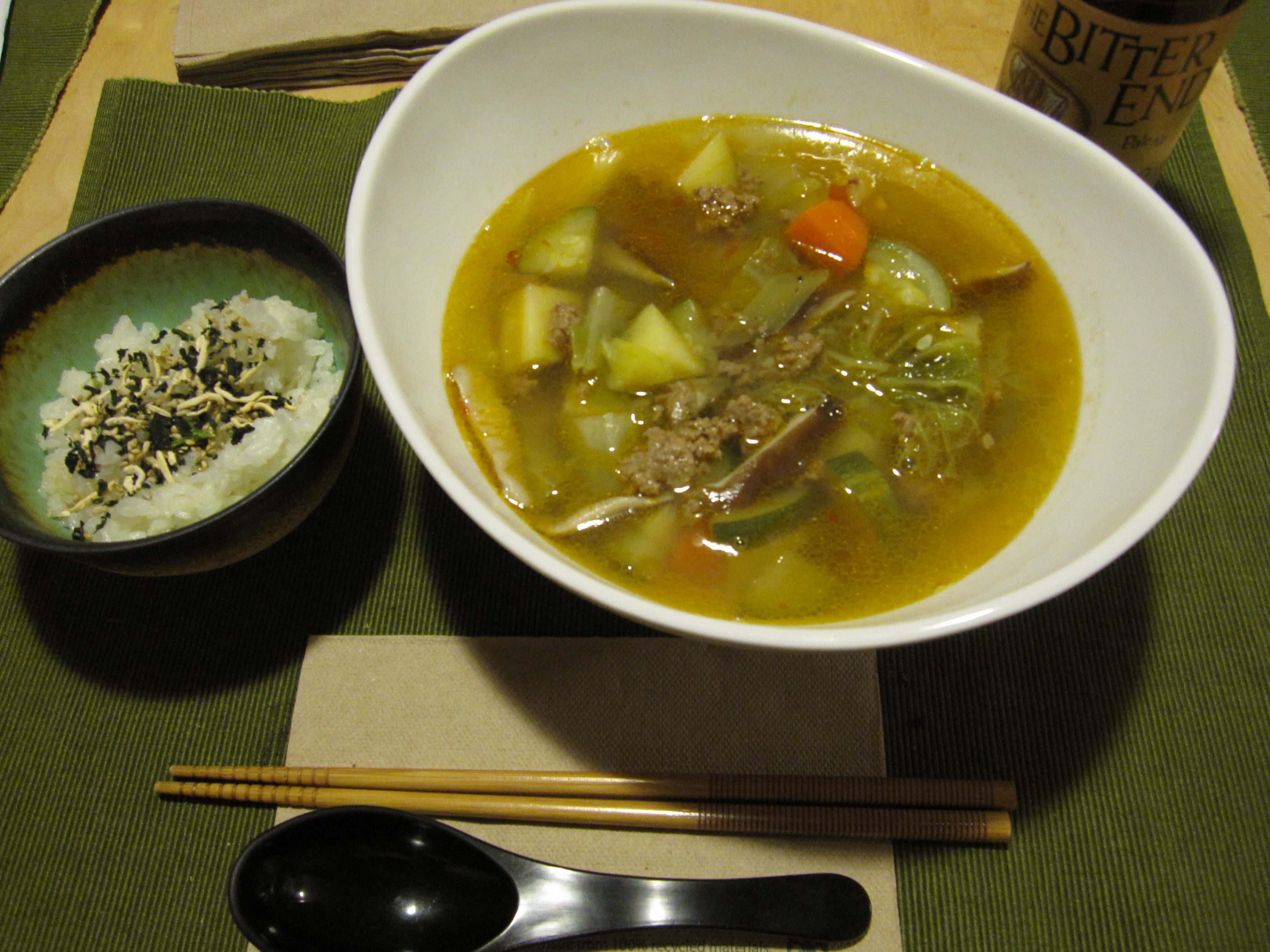
Last Friday night I made this soup for dinner. It is getting really cold here in Chicago, tis the season, and I thought a nice warm soup with tasty goodness and a little spice would hit the spot. This one is real easy and can accommodate almost any vegetables you have on hand. Since it was Friday night this recipe is only for 2 portions.

I used only about 1/3 pound of ground beef, 3 shiitake sliced, 1 clove of garlic diced, 1/2 inch of ginger slivered, 1/2  zucchini quartered and sliced, 1 carrot cut into chunks, 2 yukon gold potatoes skinned and chopped, 4 green onions cut in 1 inch lengths, 5 napa cabbage leaves chopped, 1 heaping tablespoon of Toban Djan, and 1 tablespoon of sesame oil.

In a small bowl I cut the garlic, Toban Djan, and sesame oil into the ground beef with a spoon. By doing this the beef will break apart nicely once you throw it into the soup.

I boiled 4 cups of water and tossed in the shiitake, carrot, potatoes, and green onions in. I let them simmer for about 10 minutes and then added the beef mixture. While beef was cooking I decided to pour in about 3 tablespoons of soy sauce and 1 tablespoon of sake to add a little depth to the broth. I let that simmer for about 5 minutes before adding the ginger, zucchini, and cabbage. About 5 more minutes simmering and the soup was ready.

I served it with some white rice that I sprinkled some mazekomi wakame shirasu, which is dried seaweed and little sardines. It adds some saltiness, crunch, flavor, and nutrients to rice. It’s usually used for onigiri, but I like to add to it plain rice sometimes.

Read Full Post »

« Newer Posts - Older Posts »