Feeds:
Posts
Comments

Posts Tagged ‘beef’

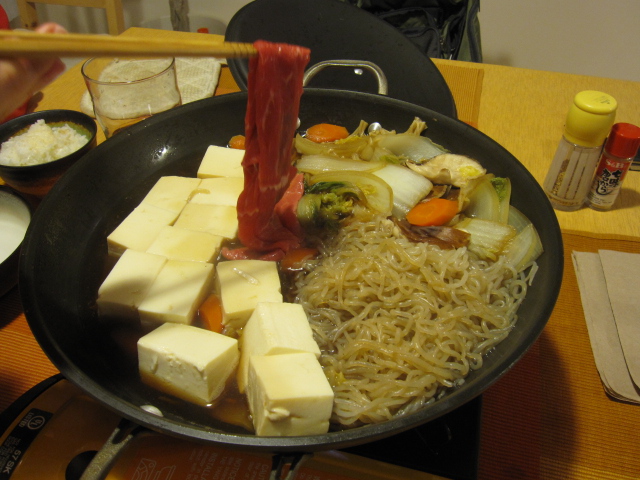
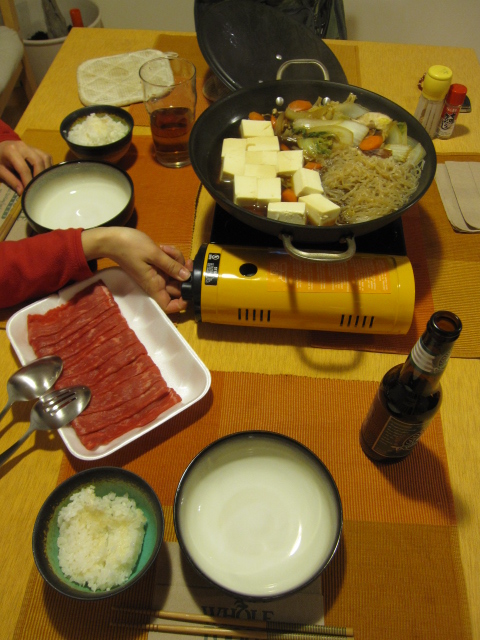
Just saying Yuki’s Sukiyaki is almost as much fun as eating it. Sukiyaki is a traditional family style one-pot meal in Japan. Vegetables are simmered in a sweet soy-based broth.

Then the pot is brought to the table and, over a table-top burner, thin slices of beef are swished around (similar to shabu-shabu) and cooked in the pot. Each individual has their own dish to put the beef and veggies in. It usually is mixed with a raw egg, but raw eggs aren’t good for prego so we omitted that.

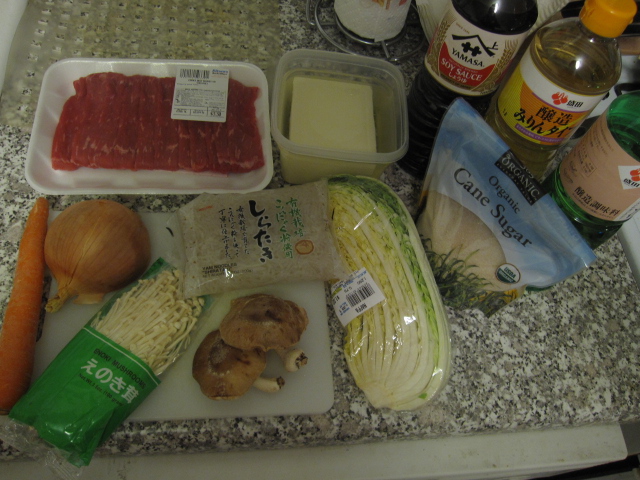
Ingredients for Yakiniku aren’t set in stone, what we used are pretty typical for the most part. I chopped up a carrot, quartered 1/2 onion, cleaned up 1 packet of enoki mushrooms, rinsed and cut up 1 packaged of konnyaku shirataki noodles, 2 large shiitake halved, 1/4 head of napa cabbage chopped, a little more than 1/2 pound of thinly sliced beef, almost 1 block of silken tofu large diced (I had previously used about 1/8th of it for miso soup, use as much as you like), about 5 tablespoons of soy sauce, 2 tablespoons mirin, 3 tablespoons sake, and 1-2 tablespoons of sugar.

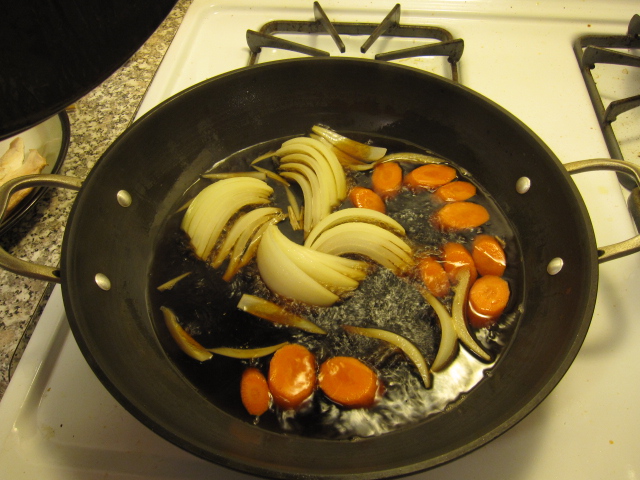
In our large pan Yuki poured in the soy, mirin, and sake along with about 1/4 cup of water. She added the sugar and brought it up to a simmer. The onion and carrot had the longest cooking time so they went in for about 5 minutes, covered.

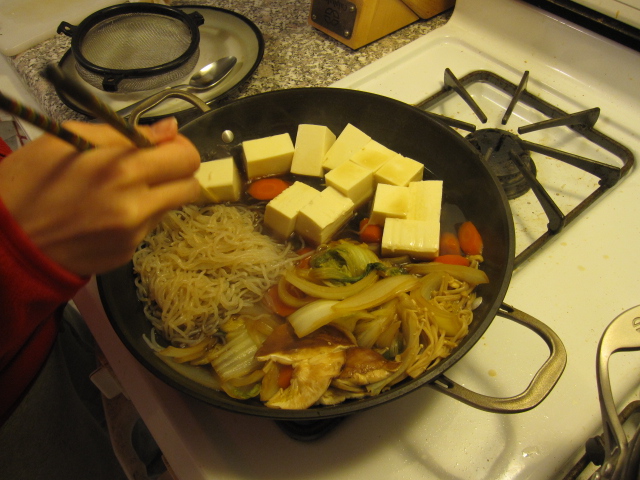
Then she added the rest of the ingredients minus the beef and let them cook for another 5 minutes or so. After that we moved the pan to our table-top burner and swished the beef in the boiling liquid. White rice on the side and cold beer in hand.

Read Full Post »

Last night I made a classic Beef and Barley stew. I didn’t quite make it using the classic ingredients though. Instead of potatoes I used sweet potatoes. Instead of the popular pearl barley I used hulled barley. Instead of stew meat, usually beef from the round or chuck roast, I used brisket. Oh brisket, how I love thee! I did this for health reasons as sweet potatoes have more nutrients than regular ones and hulled barley is a whole grain that still has the germ, it has 8 essential amino acids. While brisket isn’t any healtheir than typical stew meat it’s all about flavor and texture.

My ingredient list included 3 medium sized sweet potatoes skinned and chopped, 1 tablespoon of dried oregano, 2 medium sized carrots chopped, 3 stalks of celery chopped, 1 tablespoon of worcestershire sauce, 1 onion chopped, 2 cups of beef stock, 2 medium sized parsnips chopped, 5 cloves of garlic diced, 1 14oz can of peeled whole tomatoes, 1/2 cup of rinsed hulled barley, 2/3 cup of edamame, and 1 pound of brisket cubed. Not in the picture are 1 tablespoon of flour, 2 bay leaves, and 2 tablespoons of olive oil.

I started by heating up my stock pot. Once hot I poured in the olive oil, added the brisket, and sprinkled the flour on top. I stirred it all around just until the surface of the beef turned brown and no longer pink. Then I added the onion, celery, and garlic and sweated them down for about 5 minutes. After that I poured in the stock, added the bay leaves, brought it up to a boil, covered, turned the heat down, and let it simmer for about an hour.

Once the hour passed by I tossed in the barley, sweet potatoes, carrots, parsnips, worcestershire, and oregano. I let that come back to a boil and let it simmer for another 45 minutes.

Finally, I added the edamame and tomatoes with their juice. I took each tomato out one at a time and broke them up with my hands as they dropped into the stew. Once everything was mixed in I seasoned with salt and pepper and let it stew for about 15 more minutes to bring it all together.

A couple slices of toast, a bowl of hot beef and barley stew, and a nice cold beer and that’s all she wrote.

Read Full Post »

Friday night Yuki and I took advantage of another Groupon we had purchased a while back. Gotta love Groupon, great opportunities to try new places at a discount. This one was for an Ethiopian restaurant we haven’t tried yet, Demera. We love Ethiopian food and had read good things about Demera, so it was one of those things that had to be done.

Apparently we weren’t alone in our love for Ethiopian food. We didn’t have a reservation and when we got there, about 6:30 or so, we were told there was a 15-20 minute wait. No worries, we had just driven all the way up to Lawrence and Broadway, no way were we going to turn back. A few minutes of waiting and the manager came by and said there would be a 35-45 minute wait. Eh? How’d it get longer? It ended up only being about 15 minutes, so I’m glad we stuck it out.

Typically a beer drinker with Ethiopian food I saw that they have house made honey wine. Had to give that a try. Not so sure I’m glad I did. It wasn’t bad, but I wouldn’t say it was good either. Honey fermented with hops. It was like a honeyweiss without the bubbles. Not a big fan of honeyweiss. Oh well, it was tolerable. Next time I’m sticking with beer though.

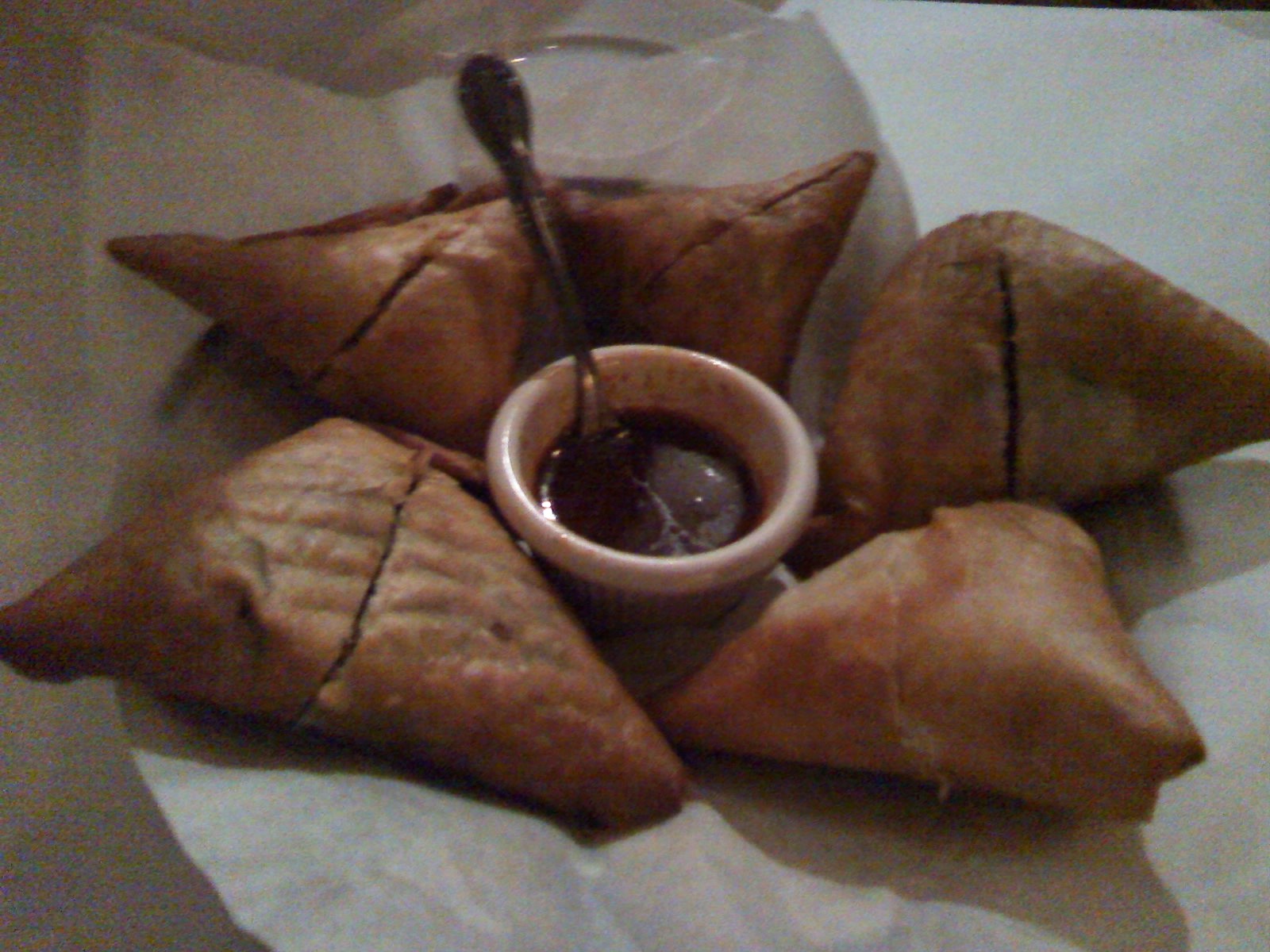
We started off with the Sambussa Sampler. Basically it’s one each of their sambussas…beef, chicken, tuna, lentils, and spinach. Served with a spicy little chili sauce they were all very good. Simple, but delicious and homemade.

For the main course we had to go with the Messob, traditional communal dining. That way we could sample a bunch of different items instead of each of us ordering 1 dish. Plus, it’s the Ethiopian way to eat. Why eat American-style at an ethnic restaurant? Starting at the top and going clockwise we got the quosta (spinach), ye-shimbra assa (ground chickpeas), michetabish (ground beef), ye-salmon dulet (salmon with homemade cottage cheese), doro wat (chicken and hard-boiled egg in berbere, Ethiopia’s national dish), lega tibs (lamb with rosemary), and a salad in the center. Of course, everything was served on top of a piece of injera with plenty of injera on the side to grip and scoop our food. We couldn’t finish everything, but we expected that. Gotta love Ethiopian leftovers the next day, yet another similarity between Ethiopian food and Indian food (simmered food, communal dining, similar spices, same upset stomach, etc.).

In all honesty, we probably could have finished our dinner, but not only would we have missed out on leftovers, we would have missed out on dessert! We decided to split the hibist volcano. I’ve never had hibist bread before. It’s very much like a thick sweet roll. If it weren’t for the refreshingly cold ice cream on top I don’t know that we could have eaten it all. The spiced lemon sauce was really good as well.

Overall, everything we ate was delicious! Would I call Demera the best Ethiopian food in Chicago? I don’t know about that. Ras Dashen and Abyssinia are right up there as well, I don’t think you can go wrong with any of the three. I think it all depends on what you are looking for. If I were in the mood for doro wat I would go to either Ras Dashen or Abyssinia. If I wanted seafood I’d come to Demera (the salmon was fantastic with the jalapeno and cheese). It’s really a toss-up. I’m sure I’ll be back at all three at some point in my life, and my digestive system will be all the better for it.

Read Full Post »

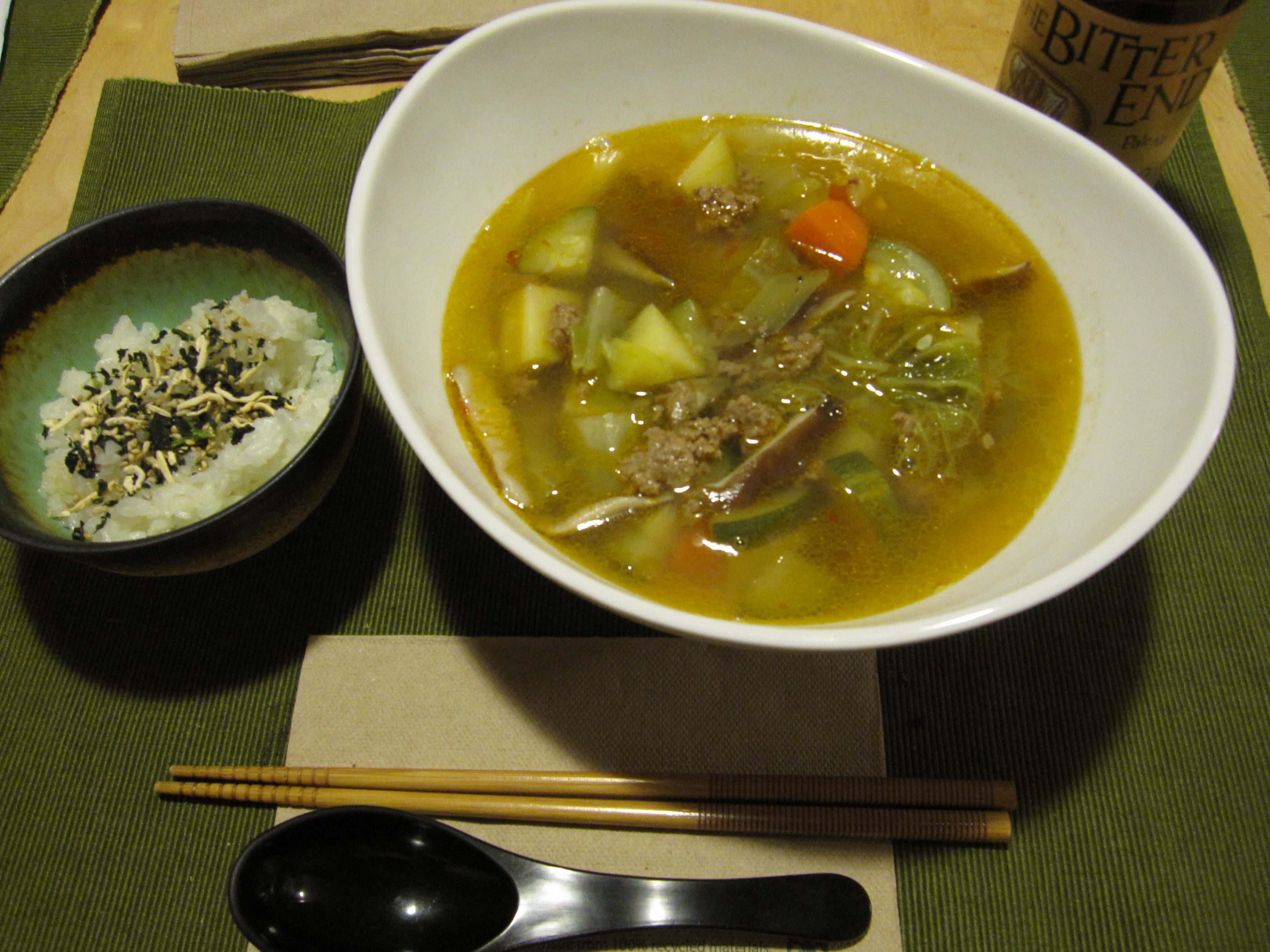
Last Friday night I made this soup for dinner. It is getting really cold here in Chicago, tis the season, and I thought a nice warm soup with tasty goodness and a little spice would hit the spot. This one is real easy and can accommodate almost any vegetables you have on hand. Since it was Friday night this recipe is only for 2 portions.

I used only about 1/3 pound of ground beef, 3 shiitake sliced, 1 clove of garlic diced, 1/2 inch of ginger slivered, 1/2  zucchini quartered and sliced, 1 carrot cut into chunks, 2 yukon gold potatoes skinned and chopped, 4 green onions cut in 1 inch lengths, 5 napa cabbage leaves chopped, 1 heaping tablespoon of Toban Djan, and 1 tablespoon of sesame oil.

In a small bowl I cut the garlic, Toban Djan, and sesame oil into the ground beef with a spoon. By doing this the beef will break apart nicely once you throw it into the soup.

I boiled 4 cups of water and tossed in the shiitake, carrot, potatoes, and green onions in. I let them simmer for about 10 minutes and then added the beef mixture. While beef was cooking I decided to pour in about 3 tablespoons of soy sauce and 1 tablespoon of sake to add a little depth to the broth. I let that simmer for about 5 minutes before adding the ginger, zucchini, and cabbage. About 5 more minutes simmering and the soup was ready.

I served it with some white rice that I sprinkled some mazekomi wakame shirasu, which is dried seaweed and little sardines. It adds some saltiness, crunch, flavor, and nutrients to rice. It’s usually used for onigiri, but I like to add to it plain rice sometimes.

Read Full Post »

Belly Shack has been open for, I don’t know, a little more than a year now. I remember freezing my nads off with my buddy Nick early last winter walking 2 blocks from his place for our first taste. I’ve been there at least a half-dozen times since. But this weekend Yuki and I met up with one of our friends there and they both wondered why I haven’t blogged about it yet. So ladies, here it is, my blog about Belly Shack.

Located right under the Western “L” stop this is Chef Bill Kim’s second joint. Like its counterpart, Urban Belly, Chef Kim fuses Asian and Latin seamlessly. It’s also similar to Urban Belly in that it is counter service, communal dining, and recycled fixtures. They differ in that Urban Belly is based on ramen noodles while Belly Shack is sandwiches.

During this trip I ordered the special that they had running, a pulled pork sandwich with pickles. I’m not a big pickle guy, so Yuki polished those off for me. The sandwich was fantastic though. Pulled pork served with sautéed mushrooms, bean sprouts, melted cheese, cilantro, salsa verde, and Korean chili paste. My only problem with it was that they cut the pita bread and served it like a Western-style sandwich. With all of the juice it was a sloppy sandwich. It would have been better served Middle Eastern-style stuffed into the pita. Oh well, still a delicious sandwich well worth gorging on.

Yuki ordered our favorite sandwich on their menu and one of the best sandwiches in all of Chicago, the Asian Meatball. Juicy, tender meatballs of pork and beef served inside a pita with somen noodles, bean sprouts, mint, and Korean chili paste. Just thinking about this sandwich makes my mouth water.

Our friend ordered the Korean BBQ Beef. Extremely tender beef that just falls apart. The beef has sliced scallions and fried garlic chips on top along with some ssam paste. Next to it is kimchi and some flat bread. For this dish you make your own little sandwiches, much more Asian in presentation. I have no beef with this dish, it was outstanding.

She also ordered the Togarashi Fries. French fries topped with togarashi and lime zest served with a curry mayonnaise.

Belly Shack isn’t the cheapest sandwich in town at $9 a pop, but you’ll be hard-pressed to find a more flavorful, well prepared one. This place is definitely worth the visit.

Read Full Post »

One of the great things about meatloaf is that you can do pretty much anything you like with it. You can use any kind of ground meat, vegetables, sauces, etc. It’s also extremely simple to make. I have some rosemary still growing on my back porch and with the weather starting to cool down here I figured I should use it up before my plant dies. With that in mind I decided to make a very straight-forward meatloaf and use up the rosemary, although I still have some left that needs to be used within the next week or so.

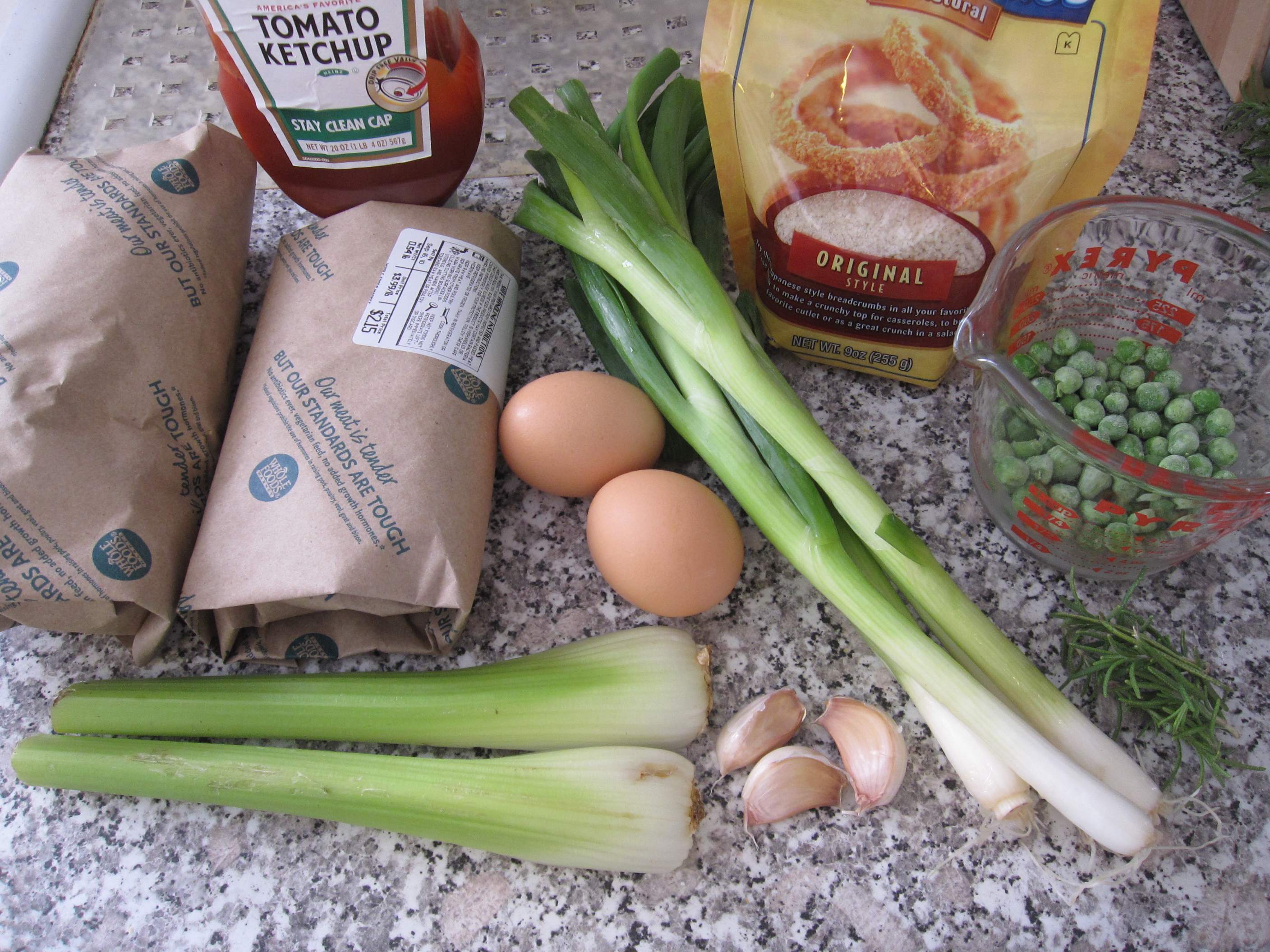
My ingredient list includes 1.5 pounds of ground beef (20% fat), 1/5 pound of ground pork, 2 small celery ribs diced, ketchup, 2 eggs beaten, 3 cloves of garlic minced, a bunch of green onions sliced, panko, 1/2 cup of frozen peas, and a bunch of rosemary chopped.

In a large glass bowl I mixed together the ground meats with the celery, eggs, garlic, green onions, peas, rosemary, and some salt and pepper. Once it was all good and mixed I let it sit for about 15 minutes to let the flavors settle.


Once the meatloaf settled a little I shaped it into a loaf and put it into a loaf pan. I squeezed some ketchup on top and brushed it to cover the entire top surface. Then I sprinkled some panko over the ketchup. I put it in a 350 degree oven and let it cook for about an hour.

For some side vegetables I used 1.5 carrots chopped, 1/2 onion sliced, a bunch of haricots vert, and some more chopped rosemary.

I simply laid vegetables out in a roasting pan, drizzled them with olive oil, and seasoned them with salt, pepper, and the rosemary. I put them in the oven for about a half hour.

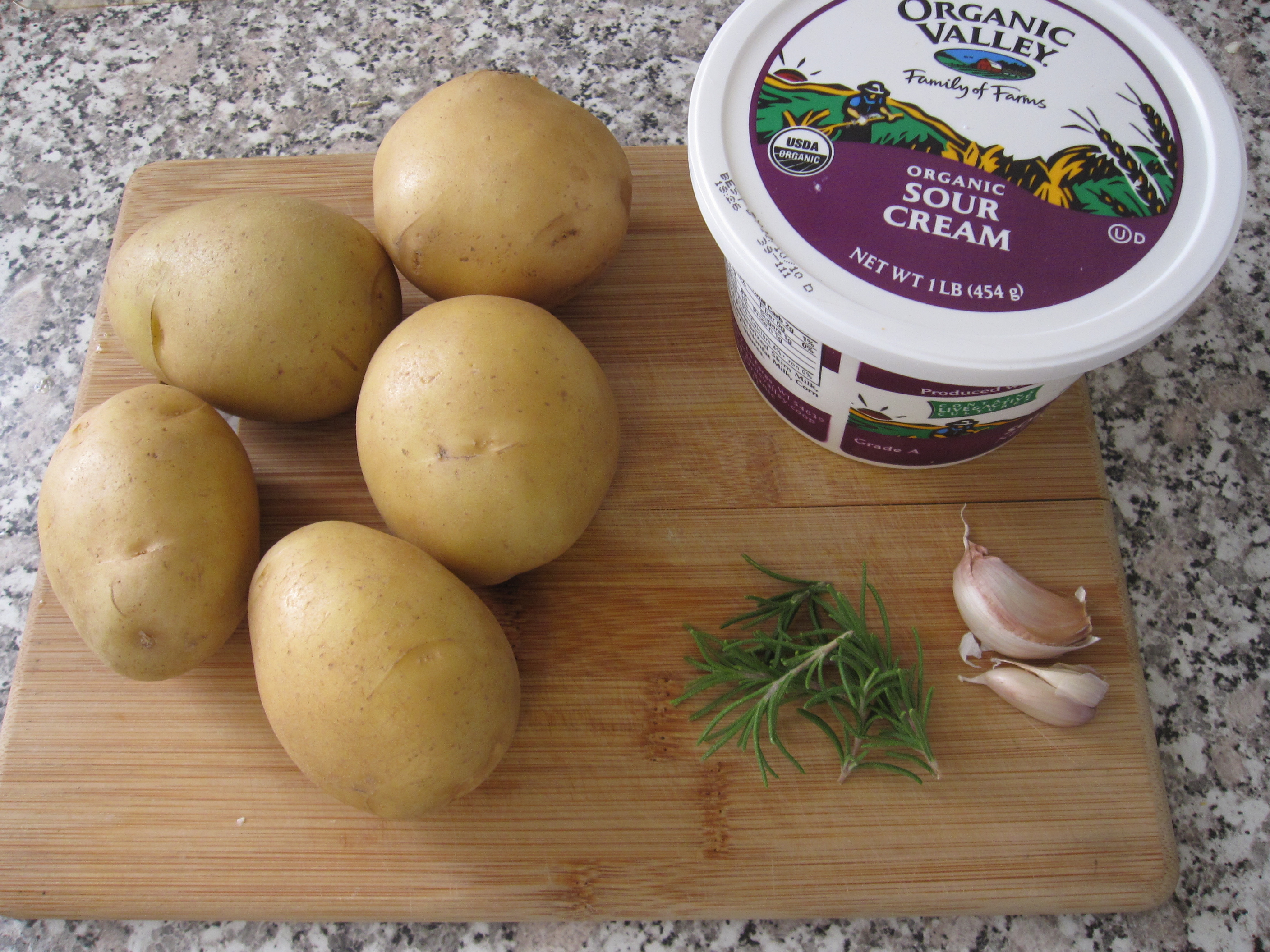
Once I got the vegetables in the oven I boiled some water and salted it. I took 5 good-sized Yukon Gold potatoes and skinned them then chopped them into quarters and dropped them in the boiling water along with 2 garlic cloves cut in quarters as well. I let them boil for about 10-15 minutes. Before draining them I reserved a cup of the water. After draining them I put the potatoes and garlic back into the pot, scooped about 1/3 cup of sour cream in, about 1/2 cup of the reserved water (didn’t need the rest but had it there in case I wanted to thin out the mashed potatoes), salt, pepper, and more chopped rosemary. With my potato masher I mashed it all up till they were smooth and creamy.

Read Full Post »

Last night Yuki and I went to see RUSH at Northerly Island. What a great band! Because of that I didn’t cook Meatless Monday, though I did eat a falafel sandwich with some babaganoush before the show to keep with the theme. I tell ya, being at the concert really drove home the point that all Americans need to adopt a healthier diet as at least 75% of the concert goers were way overweight. That might be an understatement too. Concert seats are only so big and literally everyone around us was well over 200 pounds. I felt claustrophobic at time. America, start eating healthy well-balanced diets!!! But that didn’t stop us from enjoying the show. At any rate, I’m going to blog about the dinner we had Saturday night.

We were out in Schaumburg so that we could stop at the Tensuke Market, which is actually in Elk Grove, but just south of Mitsuwa. It’s smaller than Mitsuwa but sometimes has better deals and has the absolute best retail seafood in the Chicago area. If you want to make sashimi at home, I highly suggest making the trek to Tensuke for your fish. There’s a restaurant called Daruma that Yuki had wanted to try for a while so we decided to give it a try. Honestly, walking through the doors was almost like walking into Japan. I mean that in every good way possible.

The decor is very traditional of casual dining in Japan. The Japanese don’t put a whole lot of stock into gaudy decor, instead they prefer to focus on high quality food. The walls were poorly painted, the tables and seats a little worn down, cheap napkins (in Japan you usually don’t find any napkins). It really felt like a restaurant in Japan. Made me feel homesick even though I’m not Japanese.

Service was pretty good. All Japanese servers, but bi-lingual so don’t worry. It was the food that starred though.
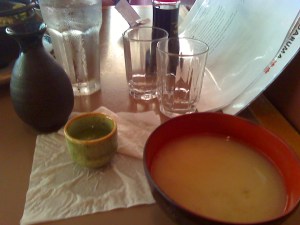
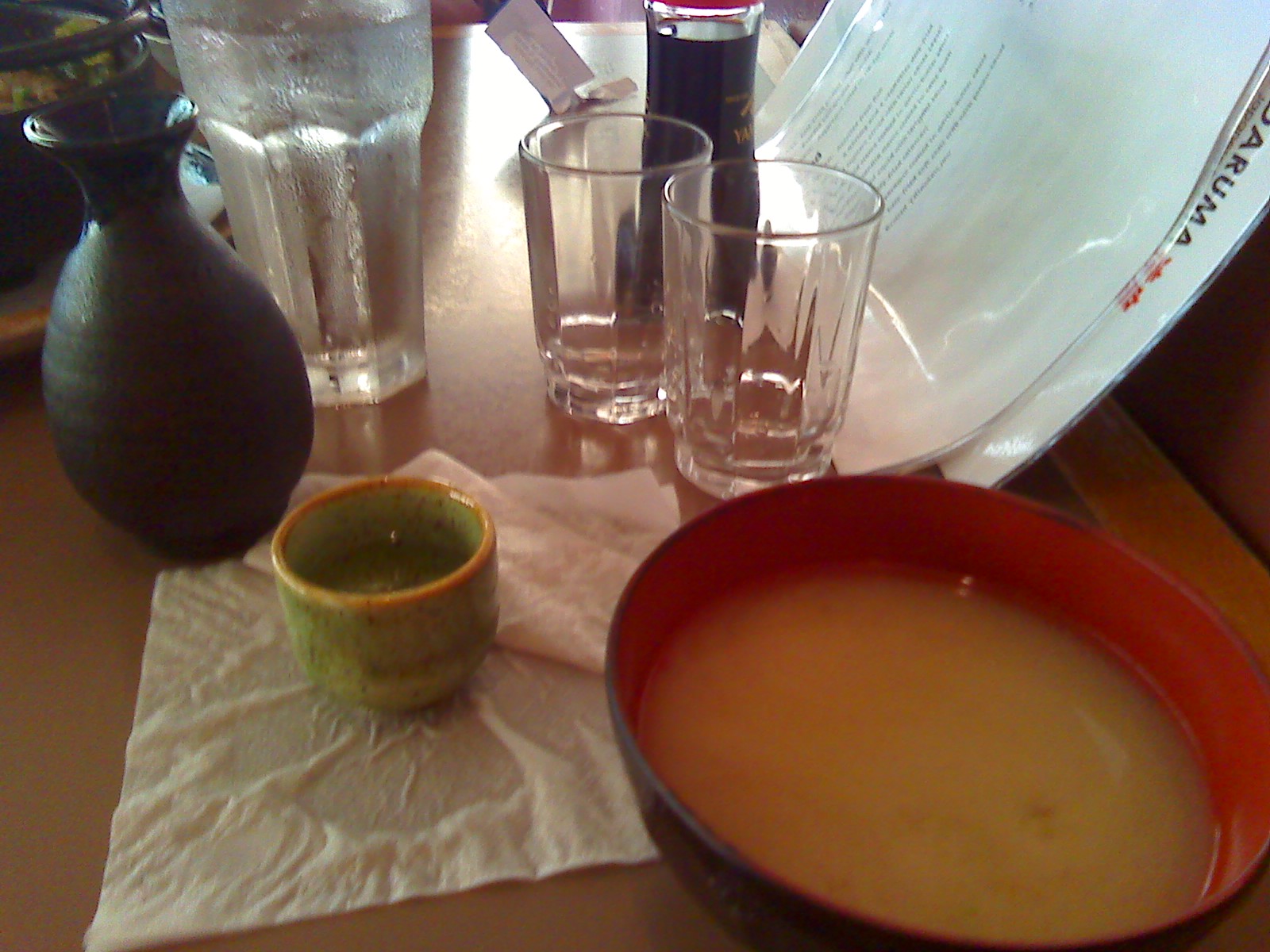
We started off with some Miso Soup. Nothing fancy, just a well made miso soup with wakame and tofu. I also had some sake. I was torn between two kinds so they gave me a couple of samples. The samples were very generous and I honestly didn’t need to order any sake due to the large pours. But, I did get a sake from the Nara Prefecture.
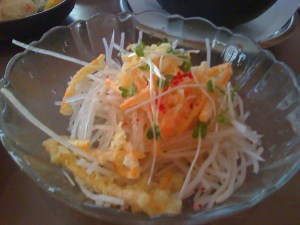
We got a Daikon Salad. Thin sticks of daikon served with carrot stick tempura and a shiso dressing. Carrots often accompany daikon, but this is the first time I’ve seen carrot tempura with the daikon. Nice touch. Little pea shoots for a bit of peppery bit and color.

We ordered two maki rolls. Ebi Ten, shrimp tempura with avocado, cucumber, and smelt roe. Unakyu, fresh water eel with cucumber. The sushi was good. Not the best I’ve ever had, but overall solid.
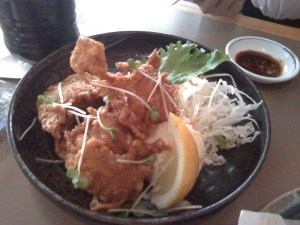
Tatsuta Age, deep-fried chicken thigh. Usually served in smaller pieces and called karage, these were pretty big chunks of chicken. Served with shredded cabbage, potato salad, pea shoots, and a slice of lemon this is a classic. It’s also one of mine and Yuki’s favorites.
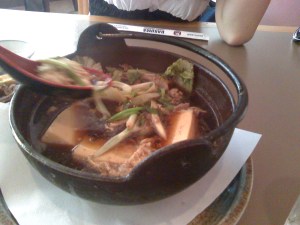
Niku Tofu, a play on the popular Japanese home cooked dish called niku jaga (meat and potato). Instead of potato Daruma used tofu. It’s thin sliced beef with tofu simmered in a sweet soy broth. Also simmered in the dish were chopped napa cabbage and green onions. This was delicious!

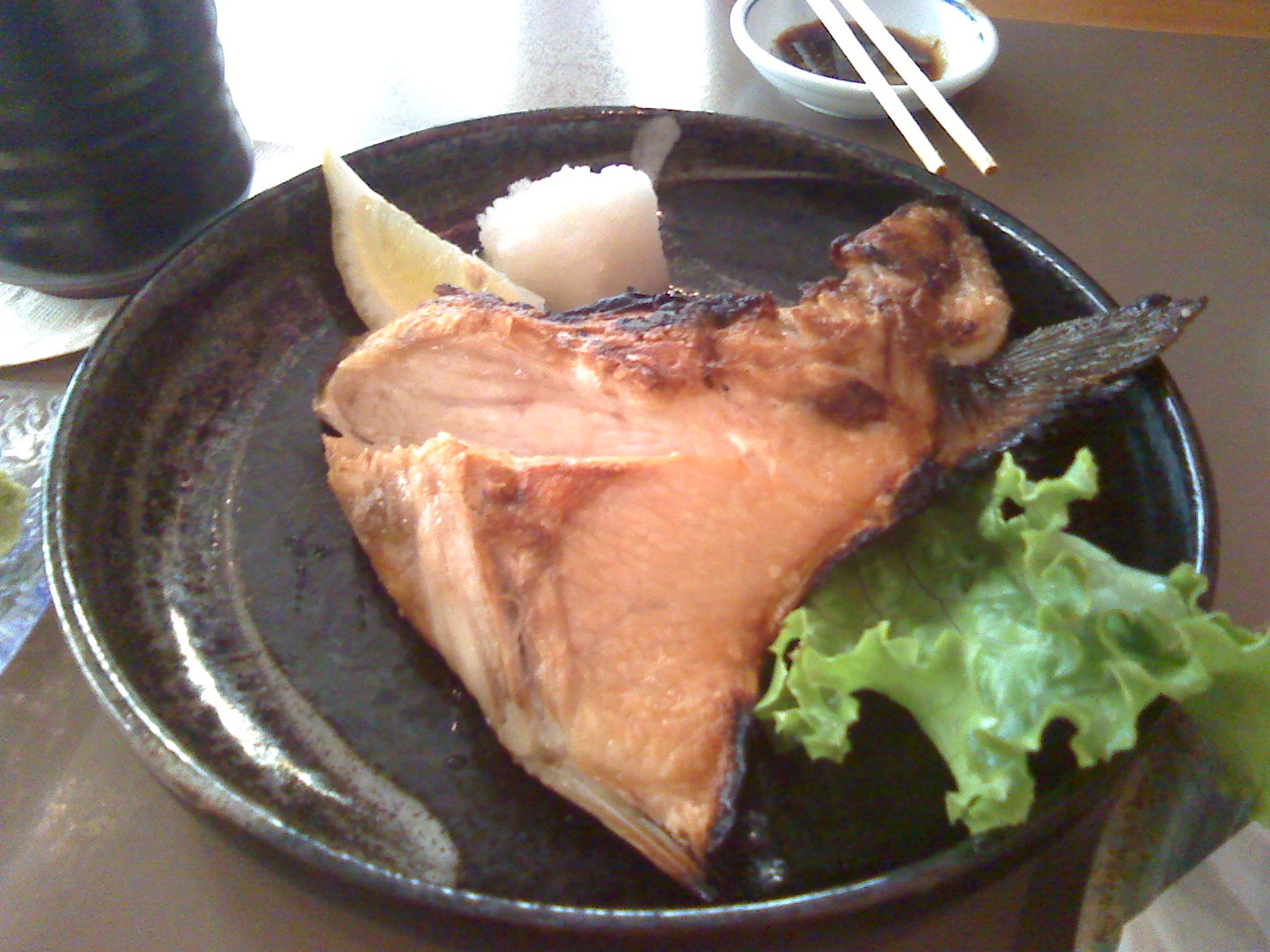
Hamachi Kama, the absolute star of the show! Yellowtail jaw broiled to perfection. You got all of that flavorful cheek meat, easily the best part of any large fish. I don’t know why this part isn’t served more in American cuisine because it has so much more meat and flavor than our prefered filets. This chunk of fish was so tasty it almost brought a tear to my eye. My stomach thanked me for eating this.

Overall, the food and ambiance at Daruma were fantastic. So far it’s the most authentic Japanese restaurant we’ve been to in the Chicagoland area. The food is delicious, portions are priced accordingly (we had leftovers), and the sake was flowing. The only downfall of this place is that I have to fight Hwy 90 traffic to get there. Next time Yuki’s parents are in town we’re definitely taking them there to show them that there is real Japanese cooking here.

Read Full Post »
I was perusing my Charlie Trotter cookbook the other day and came across a recipe that uses a very similar marinade to one I often use. Since he’s the great Charlie Trotter I thought I’d give his a try. Oh, and yakigyu is simply Japanese for grilled beef.

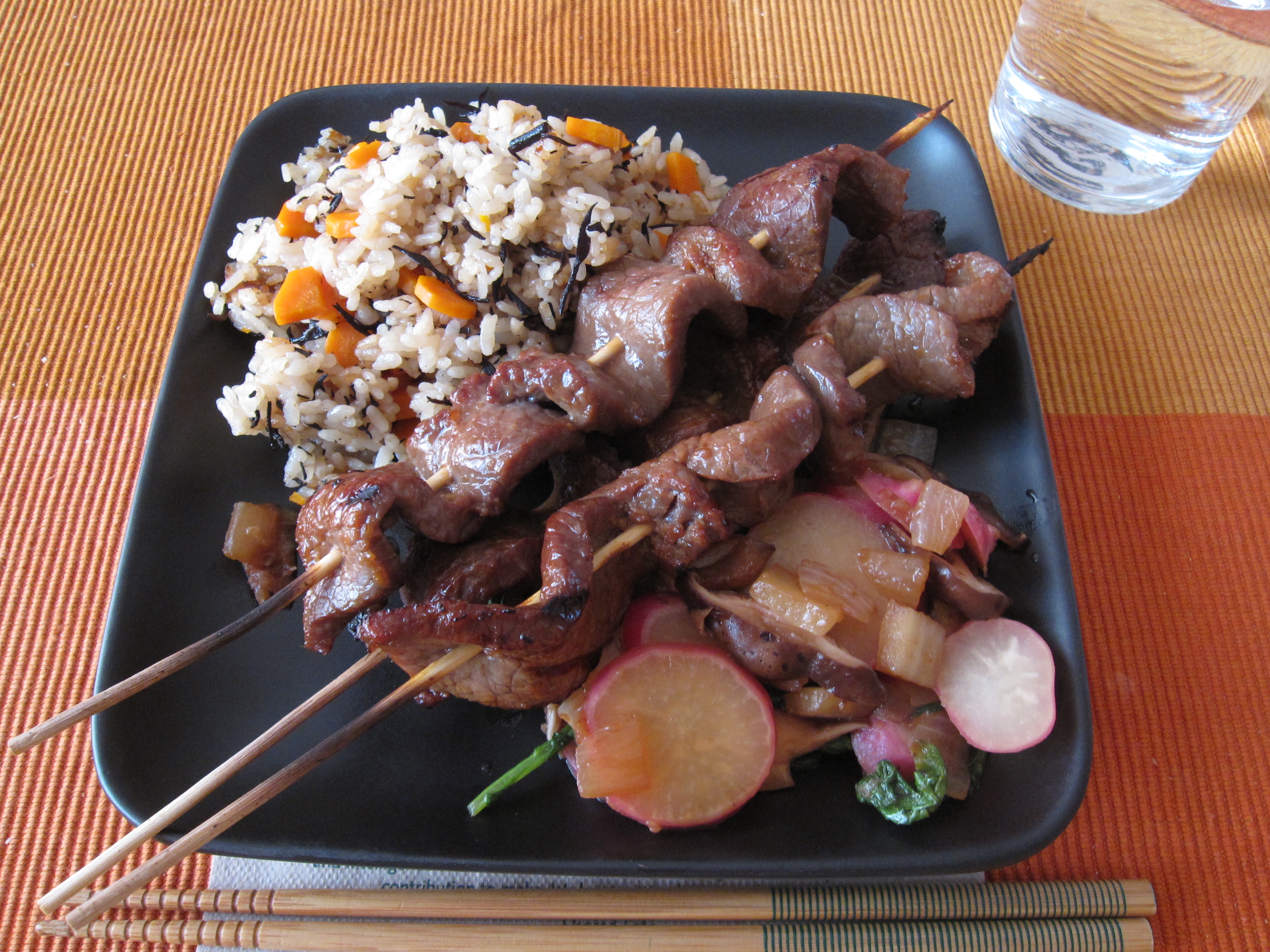
His marinade consisted of 1/2 cup of tamari which is probably the most ancient style of Japanese soy sauce as it contains no wheat and is a little richer than regular soy (it is the byproduct of making miso), 1/4 cup of mirin, 1.5 tablespoons of sesame oil, and 2 tablespoons of grated ginger. Once I mixed up the marinade I set 3 tablespoons aside and then thinly sliced 3/4 pound of sirloin and threw that into the marinade. I covered it with plastic wrap and let it sit in the fridge for 2 hours.

Then, using some bamboo skewers that I soaked in water for an hour, I threaded the meat and got it ready for the grill. Since the meat was thin it only needed about 2-3 minutes on each side over a medium-hot grill.

To accompany the meat I made a quick vegetable saute of 5 shiitake sliced, half an onion large diced, and 5 radishes. I separated the greens from the radish and thinly sliced the radishes with my mandolin slicer. I could have used my knife, but the wife was wondering why I got a mandolin slicer if I never use it. So, there you go sweetheart, I used the mandolin.

In my hot pan I poured 1 tablespoon of soy oil and sautéed the onion first for about 5 minutes. Then I added the shiitake and let that go for about 4 minutes. After that I tossed in the sliced radishes. Those cooked for about 4 minutes until I poured in the reserved 3 tablespoons of marinade. I let that boil down for a few minutes and then added the radish greens. Once the radish greens wilted down, about 1-2 minutes, I turned of the heat as this was ready to go.

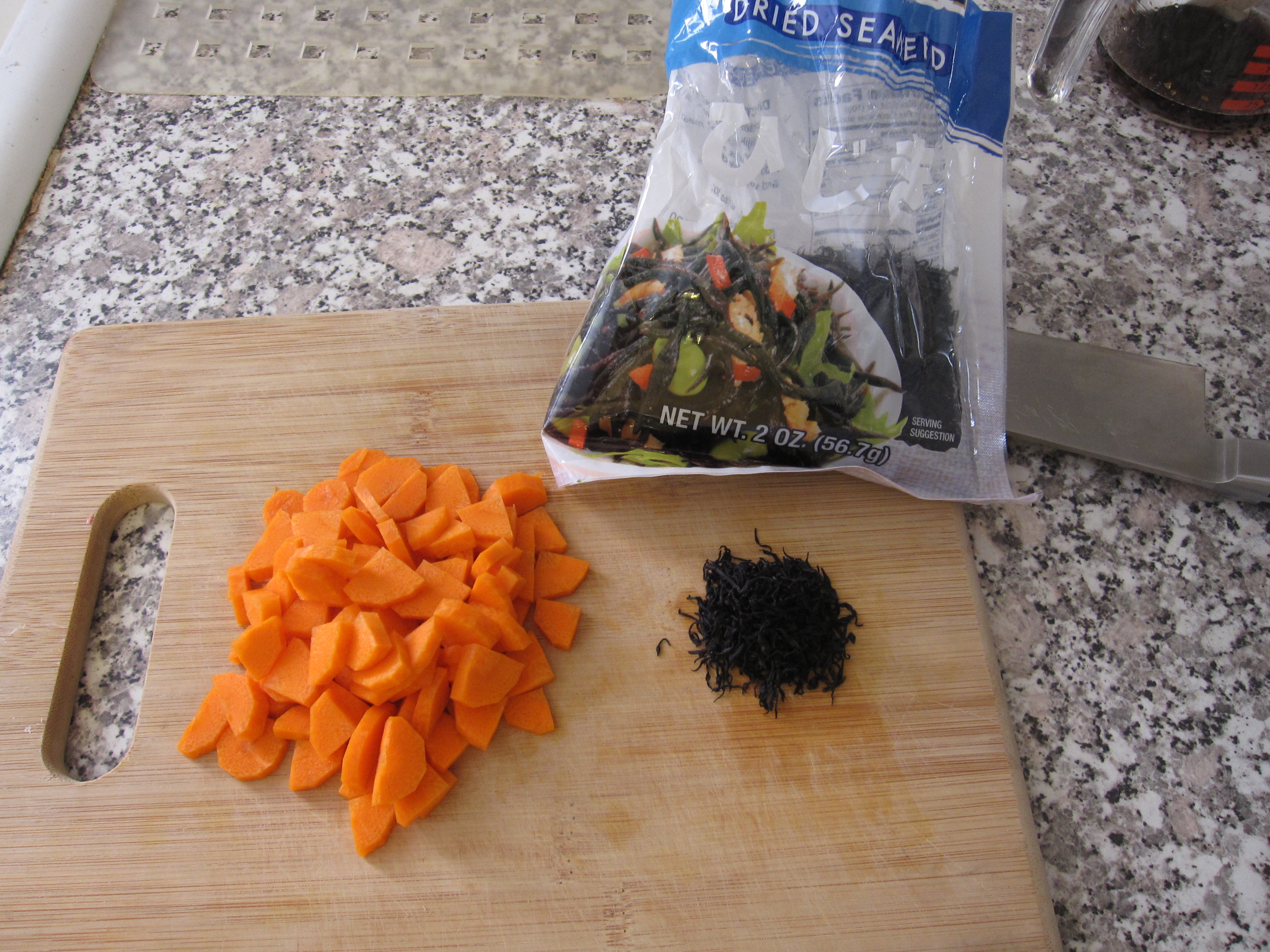
Instead of regular white rice I made hijiki and carrot rice, a recipe that Yuki taught me a long time ago and has become one of my favorite rice preparations. First, I took a heaping tablespoon of dried hijiki and soaked it in some cold water for about a half hour. I also diced up a small carrot. Once the rice was washed and in the rice cooker bowl (I only made one cup of rice) instead of regular water I poured in 2 tablespoons of soy sauce, and 1 tablespoon each of sake and mirin. Then, the get the right amount of liquid I used the hijiki soaking water to fill it up. Once the liquid was at the right level I threw in the hijiki and carrot. Hit the on button and a half hour later my rice was ready.

I have to say I was very disappointed in Trotter’s marinade. Tamari is a little bit stronger in flavor than soy sauce and it really made the beef salty. Too salty for Yuki’s taste and almost too much for mine (I tend to like food a little saltier than she does). Old Chucky Boy should know better than to have used so much tamari. I would have been much better served to have used the classic marinade I usually do, 3 parts soy, 2 parts sake, and 1 part mirin (1.5 tablespoons of sesame oil is ok). Besides the soy being a little lighter in flavor, cutting back on the amount and replacing it with sake (or vodka if you like) adds a little more depth the marinade. A little grated garlic wouldn’t have hurt either. While I have had good luck with some of his recipes in the past, this is one I will not be using again.

Read Full Post »

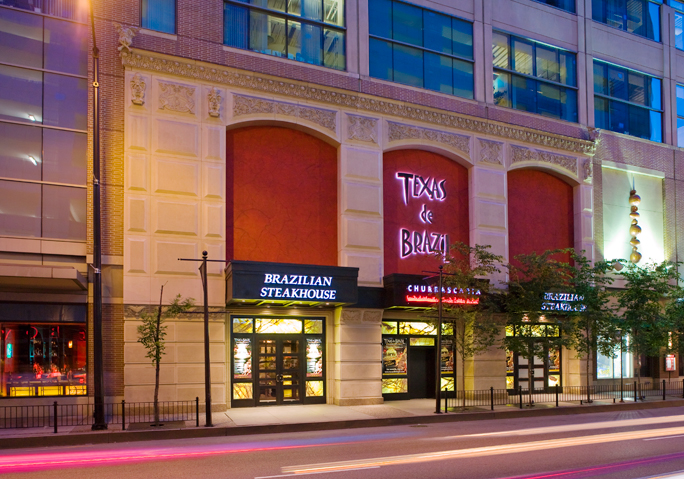
Alright, finally my last Restaurant Week experience. Yuki and I took advantage of the Art Institute’s free month in February this past Sunday. Afterwords we had planned on meeting up with a couple of friends, one in from Japan, for dinner downtown. We walked by Texas de Brazil and it looked damn tasty. So, I asked the hostess if they were participating in restaurant week, and when she said yes I made a reservation for us. What they normally charge for $50, we got for $32. Not a bad deal at all, not bad. Those of you have been to a Churrascaria before know what I’m talking about.

Again, the pics were taken with my cell, so they’re not the best quality. Also, if you’re a vegetarian or a little squeemish, don’t look any further. There are chunks of bloody animal carcass on my plate. Consider yourself warned.

We started off with a round of caipirinha’s. While the bartender whipped those up we headed over to the sushi and salad bars.

I apologize, I ate the sushi and most of my first run to the salad bar before snapping a pic. I have to say, the sushi was quite good. There were three different maki rolls, tuna and avocado, california, and salmon. The salad bar was outrageous! Check out their website for a complete list of items. My favorites were the tuna tataki, pomegranate quinoa, and the cheeses. Everything was top quality. They did not skimp at all. The soup was lobster bisque, which for some reason none of us tried. Why is that?

Once we finished the first round at the salad bar the meat-a-thon began! Flip the token to green and meat just started flying everywhere! Highlights were the garlic beef (of course), bacon-wrapped filet (of course), and the sausages (of course). I asked the gaucho what the sausage was spiced with and his answer was brilliant, “Brazillian spices”. Great, now I know how to make them at home. Other tasty bits were the lamb chops, leg of lamb, and flank steak. Just like the salad bar the meat was all top quality. They definitely did not buy their meats from Jewel! While mauling the meat we were served mashed potatoes, little cheese puffs, and fried plantians as well.

After ingesting about two and three fifths of large farm animals I thought it would be best to get some leafy greens in my stomach. I made another run to the salad bar and just grabbed some mixed greens and topped them with what they call “Brazillian Dressing”, just some small diced tomatoes and peppers in lime juice. Had I not gone for the salad I don’t even want to think about what would have happened to my intestines.

Dessert was also offered with our meal. We had our choice of a banana’s foster cheese cake or key lime pie. So, we got two of each.

I tell ya, as much fun as Churrascarias are and as delicious as they are, I don’t think I can go to one again. I always end up eating so much meat it’s not even funny. Don’t get me wrong, I love meat, it’s my favorite vegetable. Let’s be honest though, a 150 pound man should not swallow 207 pounds of dead animal in one sitting! It’s just not right! I almost couldn’t get up from the chair after the night’s festivities came to a halt. It also ruined my normal cycles for a few days, but that’s a whole different story in itself.

Read Full Post »

The other night I tried my hand at making a classic home-cooking dish from Japan, Nikujaga. It is a stewed meat and potato dish that is the definition of Japanese comfort food. There are about as many different ways to make it as there are Japanese mothers (and Jewish husbands who cook for their Japanese wives).

The basics of Nikujaga are thin slices of beef (can use pork for variation), potatoes, and onions that are simmered in a sweetened soy broth. Frequently there are other veggies added such as carrots and peas or green beans. It’s really very easy to make as well as being healthy and delicious. It’s the perfect meal for a winter’s eve when served with white rice.

I made it using about 2 cups of water, 1/3 cup of soy sauce, 1/3 cup of mirin, and a couple tablespoons of sugar as the broth. I threw that all into my pot with about a pound of large chopped Yukon Gold potatoes. I brought that to a boil and let the potatoes soften for about 20 minutes. It’s best to put all of that in the pot with the potatoes cold and bring to a boil together so that the potatoes absorb more of the flavor.

Once the potatoes were partially cooked I added about 2/3’s of a pound of thinly sliced beef. After that boils for a few minutes I skimmed off the foam that forms from boiling raw meat, much like I do when making chicken soup. The foam isn’t bad for you or anything, but by skimming it off you get a clear broth.

After the meat simmered for about 5 minutes or so I added a thinly sliced onion along with a sliced carrot. I simmered those for about 10 minutes. I just wanted them softened, not fully cooked, so that there was still some texture left in them.

Then I threw in a bunch of shelled edamame. Those don’t need to cook since they’re small and already cooked when you buy them. They just need to be heated through so they go in towards the end. After they’re cooked through I thought I was finished and proceeded to serve up the meal.

However, I forgot the last ingredient that I wanted to put in, shirataki. These are clearish-white “noodles” that are made from the starch of a yam-like vegetable. It’s the same substance as konnyaku, but in noodle form. They don’t need to be cooked, just heated through. They come in a package in liquid. Drain the liquid, rinse them off, cut them into smaller pieces, and throw them in to the stew for a few minutes. Unfortunately, I forgot to take a pic with the shirataki in the Nikujaga. Just imagine some opaque noodles in the stew and you’ll get the idea.

If you follow my recipe you’ll end up with about 4 servings. The only suggestion I would make, and it’s something that I’ll do the next time I make it, is to use Russets instead of Yukon Gold. Russets will stand up to the long stewing a little better as their a little more dense.

After Yuki ate the Nikujaga she gave me probably the best compliment I could have received. She said that her mother would definitely enjoy eating it. Knowing her mom and what a great home cook she is, that’s pretty high praise. I am now officially a Japanese mother! I may be the only Japanese mother in the world who is actually a Jewish husband without any children. That’s all part of my charm.

Read Full Post »

« Newer Posts - Older Posts »